A Symphony in Black and Color: Deconstructing Mondrian’s ‘Composition II’
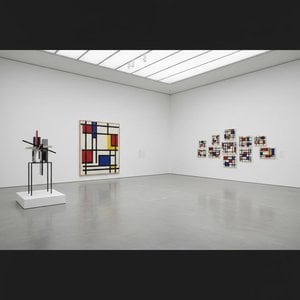
Piet Mondrian's *Composition II* isn’t merely a painting; it’s an architectural blueprint for the soul, a distilled essence of order rendered in stark black lines and luminous rectangles. Created in 1929 during his most intensely productive period within the De Stijl movement, this work embodies the radical shift Mondrian sought – to move beyond representation and capture the underlying structure of reality itself. It’s a deceptively simple piece, yet one that invites prolonged contemplation, revealing layers of intellectual rigor and profound emotional resonance. The painting immediately commands attention with its rigorous grid, a framework built from precisely delineated white rectangles intersected by bold, unwavering black lines. These aren't arbitrary divisions; they are the fundamental elements of Mondrian’s visual language, representing not just spatial relationships but also the very building blocks of existence – horizontal and vertical forces, masculine and feminine energies, if you will. The limited palette—primarily white, black, red, blue, and yellow—further amplifies this sense of essentialism. Each color is deployed sparingly, a deliberate choice to avoid distraction and focus solely on the interplay between form and hue.
The Roots of Neoplasticism: A Movement Born from Dissatisfaction
To truly appreciate *Composition II*, one must understand the context in which it was created – the fervent belief within De Stijl that art could transcend the limitations of naturalistic depiction. Mondrian, along with Theo van Doesburg, sought to create a universal visual language based on geometric abstraction and primary colors. This philosophy stemmed from a deep dissatisfaction with traditional painting methods, which they felt were overly reliant on subjective interpretation and failed to capture the underlying harmony of the universe. Mondrian’s early work, as evidenced by pieces like *The Red Mill*, demonstrates his initial grounding in landscape painting and Impressionism. However, he quickly recognized that these styles lacked the purity he sought – a way to express something beyond mere visual imitation. Pointillism and Fauvism offered valuable lessons in color theory, but ultimately proved insufficient. It was through this process of experimentation and refinement that Mondrian arrived at Neoplasticism, a doctrine advocating for the reduction of art to its purest geometric forms and colors. *Composition II* is a quintessential example of this philosophy in action.
Decoding the Geometry: Lines, Shapes, and Spatial Relationships
The power of *Composition II* lies not just in its color palette but also in the meticulous execution of its geometric elements. The black lines are not merely decorative; they define the boundaries of each rectangle with unwavering precision, creating a sense of absolute order and stability. These lines aren’t drawn with a casual hand; rather, they suggest a deliberate, almost mathematical approach to composition. The rectangles themselves vary in size and proportion, contributing to a dynamic equilibrium within the rigid framework. This interplay between order and dynamism is crucial to understanding the painting's emotional impact – it speaks to both our desire for structure and our appreciation for visual complexity. The absence of perspective—the canvas exists entirely on a flat plane—further emphasizes this sense of abstraction, inviting viewers to engage with the work purely through its formal qualities.
Symbolism Beyond Representation: Harmony and Universal Truth
While *Composition II* eschews recognizable subject matter, it’s far from devoid of symbolic meaning. Mondrian believed that art could express universal truths by stripping away all representational elements. The black lines, representing verticality and stability, are balanced by the red, blue, and yellow rectangles, symbolizing horizontality and dynamism. This dynamic equilibrium reflects Mondrian's belief in a harmonious universe governed by underlying geometric principles. The painting isn’t about depicting a specific scene or object; it’s about conveying an abstract state of being – a feeling of order, balance, and intellectual clarity. It’s a visual meditation on the fundamental forces that shape our world, offering a glimpse into Mondrian's deeply held philosophical convictions.
Bringing ‘Composition II’ Home: A Timeless Masterpiece for Modern Spaces
WahooArt offers meticulously crafted hand-painted reproductions of *Composition II*, allowing you to experience the profound beauty and intellectual rigor of this iconic work in your own home or office. Our artists replicate Mondrian's precise lines and subtle color variations with exceptional skill, ensuring that your reproduction captures the essence of the original while retaining a vibrant, contemporary appeal. Whether you’re an art enthusiast, a collector seeking to expand your collection, or simply someone looking for a striking piece of modern décor, *Composition II* is a timeless masterpiece that will undoubtedly elevate any space. Explore our range of sizes and canvas options to find the perfect representation of this seminal work – a testament to Mondrian's enduring legacy.
질의응답
피에트 몬드리안의 "Composition II"은 어떤 종류의 작품인가요?
카탈로그에서 피에트 몬드리안의 "Composition II"은(는) WallArt로 분류되어 있습니다. 이 카테고리를 통해 유사한 작품들을 찾아보실 수 있습니다.
피에트 몬드리안의 "Composition II"의 전반적인 분위기는 어떠한가요?
피에트 몬드리안의 "Composition II"의 전반적인 분위기는 Minimalist입니다. 이 분위기는 작품의 전반적인 공기를 설명합니다.
피에트 몬드리안의 "Composition II"의 프린트 제품은 어디에서 구매할 수 있나요?
피에트 몬드리안의 "Composition II"의 프린트를 구매하시려면, 해당 작품의 파인 아트 프린트 페이지에서 간단히 주문하실 수 있습니다: 코튼 캔버스 또는 아카이브용 캔버스지에 인쇄된 파인 아트 프린트.