Reflection: A Moment Frozen in Light – Renoir’s Impressionistic Intimacy
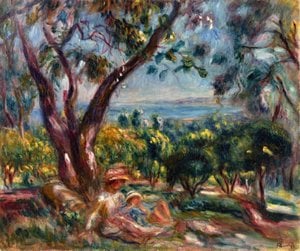
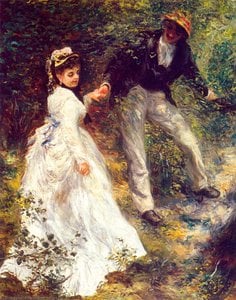
Pierre-Auguste Renoir's “Reflection,” painted in 1877, isn’t merely a portrait; it’s an exquisitely captured slice of Parisian life imbued with a profound sense of nostalgia and quiet observation. This captivating oil on canvas immediately draws the viewer into a private moment, a fleeting impression of a woman lost in thought as she gazes off-camera. The painting exemplifies the core tenets of Impressionism – not just a style, but a philosophy of seeing and representing the world around us. Renoir’s masterful manipulation of light and color transforms a simple scene into an evocative meditation on beauty, memory, and the elusive nature of emotion.
The subject herself remains subtly enigmatic. Dressed in a fashionable black hat adorned with a vibrant red ribbon – a detail that immediately commands attention – she possesses a captivating stillness. Her posture suggests a gentle contemplation, perhaps a fleeting smile or a hint of melancholy playing on her lips, though her gaze is directed beyond the frame, inviting us to imagine what occupies her thoughts. The background, featuring a simple chair, isn’t merely decorative; it grounds the scene in reality and adds a layer of intimacy, as if we are privileged witnesses to this private reverie. The brushstrokes themselves are loose and visible, characteristic of Impressionism's rejection of academic precision in favor of capturing the immediacy of perception.
The Language of Light: Renoir’s Revolutionary Technique
Renoir’s approach to light is arguably the painting’s most striking element. He abandons traditional shading techniques and instead employs a vibrant, almost luminous palette to depict the scene. The red ribbon, rendered in bold strokes of crimson and pink, practically vibrates with color, while the black hat provides a dramatic contrast. This deliberate use of color isn't simply decorative; it’s a fundamental aspect of Impressionism’s exploration of how light affects our perception. As discussed in articles like those found on Light in painting, Renoir was pushing the boundaries of artistic representation by prioritizing the *effect* of light over a literal depiction of form and shadow. He sought to capture the transient qualities of sunlight as it danced across surfaces, creating an atmosphere of warmth and vibrancy.
The technique employed is remarkably fluid – short, broken brushstrokes layered upon each other to build up color and texture. This creates a sense of movement and luminosity, mirroring the way light itself seems to shimmer and shift. It’s a deliberate departure from the smooth, polished surfaces favored by earlier artists, reflecting a new emphasis on spontaneity and direct observation.
A Bridge Between Styles: Renoir's Influence and Legacy
Pierre-Auguste Renoir stands as a pivotal figure in the transition from Realism to Impressionism. His work resonated with the burgeoning artistic circles of 19th-century Paris, influencing generations of artists who followed. As noted in resources like Paul Cézanne, the Post-Impressionist painter was deeply impacted by Renoir’s emphasis on color and form. Cézanne's later explorations of planes of color and simplified forms can be seen as a direct response to Renoir’s pioneering approach. The influence extends beyond Cézanne; artists like Monet and Sisley, with whom Renoir collaborated closely, also built upon his innovations.
“Reflection” itself serves as a testament to this legacy – a beautiful example of Impressionism's commitment to capturing the fleeting beauty of everyday life. Further exploration of Renoir’s oeuvre, such as in pieces like Portrait of Margot (Portrait of a Model), reveals the breadth and depth of his artistic vision.
Bringing “Reflection” Home: A High-Quality Reproduction
WahooArt offers meticulously crafted hand-painted reproductions of Pierre-Auguste Renoir’s “Reflection,” allowing you to experience this iconic artwork in stunning detail. Each reproduction is created by skilled artists who painstakingly recreate the original's delicate brushstrokes, vibrant colors, and atmospheric quality. Whether displayed in a formal setting or cherished as a personal treasure, our reproductions capture the essence of Renoir’s masterpiece – its quiet beauty, evocative mood, and timeless appeal. For those seeking to delve deeper into Renoir’s world, we encourage you to visit the Museu Rhode Island School of Design Museum of Art in Providence, Rhode Island, to view original works and gain further insight into Renoir’s artistic journey.



 미리보기
미리보기
 프린트 구매
 공유하기
공유하기 공유하기
공유하기
 상세 정보
상세 정보

 다운로드
다운로드
 유사 작품
유사 작품 X-레이
X-레이 슬라이드 쇼

 더 보기
더 보기






































 유리 옵션은 110cm 미만 크기에서만 선택 가능합니다.