A Celestial Encounter: The Serenity of Piero della Francesca’s Angel
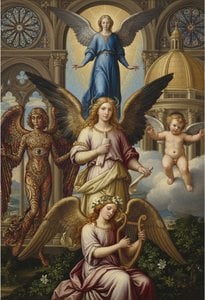
In the quietude of the Early Renaissance, few works capture the intersection of divine mystery and mathematical precision as poignantly as Piero della Francesca’s Angel. Created around 1452, this masterpiece serves as a window into a world where the spiritual and the physical are harmoniously entwined. The painting presents us with an angelic figure, a woman of ethereal beauty whose presence commands a profound stillness. Adorned with a delicate crown, her gaze is not one of overwhelming power, but of a deep, contemplative grace. As she emerges from the soft shadows, her serene expression invites the viewer into a state of meditative reflection, making the artwork much more than a mere religious icon; it is an emotional sanctuary.
The composition is a masterclass in the Early Renaissance style, characterized by a unique blend of humanism and geometric rigor. Piero della Francesca, a painter who was as much a mathematician as an artist, utilized the revolutionary principles of linear perspective to construct a space that feels both tangible and transcendent. Through his meticulous use of light and shadow, he achieves a sculptural quality in the figure’s features, lending the angel a weight and reality that grounds her celestial nature. The color palette is intentionally restrained, favoring muted, earthy tones and soft highlights that avoid the distraction of vibrant hues, thereby focusing the observer's attention on the purity of form and the solemnity of the subject.
The Geometry of Grace and Historical Resonance
To look upon this work is to witness the dawn of a new intellectual era. During the mid-15th century, the artistic landscape of Italy was being reshaped by the innovations of Brunelleschi and Masaccio, and Piero was at the forefront of this movement. His technique involves an unwavering commitment to accuracy, where every line and contour serves a structural purpose. In the Angel, the background figures and decorative elements are not mere ornaments; they are carefully placed components of a larger geometric order that reflects the Renaissance belief in a divinely ordered universe. This sense of balance and proportion creates a rhythmic stability that is deeply soothing to the eye.
For the discerning collector or interior designer, this painting offers an unparalleled opportunity to introduce a sense of timelessness and intellectual depth into a space. The artwork’s ability to evoke tranquility and dignity makes it a versatile centerpiece for sophisticated environments, whether in a private study, a grand gallery, or a curated living area. A high-quality reproduction of this piece does not merely decorate a wall; it anchors a room with its historical gravity and quiet majesty. It serves as a constant reminder of the beauty found in clarity, the strength found in stillness, and the enduring power of the divine spirit captured through the lens of human genius.
질의응답
학생들을 위한 피에로 델라 프란체스카의 "Angel" 관련 팩트시트가 있나요?
피에로 델라 프란체스카의 "Angel"의 학습 가이드 페이지에서는 인쇄 가능한 두 장 분량의 학습용 팩트시트를 제공합니다. 여기에는 작품과 상세 정보표, 작가의 생애 속 시기를 보여주는 연대기, 해당 작가의 다른 작품들, 추출된 컬러 팔레트, 그리고 네 가지 스타일로 바로 복사하여 사용할 수 있는 인용 문구가 포함되어 있습니다.
피에로 델라 프란체스카의 "Angel"의 색채 구성은 어떻게 묘사되어 있나요?
"Angel"의 색상은 Neutrals 팔레트를 이룹니다. 이 분류는 작품을 지배하는 주요 색상군을 나타냅니다.
피에로 델라 프란체스카의 "Angel"은(는) 얼마나 유명한가요?
피에로 델라 프란체스카의 "Angel"의 인기도는 Recognized 수준입니다. 이 분류는 해당 작품이 얼마나 널리 알려져 있는지를 반영합니다.