Petrus Christus’s “Head of Christ (Ecce Homo)” – A Window into Early Renaissance Devotion
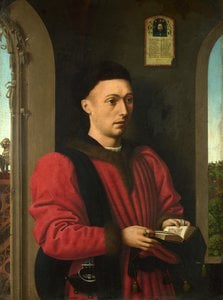
The image before us—Petrus Christus’s “Head of Christ (Ecce Homo),” painted circa 1445—isn't merely a portrait; it’s a profound meditation on sacrifice, suffering, and the very essence of Christian faith. Often considered a precursor to the more fully realized depictions of Christ’s Passion that would emerge later in the Renaissance, this intimate panel offers a remarkably direct and emotionally resonant experience for the viewer. It’s a work born from a specific historical context—the burgeoning influence of oil painting in Bruges, a city rapidly becoming a center for artistic innovation—and imbued with a deeply personal devotional purpose.
The genesis of this piece is fascinating. Tradition holds that it was created as a copy of a lost “Holy Face” image by Jan van Eyck, the master who had tragically died just three years before Christus began his career. This foundational image—a depiction of Christ’s face after the crucifixion—was believed to possess miraculous powers and was frequently used in private prayer. Christus's version retains the core elements of this prototype: the stark realism of Christ’s features, the visible wounds inflicted during his ordeal, and the solemnity of his gaze. However, Christus subtly transforms the image, imbuing it with a palpable sense of anguish and vulnerability that transcends mere replication.
A Masterclass in Oil Technique and Linear Perspective
Christus’s skill as a painter is immediately apparent in the meticulous detail he applies to every aspect of the work. The oil paint, relatively new to Northern European art at this time, allows for an unprecedented level of luminosity and depth—a far cry from the tempera paints favored by earlier artists. Notice how the light catches on Christ’s brow, highlighting the lines etched by pain, and how the folds of his garment subtly suggest texture and volume. This isn't a flat, idealized representation; it’s a remarkably lifelike portrayal of human suffering.
Crucially, Christus employs a technique known as “linear perspective,” a revolutionary approach to depicting space that he likely learned from Italian artists who were increasingly influencing the Northern Renaissance. The framing device—a meticulously rendered architectural setting—creates an illusion of depth, drawing the viewer’s eye directly to Christ's face and intensifying the emotional impact of the image. This innovative use of perspective was groundbreaking for its time, demonstrating Christus’s forward-thinking approach to artistic representation.
Symbolism and Emotional Resonance
Beyond the technical mastery, “Head of Christ (Ecce Homo)” is rich in symbolic meaning. The crown of thorns, a potent symbol of suffering and sacrifice, dominates the composition, immediately conveying the gravity of Christ’s fate. The drops of blood streaming down his face are not merely depictions of physical wounds; they represent the shedding of his blood for humanity's sins—a central tenet of Christian theology. Christ’s furrowed brow and downward gaze communicate a profound sense of sorrow and resignation, inviting contemplation on themes of redemption and forgiveness.
The choice to depict only Christ’s head—a cropped portrait—further intensifies the emotional impact. It forces the viewer to confront the image directly, fostering a sense of intimacy and personal connection with the subject. This was likely intended for private devotion, a silent prayer offered in contemplation of Christ's sacrifice.
A Timeless Testament to Faith
“Head of Christ (Ecce Homo)” is more than just a beautiful painting; it’s a powerful testament to the enduring themes of faith, suffering, and redemption. Christus’s masterful technique, combined with his profound understanding of symbolism and emotional resonance, creates an image that continues to move viewers centuries after its creation. It stands as a pivotal work in the development of Northern Renaissance art—a window into the spiritual world of 15th-century Bruges and a timeless reminder of the sacrifice at the heart of Christian belief.
질의응답
페트루스 크리스트우스의 "Untitled (D2X65E)"에는 어떤 모습이 담겨 있나요?
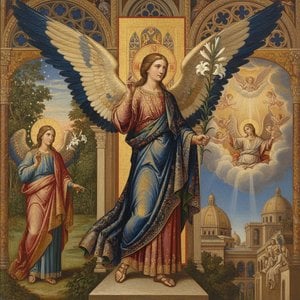
페트루스 크리스트우스의 "Untitled (D2X65E)"에 담긴 주제: mary and angel gabriel, religious scene artwork, medieval european art, brick wall composition, devotional painting style, renaissance religious art, angel figure depiction
페트루스 크리스트우스의 "Untitled (D2X65E)"을(를) 슬라이드쇼로 어떻게 감상할 수 있나요?
페트루스 크리스트우스의 "Untitled (D2X65E)"은(는) 작품의 슬라이드쇼 페이지에서 슬라이드쇼로 감상하실 수 있습니다.
페트루스 크리스트우스의 "Untitled (D2X65E)"에 관한 통계 정보는 어디에서 확인할 수 있나요?
페트루스 크리스트우스의 "Untitled (D2X65E)"에 관한 통계 정보는 작품의 방문 통계 페이지에서 확인하실 수 있습니다. 해당 페이지에서는 작품의 월간 방문 횟수, 작가 작품 전체의 방문 횟수, 그리고 최근 방문자의 국가 및 언어별 상세 현황을 제공합니다.