Introduction
Paul Cézanne, a pioneering French Post-Impressionist artist, played a crucial role in transitioning from 19th-century Impressionism to 20th-century Cubism. His unique style, evident in works like Riverbanks, showcases his ability to blend natural scenery with geometric forms.
Artistic Style and Technique
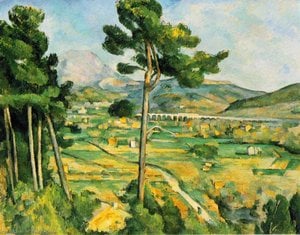
Riverbanks, painted in 1905, is a quintessential example of Cézanne's Cubist style. The painting features a landscape of a town with buildings in the background, set against a blue and cloudy sky. Trees surround the town, adding to the natural scenery, while water is visible in the distance, suggesting a river or lake. This serene and picturesque atmosphere is characteristic of Cézanne's ability to capture the essence of nature.
Significance and Influence
Riverbanks demonstrates Cézanne's influence on modern art movements. His innovative use of geometric shapes and fragmented forms paved the way for Cubism, a style that would later be popularized by artists like Pablo Picasso and Georges Braque.
Museum Collections
Works by
Paul Cézanne are highly regarded and can be found in prominent museums. For instance, the
Kunsthaus Buhler Stuttgart, Germany, established in 1905, boasts an impressive collection of both German and French art from the 19th century to the present day.
Other Notable Works by Cézanne
Some notable works by
Paul Cézanne include:
Conclusion
Riverbanks by
Paul Cézanne is a masterpiece that encapsulates the artist's unique blend of naturalism and geometric abstraction. This painting, along with his other works, has had a profound influence on modern art movements. For those interested in exploring more of Cézanne's work, WahooArt offers high-quality, handmade oil painting reproductions.
To learn more about
Paul Cézanne and his contributions to art history, visit
Paul Cézanne on WahooArt.



 미리보기
미리보기
 손으로 그린 그림 구매
 공유하기
공유하기 공유하기
공유하기
 상세 정보
상세 정보

 다운로드
다운로드
 유사 작품
유사 작품 X-레이
X-레이 슬라이드 쇼

 더 보기
더 보기






































 유리 옵션은 110cm 미만 크기에서만 선택 가능합니다.