빠른 제작과 다양한 마감 옵션을 제공하는 박물관 품질의 지클레이 또는 캔버스 프린트. ( 손으로 그린 그림 구매 디지털 이미지로 전환)





























작품의 원본 비율을 유지하는 미리 설정된 크기 중에서 선택하세요.

특정 프레임이나 공간에 맞춰 직접 치수를 입력하실 수 있습니다. 선택하신 사이즈가 원본 이미지의 비율과 일치하지 않을 경우, 작품을 크롭(자르기)하거나 이미지를 대칭 또는 단색 채우기로 확장하여 제작합니다. 제작 시작 전, 최종 확인을 위해 디지털 목업이 전송됩니다.
화면상의 미리보기는 실제 크롭이나 확장 상태를 반영하지 않으므로, 최종 구도는 오직 목업을 통해서만 정확하게 확인하실 수 있습니다.
맞춤 사이즈 제작도 가능하지만, 원본 비율을 유지하기 위해서는 사전 정의된 목록에서 치수를 선택하시는 것을 권장합니다.

퐁텐블로의 바위
복제본 크기
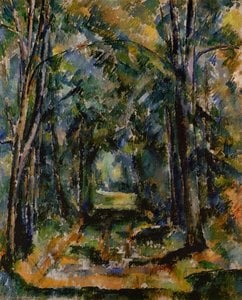
Paul Cézanne's "Rocks at Fontainebleau," painted in 1893, is a quintessential example of his post-impressionistic style and a significant contribution to the evolution of modern art. Housed within the esteemed Metropolitan Museum of Art in New York City, this oil on canvas artwork (measuring 73 x 91 cm) invites viewers into a serene yet structurally complex landscape.
The painting depicts a forested hillside near Fontainebleau, France, a location Cézanne frequently visited for inspiration. However, rather than presenting a realistic depiction of the scene, Cézanne employs his signature approach to deconstruct natural forms into geometric shapes. Large, irregular rock formations dominate the foreground, receding into the background through overlapping planes and subtle shifts in color. Vertical tree trunks punctuate the composition, creating a rhythmic interplay between solidity and verticality. A grazing sheep adds a touch of pastoral tranquility, while a chair subtly placed on the right suggests human presence within this natural setting.
Cézanne's technique is characterized by thick impasto application of paint, lending texture and physicality to the canvas. His brushstrokes are loose and expressive, defining contours with broad strokes rather than precise lines. The color palette is predominantly earthy – browns, greens, and grays – creating a harmonious yet somewhat muted atmosphere. Cézanne’s use of color isn't about replicating reality but about conveying his perception of light and form, contributing to the painting's overall sense of depth and volume.
"Rocks at Fontainebleau" emerged during a pivotal period in art history. Cézanne was moving beyond the fleeting impressions of the Impressionists, seeking instead to explore the underlying structure and permanence of objects. His work served as a crucial bridge between late 19th-century Impressionism and early 20th-century Cubism. Artists like Pablo Picasso and Henri Matisse acknowledged Cézanne's profound influence, famously referring to him as "the father of us all." The painting reflects this transition, demonstrating a shift from capturing momentary visual sensations to analyzing the fundamental forms that constitute reality.
Beyond its formal innovations, “Rocks at Fontainebleau” evokes a sense of solitude and contemplation. The rugged landscape, rendered with Cézanne’s characteristic solidity, invites viewers to reflect on the enduring power of nature. The painting isn't about narrative or storytelling; it is an exploration of form, color, and texture—a meditation on the inherent beauty of natural structures. The muted palette and diffused lighting contribute to a feeling of quiet introspection, allowing the viewer to become immersed in the scene’s tranquil atmosphere. It represents not just what Cézanne saw but how he perceived and interpreted it – a testament to his unique artistic vision.
Explore more of Cézanne's groundbreaking work:

1839 - 1906 , 프랑스

Explore the transformative era of Post-Impressionism. Discover how masters like Cézanne and Matisse revolutionized color and form, moving beyond Impressionism to shape modern art history through structural innovation and expressive emotion.

Unveil the profound revolution of Post-Impressionism. Explore how masters like Van Gogh and Cézanne utilized bold colors and emotional depth to transcend mere representation, laying the foundation for modern art. A sophisticated journey through history's most emotive brushstrokes.

Master the nuances of Impressionism vs. Post-Impressionism with our expert guide. Explore the revolutionary shift from Monet’s fleeting light to Van Gogh’s emotional depth. Discover how these iconic movements continue to inspire fine art collectors and modern interiors today.

Explore the structural genius of Paul Cézanne. Discover how his mastery of geometric form and color bridged Impressionism and Cubism in this definitive guide for art enthusiasts and collectors.
Explore the profound legacy of Paul Cézanne. Discover how his mastery of geometric forms and vibrant color bridged Impressionism and Cubism, offering timeless inspiration for fine art collectors and enthusiasts seeking to understand the foundations of modern art.


 미리보기
미리보기
 공유하기
공유하기 공유하기
공유하기
 상세 정보
상세 정보

 다운로드
다운로드
 유사 작품
유사 작품 X-레이
X-레이 슬라이드 쇼
 통계 정보
통계 정보


 더 보기
더 보기









 유리 옵션은 110cm 미만 크기에서만 선택 가능합니다.