A Glimpse into Rural France: Unveiling Cézanne’s “Houses on the Roadside”
Paul Cézanne's "Houses on the Roadside," painted in 1873, offers a captivating window into the evolving artistic landscape of 19th-century France. This work isn’t merely a depiction of buildings and a path; it represents a pivotal moment in the artist’s journey from Impressionism towards the groundbreaking innovations that would influence modern art for generations to come.
Subject & Composition: A Quiet Rural Scene
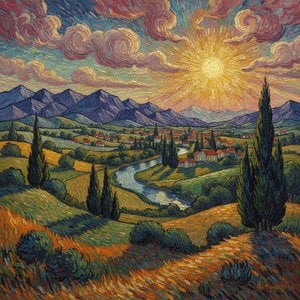
The painting presents a serene rural vista, featuring modest houses nestled along a winding roadside. The composition is deliberately structured around horizontal lines – the road itself, the walls defining properties, and the distant horizon – creating a sense of stability and grounding. Cézanne doesn’t strive for photographic realism; instead, he focuses on capturing the *essence* of the scene, emphasizing its underlying geometric forms. The arrangement feels considered, almost architectural in its planning, hinting at Cézanne's later preoccupation with structure and form.
Style & Technique: Bridging Impressionism and Post-Impressionism
“Houses on the Roadside” exemplifies Cézanne’s early exploration of Post-Impressionism. While retaining elements of Impressionistic brushwork – visible, expressive strokes – he moves beyond simply capturing fleeting light effects. The color palette is muted yet harmonious, dominated by warm yellows and greens contrasted with cooler blues and grays in the sky.
Impasto, the technique of applying paint thickly, is evident throughout, particularly in the road surface and walls, adding texture and depth to the scene. This isn’t about replicating reality; it's about constructing a visual experience through color and form.
Historical Context: Auvers-sur-Oise & Artistic Transition
Painted during Cézanne’s time in Auvers-sur-Oise, a commune north of Paris, this work marks a significant turning point in his artistic development. He was distancing himself from the purely optical concerns of Impressionism and beginning to explore more structural and conceptual approaches to painting. This period saw him experimenting with simplified forms and a greater emphasis on the underlying geometry of landscapes – a precursor to Cubism. He worked alongside Camille Pissarro during this time, further refining his technique and vision.
Symbolism & Emotional Impact: Tranquility and Reflection
While not overtly symbolic, “Houses on the Roadside” evokes a sense of tranquility and quietude. The scene invites contemplation, offering a glimpse into a simpler way of life. The absence of figures adds to this feeling of peaceful isolation. It’s a painting that speaks to the beauty of the everyday, finding artistry in the ordinary. The work's emotional resonance lies in its ability to capture a fleeting moment of serenity and invite viewers to connect with the natural world.
Cézanne’s Legacy & Influence
“Houses on the Roadside” is an important early work that foreshadows Cézanne’s revolutionary contributions to art history. His emphasis on form, structure, and color profoundly influenced subsequent generations of artists, including
Vincent van Gogh,
Henri Matisse, and the Cubists like Pablo Picasso and Georges Braque. Cézanne's insistence on painting what he *knew* to be true about an object, rather than simply what he *saw*, fundamentally altered the course of modern art.
Perfect for Your Space: Bringing Cézanne Home
A reproduction of “Houses on the Roadside” would serve as a stunning focal point in any interior. Its muted color palette and serene composition make it versatile, complementing both traditional and contemporary décor styles. The painting’s quiet beauty invites contemplation and adds a touch of sophisticated elegance to living rooms, studies, or bedrooms.
Explore More Cézanne Masterpieces
- The Loom: A captivating Post-Impressionist work showcasing Cézanne’s unique style.
- On the Outskirts of Paris: An early landscape painting offering a glimpse into rural life near Paris.
- Les Peiroulets Ravine 4: A later work demonstrating Cézanne's mastery of bold brushstrokes and muted colors in a rugged landscape.