작품 상세 설명
The Raw Emotion of Guernica
Pablo Picasso’s *Guernica*, painted in response to the devastating bombing of the Basque town of Guernica during the Spanish Civil War, is more than just a painting; it's a visceral scream against the horrors of war and violence. Created in 1937 at his Parisian studio, this monumental black-and-white canvas—a staggering 3.49 meters by 7.76 meters—immediately commands attention with its chaotic composition and emotionally charged imagery. Picasso deliberately eschewed color, opting instead for a stark monochrome palette that amplifies the painting’s sense of devastation and despair. The figures – a screaming woman cradling her dead child, a wounded horse writhing in agony, a dismembered soldier clutching a broken sword, and a terrified bull—are rendered with fragmented forms and distorted perspectives, mirroring the shattered reality of war-torn Guernica. The painting’s power lies not just in its depiction of suffering but also in its deliberate ambiguity; Picasso offers no easy answers or clear narratives, forcing viewers to confront the brutal consequences of conflict themselves. It's a testament to the artist’s ability to translate human experience into a universal symbol of pain and loss, solidifying *Guernica*'s place as one of the most iconic anti-war statements in art history.
Analytical Cubism: Deconstructing Reality
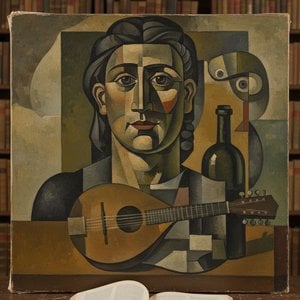
*The Mandolinist*, painted just two years prior in 1911, offers a fascinating glimpse into Picasso’s burgeoning exploration of Analytical Cubism – a revolutionary style he co-developed with Georges Braque. This work exemplifies the movement's core principles: the fragmentation and reassembly of objects into geometric forms, presented from multiple viewpoints simultaneously. The subject, a lone musician playing his mandolin amidst a bustling crowd, is not depicted realistically but rather dissected and reconstructed as a series of interlocking planes and angles. Picasso masterfully uses overlapping shapes to create an illusion of depth and movement within the confined space of the canvas. Notice how the figures are broken down into their essential components – sharp triangles, rectangles, and circles – then subtly reassembled, creating a sense of dynamism and instability. This deliberate distortion challenges traditional notions of perspective and representation, pushing the boundaries of what was considered “realistic” in art at the time. The painting’s monochromatic palette further contributes to this effect, stripping away any distracting color and focusing attention on the formal elements of composition.
A Window into Picasso's Early Years
Pablo Picasso’s journey as an artist began in Málaga, Spain, where he was born on October 25, 1881. From a remarkably young age, his innate talent for drawing was evident, nurtured by his father, José Ruiz y Blasco, who served as his initial mentor. Picasso's early works reflected a naturalistic style, but this quickly evolved through distinct periods – the Blue Period (marked by somber tones and themes of poverty and despair), the Rose Period (characterized by warmer hues and subjects related to circus performers and harlequins), and eventually, the groundbreaking development of Cubism. His time in Barcelona proved pivotal, exposing him to new influences and fostering a rebellious spirit that would shape his artistic vision for decades to come. The painting *The Mandolinist* is a product of this period of experimentation, showcasing Picasso’s willingness to challenge established conventions and explore innovative approaches to form and space. It's a crucial piece in understanding the evolution of his style and his role as a pioneer in modern art.
Symbolism and Emotional Resonance
Beyond its formal innovations, *The Mandolinist* is rich with symbolic meaning. The central figure, playing the mandolin, represents both joy and sorrow – a poignant juxtaposition that reflects the complexities of human experience. The crowd surrounding him embodies the collective suffering caused by war and displacement. The presence of two birds—one perched on a building and another soaring above—can be interpreted as symbols of hope amidst despair, or perhaps as reminders of lost innocence. Picasso’s masterful use of light and shadow further enhances the painting's emotional impact, creating a sense of drama and urgency. The fragmented forms and distorted perspectives contribute to a feeling of unease and disorientation, mirroring the psychological trauma experienced by those affected by conflict. *The Mandolinist* is not merely a depiction of a musician; it’s an evocative meditation on humanity’s capacity for both beauty and brutality.



 미리보기
미리보기
 손으로 그린 그림 구매
 공유하기
공유하기 공유하기
공유하기
 상세 정보
상세 정보

 다운로드
다운로드
 유사 작품
유사 작품 X-레이
X-레이 슬라이드 쇼

 더 보기
더 보기






































 유리 옵션은 110cm 미만 크기에서만 선택 가능합니다.