캔버스에 아크릴 물감월아트Naive Art
 1954근대
 31.0 x 12.0 cm
빠른 제작과 다양한 마감 옵션을 제공하는 박물관 품질의 지클레이 또는 캔버스 프린트. ( 손으로 그린 그림 구매 Switch to Digital Image)





























작품의 원본 비율을 유지하는 미리 설정된 크기 중에서 선택하세요.

특정 프레임이나 공간에 맞춰 직접 치수를 입력하실 수 있습니다. 선택하신 사이즈가 원본 이미지의 비율과 일치하지 않을 경우, 작품을 크롭(자르기)하거나 이미지를 대칭 또는 단색 채우기로 확장하여 제작합니다. 제작 시작 전, 최종 확인을 위해 디지털 목업이 전송됩니다.
화면상의 미리보기는 실제 크롭이나 확장 상태를 반영하지 않으므로, 최종 구도는 오직 목업을 통해서만 정확하게 확인하실 수 있습니다.
맞춤 사이즈 제작도 가능하지만, 원본 비율을 유지하기 위해서는 사전 정의된 목록에서 치수를 선택하시는 것을 권장합니다.

Jug with handle
복제본 크기
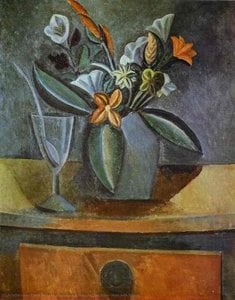
Pablo Picasso, a titan of 20th-century art, possessed an almost boundless capacity for reinvention. Yet, within his revolutionary explorations of Cubism and Surrealism, he periodically returned to simpler, more direct forms – a strategy that reveals a fascinating depth to his artistic process. “Jug with Handle,” painted in 1954 at the twilight of his career, offers a compelling example of this tendency, presenting a deceptively straightforward depiction of a ceramic vessel while simultaneously embodying the spirit of naive art and hinting at Picasso’s enduring fascination with form and perspective.
This unassuming work, measuring just 31 x 12 cm, immediately draws attention to its unusual color scheme: a harmonious blend of greens and whites that feels both fresh and timeless. The handle itself is rendered in a contrasting material – an element that subtly disrupts the viewer’s expectation of a unified form. This deliberate discordance is characteristic of Picasso's approach during this period, suggesting a playful engagement with visual paradox and challenging conventional notions of representation. It’s not merely a depiction of a jug; it’s an exploration of how we perceive objects and their relationships within space.
“Jug with Handle” is firmly rooted in the style of naive art, a movement that Picasso frequently embraced as a source of inspiration. Naive art, created by self-taught artists lacking formal training, is distinguished by its directness, bold colors, and simplified forms. Unlike academic realism, it prioritizes emotional expression and personal perspective over technical precision. Picasso’s engagement with this style wasn't simply mimicry; he used naive techniques to unlock new ways of seeing and representing the world – a deliberate contrast to his highly intellectual Cubist explorations. The painting’s flattened planes, lack of shading, and slightly distorted proportions are hallmarks of this approach, creating an immediate sense of innocence and spontaneity.
The influence of primitivism is also evident. Picasso was deeply interested in non-Western art forms, particularly African masks and sculptures, which he saw as embodying a raw, unmediated connection to the human experience. The stylized features and geometric shapes within “Jug with Handle” echo this fascination, suggesting a dialogue between Western artistic traditions and the visual language of other cultures.
Beyond its stylistic influences, "Jug with Handle" speaks to Picasso’s broader concerns about time and memory. The painting feels simultaneously ancient and modern – a testament to the artist's ability to synthesize disparate elements into a cohesive whole. The simple form of the jug evokes a sense of timelessness, while the vibrant colors and unconventional handling suggest a contemporary sensibility. It’s as if Picasso is inviting us to contemplate the enduring nature of everyday objects and their capacity to hold within them echoes of the past.
Considered alongside other works from this period, such as “Portrait of Sylvette David” and “Pigeon,” "Jug with Handle" reveals a consistent thread: Picasso’s persistent exploration of simplified forms and bold colors. These pieces, along with his charcoal drawing “Untitled (41),” demonstrate his versatility and his willingness to experiment with different mediums and techniques while maintaining a core aesthetic sensibility. The reproduction offered by WahooArt allows you to experience the immediacy and emotional resonance of this remarkable work firsthand.
For those seeking to delve deeper into Picasso’s artistic journey, we encourage you to explore our collection of high-quality reproductions, including “Portrait of Sylvette David,” “Pigeon,” and “Untitled (41).” You can also discover more about the Naive Art Movement on The Naïve Art Movement at WahooArt.

1881 - 1973 , 스페인

Unveil the radical revolution of Cubism. Explore how masters like Picasso and Braque redefined modern art through fragmented forms and geometric abstraction, offering profound insights for discerning collectors of fine art history and masterpieces.

Explore the profound elegance of ceramic art. From master glazes to sculptural forms, our expert guide offers discerning collectors deep insights into the mastery, texture, and timeless value of fine ceramics for sophisticated collections and luxury interiors.

Embark on a journey through the revolutionary world of Cubism. Discover how masters like Picasso redefined perspective through Analytical and Synthetic techniques in this expert-led guide for art enthusiasts and collectors.

Explore the profound evolution of Cubism through an expert analysis of Pablo Picasso's revolutionary works. From Analytical to Synthetic Cubism, discover the techniques that redefined modern art and learn how to curate these iconic masterpieces for your private collection.

 미리보기
미리보기
 공유하기
공유하기 공유하기
공유하기
 상세 정보
상세 정보

 다운로드
다운로드
 유사 작품
유사 작품 X-레이
X-레이 슬라이드 쇼
 Stats
Stats 더 보기
더 보기









 유리 옵션은 110cm 미만 크기에서만 선택 가능합니다.