A Fragmented Coastal Reverie
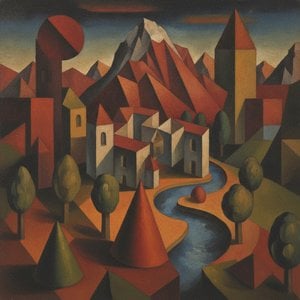
In the evocative masterpiece Café à Royan, Pablo Picasso invites us into a world where the boundaries between reality and abstraction dissolve into a rhythmic dance of geometry. This captivating work transports the viewer to the sun-drenched coastal town of Royan, France, yet it eschews the traditional, literal depiction of a seaside retreat. Instead, Picasso presents a fragmented and dynamic interpretation of a harborside scene, where buildings, boats, and lush vegetation coalesce into a complex interplay of planes and forms. The composition does not seek to provide a photographic record; rather, it serves as a profound evocation of the energy, light, and atmosphere of this bustling port, capturing the very essence of a moment in time through the lens of Cubist innovation.
The brilliance of the piece lies in its revolutionary approach to perspective. As a cornerstone of his Cubist exploration, Picasso breaks down the physical world into its essential geometric components—rectangles, triangles, and interlocking planes—and reassembles them to challenge the viewer's perception. By presenting multiple viewpoints simultaneously, he offers a more complete, albeit abstracted, understanding of the subject matter. This technique creates a sense of movement within the frame, as if the eye is constantly navigating through the shifting layers of the landscape. For the discerning collector or interior designer, this complexity provides a sophisticated focal point that rewards prolonged contemplation and adds a layer of intellectual depth to any curated space.
Technique, Texture, and the Shadows of History
Executed with masterful precision in oil on canvas, the technique behind Café à Royan is as vital to its impact as the subject itself. Picasso’s brushwork is visibly textured, contributing to a surface that feels both solid and ethereal. The visible strokes create a captivating visual depth, allowing certain forms to appear heavy and grounded while others seem almost transparent, caught in the shimmering coastal light. His use of color is equally striking; bold hues and contrasting tones enliven the scene, injecting a vibrant vitality that prevents the geometric fragmentation from feeling cold or clinical. This interplay of light and pigment breathes life into the inanimate structures of the harbor.
Beyond its aesthetic splendor, the painting carries a poignant historical weight. Created around 1940, during the tumultuous early years of World War II, the work reflects the underlying tension of an era marked by occupation and uncertainty. While the subject matter—a coastal café—appears tranquil, there is an inherent sense of distortion and unease that permeates the composition. This subtle psychological layer suggests that even in moments of apparent peace, the world is being fundamentally reshaped by external forces. For those seeking a piece that offers more than mere decoration, Café à Royan provides a window into the resilience of the human spirit and the transformative power of art during times of profound global change.
Whether displayed in a modern gallery setting or as a centerpiece in a luxurious residential interior, a high-quality reproduction of this work brings with it an incomparable aura of prestige. It is a piece that speaks to the soul through its vibrant energy and challenges the mind through its structural complexity, making it an enduring choice for those who appreciate the intersection of historical significance and avant-garde beauty.
질의응답
파블로 피카소의 "Cafe a Royan"의 색채는 작품이 전달하는 감정과 어떻게 연결되나요?
파블로 피카소의 "Cafe a Royan"의 Neutrals 색조는 작품 특유의 Reflective 분위기와 조화를 이룹니다. 색채는 작품이 감정을 전달하는 핵심적인 요소 중 하나입니다.
"Cafe a Royan"을(를) 완성한 예술가와 화풍은 무엇인가요?
"Cafe a Royan"은(는) 파블로 피카소가 Cubism 양식으로 제작한 작품입니다. 작가와 미술 사조를 통해 해당 작품의 예술적 전통을 확인할 수 있습니다.
"Cafe a Royan"의 화풍은 작가가 활동했던 시대와 어떤 연관이 있나요?
파블로 피카소의 "Cafe a Royan"은(는) Cubism 사조와 근대 미술 시대의 만남을 보여줍니다.