

 Abstract Art
 1989Contemporary
 116.0 x 89.0 cm
 The Ramzi and Saeda Dalloul Art Foundation
이 페이지에 표시된 작품은 저작권법의 보호를 받으며, 이에 따라 동일한 복제품을 제작하거나 판매하는 것은 법으로 금지되어 있습니다. 이러한 권리 보호는 다음과 같은 국제 협약에 따라 시행됩니다. 베른 협약 또한 다음에서 명시하는 법률을 포함한 국내법에 의해 보호됩니다. 미국 저작권법 제17조.
이 방식은 저작권 보호를 받는 예술 작품을 복제하거나 그대로 재현하는 것이 아니기에 저작권 규정을 완벽히 준수합니다. 대신, 이는 창의적인 재해석의 과정을 거칩니다. 즉, 원작에서 영감을 받되 원작과 동일하지 않은 새로운 회화 작품을 의미합니다.
빠른 제작과 다양한 마감 옵션을 선택할 수 있는 박물관 수준의 지클레이 및 캔버스 프린트. ( 수작업 채색 복제본 주문하기 디지털 이미지 판매 채널로 전환)
작품의 원본 비율을 그대로 유지하는 프리셋 사이즈 중에서 선택해 보세요.

액자나 벽면 크기에 맞춰 필요한 가로와 세로 길이를 입력해 주세요. 프린트는 원본 이미지보다 크게 제작할 수 없으며 오직 자르는 것만 가능하므로, 비율이 다른 사이즈를 선택할 경우 이미지의 일부가 잘려 나갈 수 있습니다. 인쇄 작업에 들어가기 전, 최종 확인을 위해 디지털 목업을 보내드립니다. 이 페이지에 표시된 이미지는 실제 잘리는 영역을 나타내지 않으며, 오직 목업을 통해서만 정확한 확인이 가능합니다.
Carrefour
복제본 규격
In the evocative masterpiece Carrefour, created in 1989, the late Algerian visionary Mohammed Khadda invites us into a vibrant crossroads where human emotion meets abstract complexity. At the heart of this expansive composition stands a central figure, draped in a striking red attire, whose arms are raised toward the heavens in a gesture that oscillates between triumph and profound yearning. This focal point serves as an anchor amidst a swirling sea of color and pattern, drawing the viewer into a rhythmic dance of light and shadow. The painting is not merely a depiction of a moment, but a profound exploration of presence within a chaotic yet harmonious universe.
The composition breathes with a sense of layered depth, achieved through Khadda’s masterful use of secondary figures that populate the periphery. In the upper reaches of the canvas, silhouettes emerge from the background, while others linger in the lower corners, creating a panoramic effect that suggests a bustling, multidimensional reality. This arrangement transforms the canvas into a stage where the individual and the collective coexist, making Carrefour an ideal centerpiece for those looking to introduce a sense of narrative movement and intellectual depth into a sophisticated interior space.
To understand Carrefour is to understand the revolutionary spirit of Mohammed Khadda himself. As a pioneer of the ‘sign painters’ movement, Khadda achieved what few artists could: the seamless reconciliation of Western Cubist structure with the lyrical elegance of Arabic calligraphy. In this work, we see the traces of his unique visual vocabulary—a language where lines do not merely define shapes but act as rhythmic pulses of meaning. The background, a tapestry of intricate patterns and varied textures, echoes the ancient traditions of North African art while remaining firmly rooted in the avant-garde movements of the 20th century.
The technique employed here is one of deliberate layering, where color is used not just for decoration but to build a structural foundation. The interplay between the bold, saturated reds and the more muted, complex patterns creates a visual tension that keeps the eye perpetually moving across the surface. For the discerning collector or interior designer, this piece offers a rare opportunity to possess a work that embodies the historical weight of Algerian contemporary art through a lens of modern abstraction.
Beyond its technical brilliance, Carrefour possesses an undeniable emotional magnetism. The title itself—meaning "Crossroads"—suggests a place of decision, transition, and meeting. There is a palpable energy in the central figure's upward reach, evoking feelings of hope, spiritual ascension, or perhaps the struggle for identity within a changing world. This duality of tension and grace makes the artwork incredibly versatile; it can serve as a bold, conversational statement in a contemporary gallery setting or provide a soulful, contemplative anchor in a private study.
Integrating a high-quality reproduction of such a significant work allows one to surround themselves with the legacy of a master. The painting’s ability to command attention through its scale and color palette ensures it remains a focal point, inspiring anyone who gazes upon it. Whether you are drawn to its historical significance as a cornerstone of Algerian modernism or its sheer aesthetic power, Carrefour stands as a timeless testament to the beauty found at the intersection of culture, history, and pure artistic expression.
Mohammed Khadda의 "Carrefour"의 대비 수준은 Serene입니다.
"Carrefour"을(를) 다운로드하실 수 있습니다: 작품의 다운로드 페이지에서 고해상도 디지털 이미지 다운로드 이용이 가능합니다.
Mohammed Khadda의 "Carrefour"의 Portrait 형식은 Living Room에 추천합니다. 작품의 형식과 공간의 조화는 복제화 배치에 중요한 가이드가 됩니다.
Mohammed Khadda, an Algerian painter, sculptor, and writer, was born in 1930 in Djebel Djellal, Algeria, and passed away in 1991. He is widely regarded as one of the founding figures of contemporary Algerian painting and a key representative of the ‘sign painters’ movement.
Khadda's artistic journey began in 1960, deeply influenced by two seemingly disparate yet powerfully combined forces: Cubism and Arabic calligraphy. This unique blend propelled him to explore non-figurative and abstract art forms, setting the stage for his distinctive style.
Khadda’s work embodies a generation of Algerian artists who sought to reconcile their cultural heritage with modern artistic languages. He masterfully integrated the traditions of calligraphic artistry with formal elements drawn from Western abstraction, creating a visual vocabulary that was both deeply rooted in his identity and strikingly contemporary.
Khadda’s debut in 1960 marked the beginning of a new era in Algerian painting. His work quickly gained recognition for its originality and artistic merit.
Mohammed Khadda’s contributions to Algerian contemporary painting are undeniable. He played a pivotal role in establishing a distinct artistic identity for Algeria following independence, moving beyond colonial influences towards a uniquely national expression.
As one of the pioneers of this movement, his work continues to inspire new generations of artists and serves as a testament to the power of cultural fusion and artistic innovation. His legacy extends beyond painting; he also contributed significantly to Algerian sculpture and literature.

1930 - 1991 , Algeria

Discover the profound beauty of abstract art. Our expert guide explores geometric abstraction, Op Art, and Expressionism, offering connoisseurs deep insights into collecting and curating powerful, non-representational masterpieces for sophisticated interiors.

Explore the profound evolution of Cubist still life, from Cézanne's structural foundations to the fragmented brilliance of Braque and Léger. Discover how geometric abstraction redefined reality through a sophisticated lens of form, color, and modern artistic mastery.
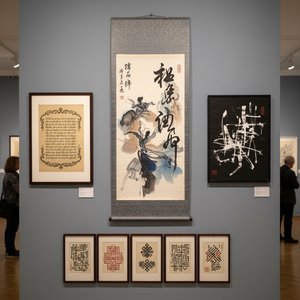
Explore the profound beauty of calligraphy art. From the fluid running script of Chinese masters to historical ink masterpieces, discover how the elegance of line transforms spaces with timeless grace and scholarly sophistication.

 실제 크기로 보기
 보내기
보내기 공유하기
공유하기
 상세 보기
상세 보기 가이드 보기

 이미지 다운로드
 유사 작품 더 보기
 X-레이
X-레이 슬라이드 쇼 보기
 통계 정보
통계 정보 상세 보기
상세 보기






































 유리 옵션은 110cm 미만 크기에서만 선택 가능합니다.


