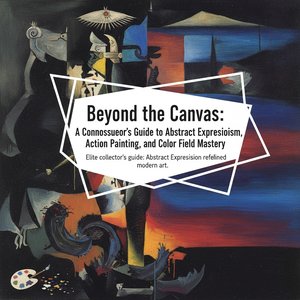
A Fragmented Vision: Exploring Mark Rothko’s ‘Untitled 28’
This captivating work by
Mark Rothko, designated ‘Untitled 28’, offers a compelling glimpse into the artist's transitional period, bridging his earlier figurative explorations with the iconic color field paintings that would define his legacy. While not immediately recognizable as a typical Rothko composition, this piece reveals crucial elements of his developing artistic language and emotional depth.
Subject & Composition
‘Untitled 28’ presents a fragmented scene populated by ambiguous human figures contained within rectangular frames. The composition is deliberately chaotic, lacking traditional perspective and relying instead on layering and overlapping to suggest spatial relationships. A dominant central figure draws the eye, surrounded by smaller, less defined forms. Below, a band of linear elements anchors the composition, adding a sense of grounding amidst the overall instability. This arrangement creates a feeling of enclosure and psychological tension.
Style & Technique
The artwork leans heavily towards
Expressionism, characterized by distorted forms, exaggerated features, and an intense emotional charge conveyed through color and brushwork. Rothko employs loose, gestural brushstrokes and visible texture, likely achieved using watercolor or gouache on paper. The layering of colors creates depth and movement, while the porous surface adds to the work’s tactile quality. Dramatic lighting – strong highlights and shadows – further enhances the unsettling atmosphere.
Historical Context & Artistic Evolution
Created during a pivotal period in Rothko's career (estimated between 1948-1950), ‘Untitled 28’ reflects his move away from purely representational art towards abstraction. Following World War II, Rothko grappled with expressing profound human emotions – tragedy, anxiety, and the search for meaning – through his work. This piece represents a crucial step in that journey, demonstrating his experimentation with form and color as vehicles for emotional resonance. It precedes his fully realized Color Field paintings but contains their seeds.
Symbolism & Emotional Impact
The red borders framing the figures evoke a sense of confinement or isolation, perhaps symbolizing the psychological boundaries individuals construct around themselves. The ambiguous nature of the figures invites viewers to project their own emotions and interpretations onto the work. The overall feeling is one of unease and introspection. While not explicitly narrative, ‘Untitled 28’ speaks to universal themes of human existence – vulnerability, alienation, and the search for identity.
For Collectors & Interior Designers
‘Untitled 28’ offers a unique opportunity to acquire a work by a master artist at a potentially accessible price point (through high-quality reproductions). Its complex composition and emotive power make it a compelling focal point for any collection. In an interior design context, the artwork's muted palette and expressive brushwork would complement modern or minimalist spaces, adding depth and intellectual intrigue. The piece’s inherent drama also lends itself well to more eclectic settings, sparking conversation and contemplation.
- Style: Expressionism, Abstract Expressionism (Transitional)
- Medium: Watercolor or Gouache on Paper
- Key Themes: Isolation, Anxiety, Human Condition, Fragmentation
- Emotional Impact: Unsettling, Introspective, Evocative