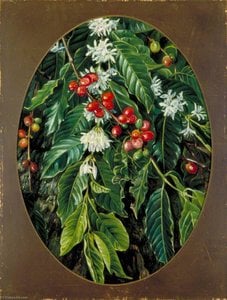
A Victorian Vision of Tropical Majesty: Marianne North’s “The Preanger Mountains, Java”
Marianne North (1830–1890) wasn't merely an artist; she was a pioneer—a woman who defied societal expectations and embarked on extraordinary expeditions to document the breathtaking beauty of the natural world. Her legacy resides not just in her stunning paintings but also in her unwavering determination to pursue scientific curiosity alongside artistic expression, establishing herself as one of Britain’s foremost botanists and visual artists of her era. “The Preanger Mountains, Java,” completed around 1876, exemplifies this remarkable blend of observation and artistry—a captivating glimpse into a pivotal moment in Victorian exploration and botanical science.
A Landscape Steeped in Symbolism
North's depiction transcends a simple topographical representation; it’s infused with symbolic resonance reflecting the prevailing Victorian fascination with exotic landscapes and the burgeoning field of biogeography. The towering Preanger Mountains, rising majestically from the verdant valleys below, symbolize resilience and grandeur—qualities deeply admired during a period marked by imperial ambition and scientific discovery. More subtly, the snow-capped peaks hint at aspirations for purity and transcendence, mirroring the Victorian yearning for spiritual contemplation amidst the dynamism of the natural world. The artist’s meticulous attention to detail – from the delicate textures of mosses and ferns to the subtle gradations of color in the sky – underscores this profound engagement with both visual beauty and intellectual inquiry.
Technique and Impressionistic Style
Executed in oil on board, “The Preanger Mountains” showcases North's mastery of impressionistic technique. Unlike academic painting’s emphasis on precise realism, North prioritized capturing fleeting moments of light and atmosphere—a stylistic choice that aligns perfectly with the burgeoning influence of Impressionism on British art. Visible brushstrokes contribute to a sense of movement and immediacy, conveying not just what the eye sees but also how it feels. The artist skillfully employs layering techniques, blending colors to create luminous hues and enhancing tonal variations – methods honed through years of painstaking botanical observation and artistic experimentation. This deliberate approach elevates the painting beyond mere depiction, transforming it into an emotive response to the grandeur of Java’s mountainous terrain.
Historical Context: Victorian Exploration and Botanical Art
“The Preanger Mountains” emerged during a period of intense scientific exploration fueled by imperial expansion and underpinned by Darwinian theory. Marianne North's expeditions to Southeast Asia—particularly Java—were driven by a desire to collect specimens for Kew Gardens’ Herbarium, furthering the advancement of botanical knowledge and challenging conventional artistic conventions. Simultaneously, Impressionism was gaining traction in Europe, rejecting traditional academic styles in favor of capturing subjective experience and prioritizing color and light over meticulous detail. North's work embodies this convergence of scientific ambition and artistic innovation—a testament to her pioneering spirit and her unwavering commitment to documenting the wonders of the natural world through a uniquely expressive medium.
Emotional Resonance: Tranquility Amidst Adventure
Despite its depiction of challenging terrain, “The Preanger Mountains” exudes an aura of serene tranquility. The muted palette – dominated by greens and blues – fosters a sense of calm contemplation, inviting viewers to immerse themselves in the beauty of Java’s untouched wilderness. The absence of human figures reinforces this impression of unspoiled nature—a deliberate artistic choice that underscores North's reverence for the natural world and her conviction that art could inspire awe and wonder. Ultimately, “The Preanger Mountains” remains a powerful reminder of Victorian idealism – a celebration of scientific discovery intertwined with an appreciation for sublime beauty.
질의응답
"The Preanger Mountains, Java"의 규격은 어떻게 되나요?
"The Preanger Mountains, Java"의 형식은 Panoramic입니다. 이는 작품 복제본을 배치할 공간을 계획할 때 유용합니다.
"The Preanger Mountains, Java"은(는) 어떤 공간에서 어떤 용도로 활용하기에 좋을까요?
마리애너 노스의 "The Preanger Mountains, Java"에 대해 기록된 두 가지 추천 사항은 Accent 용도와 Living Room 공간입니다.
"The Preanger Mountains, Java"을(를) 전체 화면 슬라이드쇼로 감상할 수 있나요?
슬라이드쇼를 이용하실 수 있습니다: 마리애너 노스의 "The Preanger Mountains, Java"의 슬라이드쇼 페이지.
"The Preanger Mountains, Java"이(가) 제작되었을 당시 마리애너 노스의 나이는 어떻게 되었나요?
마리애너 노스은(는) 46세에 "The Preanger Mountains, Java"을(를) 제작했습니다. 작가는 1830년에 태어났으며, 이 작품의 제작 연도는 1876년입니다.
"The Preanger Mountains, Java"은(는) 언제 제작되었나요?
"The Preanger Mountains, Java"은(는) 1876년에 제작되었습니다. 이 시기는 마리애너 노스의 예술적 경력과 당시의 시대상을 잘 보여줍니다.
"The Preanger Mountains, Java"은(는) 어느 작가의 작품인가요?
"The Preanger Mountains, Java"의 작가는 마리애너 노스입니다.
마리애너 노스의 "The Preanger Mountains, Java"의 구성을 주도하는 색상은 무엇인가요?
마리애너 노스의 "The Preanger Mountains, Java"의 주요 색상은 Gray (#948786)입니다.