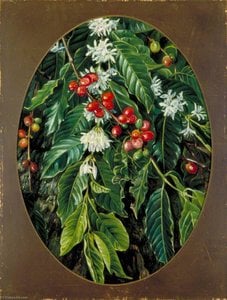
A Victorian Explorer’s Eden: Marianne North's “Chi Panas, Java”
Marianne North’s “Chi Panas, Java,” painted in 1880, isn’t merely a depiction of a tropical landscape; it’s a vibrant testament to a woman’s audacious spirit and her profound connection with the natural world. This oil on canvas, measuring 17 x 25 cm and currently residing within The Herbarium at Richmond, United States, offers a glimpse into the life of an extraordinary Victorian adventurer – a botanist, artist, and intrepid explorer who defied societal expectations to pursue her passions across continents.
The painting immediately draws the eye with its rich palette and meticulous detail. Lush vegetation dominates the scene: towering palms frame a serene lake reflecting a distant mountain range, while a small wooden structure—likely a traditional Javanese dwelling—sits nestled amongst reeds and aquatic plants. The artist’s skill is evident in the layering of colors, creating a sense of depth and texture that brings this exotic landscape to life. Notice the subtle variations in tone – the deep greens of the foliage, the shimmering blues of the water, and the warm browns of the wooden structure—all contributing to an incredibly realistic yet dreamlike quality.
A Botanical Pioneer and Her Journey
Marianne North’s story is inextricably linked to her travels. Driven by a desire to document the world's flora, she embarked on a remarkable series of expeditions throughout the 1870s and 80s, venturing into remote corners of Asia, Africa, and South America. Her journey to Java, as depicted here, was part of a larger effort to create a gallery at Kew Gardens showcasing her extensive collection of botanical paintings. This wasn’t simply an artistic pursuit; it was a scientific endeavor—North meticulously documented the plants she encountered, contributing significantly to the understanding of Asian botany.
Her travels were not undertaken in isolation. She benefited from the support and guidance of prominent figures within the British scientific community, including Sir Joseph Dalton Hooker, director of Kew Gardens, and Charles Darwin. The exchange with Sir William Hooker, particularly his gift of a rare Amherstia tree, ignited her passion for documenting exotic flora and fueled her ambition to create a visual record of these remarkable plants.
Symbolism and Victorian Identity
“Chi Panas, Java” transcends the simple representation of a landscape; it’s imbued with layers of symbolism. The tranquil lake, the towering palms, and the humble dwelling evoke an Edenic vision—a pre-civilized paradise untouched by the encroachment of Western influence. This idealized depiction reflects North's own desire to escape the constraints of Victorian society and embrace a more natural existence. Interestingly, this romanticized view of Java also subtly critiques the colonial project, presenting a world free from the complexities and inequalities imposed by European rule.
Furthermore, the painting speaks to North’s complex identity as a woman in a male-dominated field. Her artistic success challenged conventional notions of femininity, demonstrating her intellectual curiosity, adventurous spirit, and ability to contribute meaningfully to scientific knowledge. “Chi Panas, Java” becomes a powerful symbol of female agency—a testament to a woman who defied expectations and forged her own path.
A Legacy in Color and Detail
Today, “Chi Panas, Java” stands as a remarkable achievement – a vibrant snapshot of a bygone era. The painting’s meticulous detail, rich colors, and evocative atmosphere transport the viewer to a distant land, inviting contemplation on themes of exploration, identity, and the enduring beauty of the natural world. Reproductions of this stunning artwork offer a unique opportunity to bring this piece of Victorian history into your home, serving as both a beautiful decoration and a reminder of Marianne North’s extraordinary life and legacy.
질의응답
"Chi Panas, Java"의 색감을 고려했을 때, 어느 공간에 전시하는 것이 가장 좋을까요?
Earthy 색조를 고려했을 때, "Chi Panas, Java"은(는) Living Room에 추천합니다.
마리애너 노스의 "Chi Panas, Java"은 어느 시대의 작품인가요?
"Chi Panas, Java"은(는) 19th Century 시대의 작품입니다.
Chi Panas, Java은(는) 마리애너 노스의 예술적 경력 중 어느 시기에 해당하나요?
마리애너 노스의 작품 세계에서 "Chi Panas, Java"은(는) Mature Victorian 시기의 작품입니다. 이 시기는 작가의 다른 작품들과 비교해 보는 데 유용한 지표가 됩니다.