
 Arts & Crafts
 50.0 x 40.0 cm
원하는 크기와 액자로 주문 제작되는, 작가들이 직접 캔버스에 손으로 그린 유화 작품입니다. ( 프린트 판매로 전환 디지털 이미지로 전환)





























작품의 원본 비율을 유지하는 미리 설정된 크기 중에서 선택하세요.

특정 프레임이나 공간에 맞도록 직접 크기를 입력할 수 있습니다. 선택하신 크기가 원본 이미지의 비율과 일치하지 않는 경우, 작품을 자르거나 추가적인 손으로 그린 요소를 사용하여 그림을 확장합니다. 제작 시작 전 승인을 위해 디지털 목업을 보내드립니다.
화면 미리 보기는 실제 자르기 또는 확장을 반영하지 않습니다. 최종 구성은 목업을 통해서만 정확하게 확인하실 수 있습니다.
맞춤 크기 제작도 가능하지만, 원본 비율을 유지하기 위해 사전 정의된 목록에서 크기를 선택하시는 것을 권장합니다.

What's for Pudding Today
복제본 크기

In the soft, dappled light of the late Victorian and Edwardian eras, the work of Margaret Gere (1878–1965) emerged as a testament to the beauty found in stillness. Born in Leamington Spa, Warwickshire, Gere was an artist whose brush captured more than just pigment on canvas; she captured the very essence of a vanishing age. Her paintings, characterized by a remarkable sensitivity to detail and an understated Arts & Crafts aesthetic, offer intimate glimpses into domestic life and portraits imbued with a profound, quiet dignity. While her name may not have commanded the widespread fame of her contemporaries during her lifetime, her oeuvre remains a vital window into the serene landscapes and soulful character studies of her era.
Gere’s artistic journey was deeply intertwined with both familial mentorship and prestigious academic rigor. Her early training began at the Birmingham School of Art, where she studied under her brother, the esteemed painter Charles March Gere. This foundational period allowed her to absorb the principles of craftsmanship and decorative integrity that were central to the Birmingham Group of Artist-Craftsmen. Seeking to expand her horizons beyond the English Midlands, she traveled to Florence in 1900 to study Italian painting, a move that undoubtedly enriched her understanding of color and classical composition. By 1905, she had enrolled at the legendary Slade School of Fine Art in London, studying under masters such as William Holman Hunt and Frederic Leighton. It was within these hallowed halls that she forged lasting connections with notable figures like Virginia Woolf, placing her at the very heart of a burgeoning intellectual and artistic renaissance.
The technical prowess of Margaret Gere is evident in the diverse range of media she employed to bring her visions to life. While many of her most enduring works are executed in oil on canvas, she demonstrated a masterful command of tempera, a medium that lent a unique texture and luminous depth to her more symbolic compositions. Her ability to manipulate light and color allowed her to navigate between the heavy, symbolic weight of religious narratives and the delicate, ephemeral qualities of everyday life.
Her catalogue of work is marked by several standout achievements that showcase her versatility:
The soul of Margaret Gere’s work is inextricably linked to the Arts & Crafts movement. Influenced by the philosophies of William Morris and Gustav Stickley, she embraced an aesthetic that prioritized natural materials, decorative embellishment, and a profound respect for the integrity of the handmade. This reverence for craftsmanship is mirrored in her meticulous observation of nature and her commitment to realistic yet idealized subject matter. Furthermore, the influence of Pre-Raphaelite masters like John Everett Millais and Dante Gabriel Rossetti can be felt in her exploration of symbolism and her pursuit of a certain poetic truth within her portraits.
Throughout her career, Gere was not only a creator but also an educator and a participant in the wider art world. She exhibited her works at the prestigious New English Art Club and held solo exhibitions at notable venues such as the Cotswold Gallery and the Beaux Arts Gallery. Her life as an artist was one of continuous engagement with the evolving landscape of British art, from the traditionalist roots of her training to the modern social circles she inhabited in London. Today, her paintings serve as a poignant bridge to the past, inviting contemporary viewers to pause and find solace in the timeless elegance and quiet strength of her vision.
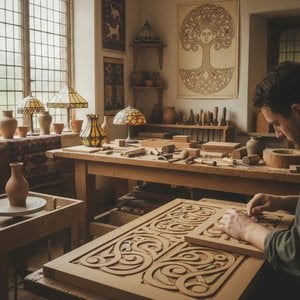
Explore the profound beauty of the Arts and Crafts Movement. Discover how the legacy of William Morris and handcrafted artistry offers a timeless antidote to mass production, inspiring soulful, luxury interiors through organic integrity and masterful craftsmanship.


 미리보기
미리보기
 공유하기
공유하기 공유하기
공유하기
 상세 정보
상세 정보 Guide
Guide

 다운로드
다운로드
 유사 작품
유사 작품 X-레이
X-레이 슬라이드 쇼
 통계 정보
통계 정보 더 보기
더 보기









 유리 옵션은 110cm 미만 크기에서만 선택 가능합니다.


