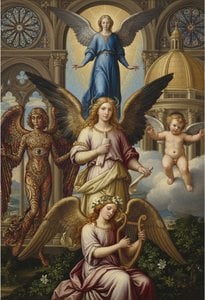
The Jacob’s Dream: A Descent into Chagall's Luminous Visions
Marc Chagall’s “The Jacob’s Dream,” painted in 1963, isn’t merely a depiction of a biblical narrative; it’s an immersive journey into the artist’s profoundly personal and intensely felt world. This vibrant canvas, rendered in his signature style—a potent blend of Cubism, Expressionism, and Symbolism—captures the essence of Chagall's lifelong fascination with dreams, folklore, and the spiritual realm. The artwork immediately draws the viewer in with its audacious color palette and dynamic composition, hinting at a story both ancient and profoundly modern. It’s a testament to Chagall’s ability to translate deeply held beliefs and memories into a visual language that transcends literal representation.
A Surrealist Tapestry of Biblical Narrative
The painting directly references the pivotal dream experience recounted in Genesis, where Jacob wrestles with an angel on a ladder extending from earth to heaven. However, Chagall doesn’t offer a straightforward illustration. Instead, he presents a deliberately fragmented and emotionally charged interpretation. The central element – a towering, somewhat precarious ladder – dominates the composition, acting as a visual pathway between the earthly and celestial realms. Figures are scattered across the canvas with an almost playful disregard for conventional perspective; a solitary chair sits on the left, while abstract shapes populate the lower right, creating a sense of disorientation and inviting speculation. This deliberate imbalance contributes significantly to the artwork’s dreamlike quality, suggesting that reality itself is fluid and subjective within Chagall's vision. The lithographic technique employed—evident in the visible lines and tonal variations—adds a layer of texture reminiscent of a hand-drawn sketch, further enhancing the feeling of immediacy and intimacy.
Color, Symbolism, and the Language of Dreams
The dominant hue is a soothing, ethereal blue, providing a luminous backdrop for the vibrant accents that punctuate the scene. Pinks and purples are used with expressive abandon, creating washes and outlines that imbue the artwork with warmth and depth. A striking yellow highlights the central angel figure, immediately drawing the eye and emphasizing its importance as a conduit between worlds. Beyond their aesthetic value, these colors hold symbolic weight. Blue often represents spirituality and the heavens, while pinks and purples are associated with dreams, intuition, and the subconscious. The ladder itself, rendered in stark black lines, provides a grounding element amidst the swirling colors, representing both the challenges and the potential rewards of spiritual ascent. The inclusion of seemingly random objects – the chair, the abstract shapes – likely represent fragments of memory or personal associations that contribute to the painting’s rich tapestry of meaning.
Chagall's Legacy: A Master of Emotional Expression
“The Jacob’s Dream” exemplifies Chagall’s unique artistic philosophy—a profound engagement with his Jewish heritage, a deep-seated belief in the power of imagination, and an unwavering commitment to expressing raw emotion through color and form. Born Moishe Shagal in 1887 in Liozna, Belarus, Chagall's early life profoundly shaped his artistic vision. His upbringing within a Hasidic community instilled in him a love for folklore, storytelling, and the mystical aspects of Jewish tradition. This influence is powerfully evident in “The Jacob’s Dream,” where familiar biblical imagery is transformed into a personal allegory—a testament to the enduring power of dreams and the search for spiritual connection. Works like this demonstrate Chagall's ability to create art that resonates deeply with viewers, inviting them to contemplate their own beliefs and experiences. The Musée Marc Chagall in Nice houses an extensive collection of his works, including the “Biblical Message” series, offering a comprehensive understanding of his artistic journey. Exploring resources such as WikiArt.org and the official museum website provides further insight into this extraordinary artist’s life and oeuvre.
질의응답
마르크 샤갈의 "The Jacob's Dream"의 수작업 복제화를 판매하는 곳이 어디인가요?
마르크 샤갈의 "The Jacob's Dream"의 수작업 복제화는 주문 제작 방식으로 수작업 유화 복제화 페이지에서 직접 주문하실 수 있습니다: 리넨 캔버스에 손으로 직접 그린 유화 복제화
"The Jacob's Dream"의 색감을 고려했을 때, 어느 공간에 전시하는 것이 가장 좋을까요?
Neutrals 색조를 고려했을 때, "The Jacob's Dream"은(는) Living Room에 추천합니다.
"The Jacob's Dream" 작품을 파인 아트 프린트로 구매할 수 있나요?
"The Jacob's Dream" 작품은 코튼 캔버스 또는 아카이브용 캔버스지에 인쇄된 파인 아트 프린트를 통해 만나보실 수 있습니다. 주문은 파인 아트 프린트 페이지에서 원하시는 사이즈를 선택하여 진행하실 수 있습니다.