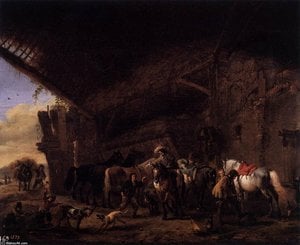
1650
1650 66.0 x 63.0 cm
원하는 크기와 액자로 주문 제작되는, 작가들이 직접 캔버스에 손으로 그린 유화 작품입니다. ( 프린트 판매로 전환 디지털 이미지로 전환)
작품의 원본 비율을 유지하는 미리 설정된 크기 중에서 선택하세요.

특정 프레임이나 공간에 맞도록 직접 크기를 입력할 수 있습니다. 선택하신 크기가 원본 이미지의 비율과 일치하지 않는 경우, 작품을 자르거나 추가적인 손으로 그린 요소를 사용하여 그림을 확장합니다. 제작 시작 전 승인을 위해 디지털 목업을 보내드립니다.
화면 미리 보기는 실제 자르기 또는 확장을 반영하지 않습니다. 최종 구성은 목업을 통해서만 정확하게 확인하실 수 있습니다.
맞춤 크기 제작도 가능하지만, 원본 비율을 유지하기 위해 사전 정의된 목록에서 크기를 선택하시는 것을 권장합니다.

Paying the Hostess
복제본 크기

In the heart of the Dutch Golden Age, a period defined by unparalleled artistic flourishing and mercantile prosperity, the name Ludolf Leendertsz de Jongh resonates with the dramatic intensity of a master storyteller. Born in 1616 in Overschie, Netherlands, de Jongh’s ascent from the son of a shoemaker to a celebrated figure in Rotterdam’s vibrant artistic circle is a testament to an extraordinary dedication to his craft. His journey was not merely one of technical mastery but of profound stylistic evolution, as he navigated the complex influences of the Utrecht School and the revolutionary shadows of the Caravaggisti. Through his brush, the quiet landscapes and bustling scenes of the seventeenth century were imbued with a psychological depth that captured the very essence of the human experience.
The foundations of de Jongh’s artistry were laid in Delft, where he studied under the tutelage of Cornelis Saftleven and Anthony Palamedes. This early training deeply embedded him within a tradition that revered the dramatic use of light and shadow. The influence of Caravaggio is palpable throughout his oeuvre; de Jongh mastered the technique of chiaroscuro, using stark contrasts to pull figures from the darkness and lend them a visceral, tactile reality. This mastery allowed him to transform simple genre scenes into profound meditations on movement and emotion. His travels further expanded his horizons, most notably a transformative voyage to France in 1635 alongside Frans Bacon, an experience that undoubtedly broadened his intellectual and visual vocabulary before he eventually established his permanent studio in Rotterdam.
De Jongh was far more than a specialist in a single niche; he was a versatile virtuoso whose repertoire spanned a breathtaking array of subjects. He was equally adept at capturing the rugged energy of a fox hunt, the architectural grandeur of cityscapes, and the serene stillness of landscapes. His ability to blend human activity with the natural world is perhaps most evident in his hunting scenes, where the frantic motion of hounds and horses is balanced by a meticulous attention to the surrounding woods and light. In these works, one can observe his skill as a staffage painter—a specialist capable of breathing life into larger compositions by adding precisely rendered figures that interact seamlessly with the environment.
Beyond the canvas, de Jongh’s life was deeply intertwined with the civic fabric of his time. He was not merely an observer of society but an active participant, serving as a merchant, an officer in the Rotterdam civil guard, and even as the schout (sheriff) of Hillegersberg. This multifaceted existence provided him with a unique vantage point from which to observe the social hierarchies and daily rhythms of Dutch life, which he then translated into his portraits and genre paintings. His influence was so significant that by the 1650s, he stood as the leading genre painter in Rotterdam, leaving an indelible mark on subsequent generations of artists, including the renowned Pieter de Hooch.
The enduring significance of Ludolf Leendertsz de Jongh lies in his ability to synthesize the dramatic tension of the Southern European tradition with the meticulous realism of the Dutch school. His works remain captivating windows into a bygone era, offering much more than mere documentation. They provide an emotional resonance that continues to stir the modern viewer, reminding us of a time when light and shadow were used not just to illuminate a scene, but to reveal the very soul of the subject.

1616 - 1679 , Netherlands


 미리보기
미리보기
 공유하기
공유하기 공유하기
공유하기
 상세 정보
상세 정보 가이드 보기

 다운로드
다운로드
 유사 작품
유사 작품 X-레이
X-레이 슬라이드 쇼
 통계 정보
통계 정보 더 보기
더 보기






































 유리 옵션은 110cm 미만 크기에서만 선택 가능합니다.