작가 약력
Lui Shou-Kwan: Bridging Tradition and Abstraction in Hong Kong’s New Ink Art
Lui Shou-Kwan (1919–1975) stands as a pivotal figure in the evolution of Chinese art, particularly within the context of 20th-century Hong Kong. His career wasn't simply one of painting; it was a deliberate and transformative act – a fusion of deeply rooted traditional ink techniques with burgeoning abstract influences, ultimately forging what became known as the Hong Kong (Asian) New Ink Movement. Born in Guangzhou during a period of immense social and political upheaval, Lui’s journey to Hong Kong in 1948 marked a crucial turning point, not just for his personal life but also for the trajectory of Chinese art in the region. His early years were shaped by his father, Lui Canming, a respected scholar-painter who instilled in him a profound appreciation for classical Chinese aesthetics and the meticulous discipline required to master traditional ink painting methods. This foundation would prove invaluable as he later sought to break free from established conventions.
Early Life and Influences: From Guangzhou to Hong Kong
Lui’s upbringing in Guangzhou provided him with a rich cultural heritage, yet also exposed him to the turbulent realities of post-war China. Following the Second World War, Hong Kong became a haven for Chinese refugees and immigrants, creating a vibrant melting pot of cultures and ideas. It was within this dynamic environment that Lui found his professional footing as an inspector for the Hong Kong and Yaumati Ferry Company – a seemingly mundane role that ironically afforded him unparalleled access to the ever-changing landscapes of Victoria Harbour. These views, constantly shifting with weather and light, profoundly influenced his artistic sensibilities, sparking a desire to capture not just the literal representation of scenes but also their underlying atmosphere and emotional resonance. Crucially, Lui’s exposure to Western art during this period – particularly the burgeoning abstract expressionism of artists like Pierre Soulages and Adolph Gottlieb – began to subtly reshape his approach to ink painting, laying the groundwork for his later revolutionary innovations.
The Birth of the New Ink Movement
Lui's artistic vision truly blossomed in the 1960s, coinciding with a period of significant social and cultural change in Hong Kong. He actively participated in organizing local art societies, alongside figures like Chao Shao-an, fostering a spirit of experimentation and challenging established norms within the Chinese art community. The pivotal moment arrived in 1956 with his participation in “Hong Kong Art Today,” a landmark exhibition that marked the first significant recognition of Hong Kong’s burgeoning artistic talent. This exhibition, however, also highlighted a shift in aesthetic sensibilities – a move away from the traditional Lingnan School of Painting and towards more modern, abstract approaches. Lui's own work during this period began to reflect these evolving trends, incorporating elements of Zen philosophy and a growing interest in capturing the essence of landscapes rather than their precise details. His signature “Zen” series, characterized by broad brushstrokes, atmospheric washes, and often a single, evocative red dot – a symbol of enlightenment – became instantly recognizable and profoundly influential.
Technique and Symbolism: A Synthesis of East and West
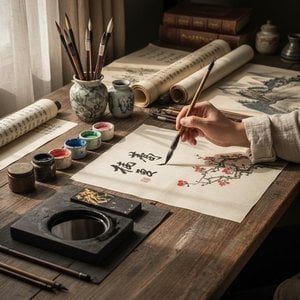
Lui Shou-Kwan’s artistic technique was a masterful synthesis of traditional Chinese ink painting methods and Western abstract principles. He retained the fundamental elements of *shufa* (calligraphy) – brushwork, composition, and tonal variation – but applied them in radically new ways. His use of loose, expressive brushstrokes, often reminiscent of Jackson Pollock’s drip paintings, created a sense of dynamism and spontaneity that was entirely absent from traditional ink painting. He also embraced unconventional materials and techniques, experimenting with splashes of color and incorporating elements of collage into his works. The red dot, a recurring motif in his “Zen” series, is believed to represent the lotus bud emerging from muddy water – a potent symbol of spiritual awakening and the potential for beauty to arise from chaos. His landscapes weren’t merely depictions of physical spaces; they were meditations on nature, spirituality, and the human condition.
Legacy and Influence
Lui Shou-Kwan's untimely death in 1975 cut short a brilliant career, but his legacy continues to resonate within Hong Kong’s art scene. He is widely considered the founder of the New Ink Movement, inspiring generations of artists who followed in his footsteps. His emphasis on individual expression, experimentation, and the integration of Eastern and Western artistic traditions profoundly shaped the development of contemporary Chinese ink painting. Artists like Irene Chou, who learned directly from Lui, built upon his innovations, pushing the boundaries of the medium even further. Today, Lui Shou-Kwan’s work is celebrated for its beauty, innovation, and its profound reflection of Hong Kong's unique cultural identity – a testament to an artist who dared to bridge tradition and abstraction, creating a truly original artistic vision. His influence extends beyond Hong Kong, impacting artists across Asia and contributing significantly to the global dialogue about contemporary art.



 Traditional Chinese Painting
 1959
1959 47.0 x 88.0 cm
 Hong Kong Maritime Museum
 손으로 그린 그림 구매









 미리보기
미리보기
 공유하기
공유하기 공유하기
공유하기
 상세 정보
상세 정보

 다운로드
다운로드
 유사 작품
유사 작품 X-레이
X-레이 슬라이드 쇼
 더 보기
더 보기






































 유리 옵션은 110cm 미만 크기에서만 선택 가능합니다.


