

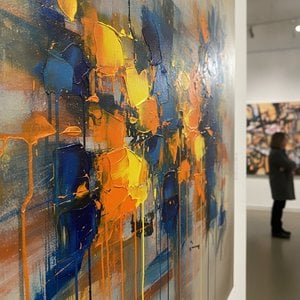
 Abstract Expressionism
 250.0 x 260.0 cm
 Centre of Contemporary Art Znaki Czasu
이 페이지에 표시된 작품은 저작권법의 보호를 받으며, 이에 따라 동일한 복제품을 제작하거나 판매하는 것은 법으로 금지되어 있습니다. 이러한 권리 보호는 다음과 같은 국제 협약에 따라 시행됩니다. 베른 협약 또한 다음에서 명시하는 법률을 포함한 국내법에 의해 보호됩니다. 미국 저작권법 제17조.
이 방식은 저작권 보호를 받는 예술 작품을 복제하거나 그대로 재현하는 것이 아니기에 저작권 규정을 완벽히 준수합니다. 대신, 이는 창의적인 재해석의 과정을 거칩니다. 즉, 원작에서 영감을 받되 원작과 동일하지 않은 새로운 회화 작품을 의미합니다.
빠른 제작과 다양한 마감 옵션을 선택할 수 있는 박물관 수준의 지클레이 및 캔버스 프린트. ( 수작업 채색 복제본 주문하기 디지털 이미지 판매 채널로 전환)





























작품의 원본 비율을 그대로 유지하는 프리셋 사이즈 중에서 선택해 보세요.

액자나 벽면 크기에 맞춰 필요한 가로와 세로 길이를 입력해 주세요. 프린트는 원본 이미지보다 크게 제작할 수 없으며 오직 자르는 것만 가능하므로, 비율이 다른 사이즈를 선택할 경우 이미지의 일부가 잘려 나갈 수 있습니다. 인쇄 작업에 들어가기 전, 최종 확인을 위해 디지털 목업을 보내드립니다. 이 페이지에 표시된 이미지는 실제 잘리는 영역을 나타내지 않으며, 오직 목업을 통해서만 정확한 확인이 가능합니다.
Untitled
복제본 규격
Leon Tarasewicz의 "Untitled"의 주된 색조는 Warm Sunset Tones입니다. 이 색조는 팔레트의 바탕이 되는 톤을 형성합니다.
Leon Tarasewicz의 "Untitled"의 휘도는 Dark입니다. 휘도는 색상이 빛을 얼마나 반사하는지를 나타냅니다.
Leon Tarasewicz의 "Untitled"은(는) Centre of Contemporary Art Znaki Czasu, Torun, Poland에 전시되어 있습니다. 박물관 목록은 복제품이 아닌 원작을 기준으로 합니다.

Born on March 14, 1957, in the quiet village of Waliły, Poland, Leon Tarasewicz carries within his artistic DNA the rich, complex textures of the Polish borderlands. A painter of Belarusian origin, his work is deeply rooted in the cultural intersections of a region defined by shifting boundaries and historical echoes. Growing up in a working-class family, Tarasewicz found his calling through the transformative power of color and form, eventually honing his craft at the prestigious Academy of Fine Arts in Warsaw. Under the mentorship of the influential Tadeusz Dominik, he developed a technical foundation that would later allow him to transcend traditional boundaries, moving from classical training toward a profound exploration of space and light.
The evolution of Tarasewicz’s style is a journey from the representational to the sublime. While his early academic years provided him with the tools of meticulous observation, his mature work embraces the language of abstract expressionism and color field painting. He possesses a unique ability to capture the essence of the Polish landscape—not through literal depiction, but through an emotional resonance achieved via expansive washes of pigment and rhythmic, vertical stripes. His canvases often function as panoramic experiences, where the distinction between painting and environment begins to blur. By utilizing multiple stretcher bars connected to create vast, immersive spaces, he invites the viewer to step into a world where the horizon line vanishes, replaced by a sense of infinite geological or organic growth.
To encounter a Tarasewicz painting is to engage in a sensory dialogue with nature. His palette is famously exuberant, utilizing vivid azures, deep reds, and sun-drenched yellows to evoke the vitality of forests, rivers, and skies. Yet, beneath this surface brilliance lies a deeper, more contemplative layer of symbolism. The artist’s work often references the sublimation of sensual experience into spiritual truth, a concept reminiscent of the icon traditions found in his Belarusian heritage. Even when his works appear purely abstract, they carry the weight of the landscape's history—the furrows of a field, the movement of wind through trees, and the layered memories of a borderland territory.
A defining characteristic of his practice is his deliberate avoidance of titles. By refusing to name his pieces, Tarasewicz escapes the "trap of representation," ensuring that his work cannot be confined to a single definition or historical movement. This allows for a multiplicity of interpretations, where a viewer might see a topographical map of a distant meadow one moment and a purely rhythmic exploration of color the next. His technique creates a tension between the physical texture of the paint—which hints at earth and stone—and the ethereal quality of light that seems to emanate from within the pigment itself.
Throughout his illustrious career, Leon Tarasewicz has garnered significant international acclaim, establishing himself as a pillar of contemporary Polish art. His contributions to the academic world are equally profound; as a professor of fine arts and a lecturer at the Academy of Fine Arts in Warsaw, he has shaped the perspectives of subsequent generations of artists. His professional journey is marked by prestigious accolades that reflect both his cultural impact and his technical mastery:
Beyond the gallery walls, Tarasewicz has served as a cultural ambassador, notably representing the European Year of Intercultural Dialogue. His life’s work remains a profound meditation on the beauty of the natural world and the enduring strength of cultural identity, proving that even in abstraction, the soul of a landscape can be found.

1957 - , Poland
Master the high-impact world of contemporary abstraction. Discover how bold colors, textures, and modern movements like Abstract Expressionism can transform your space with premium, high-energy art curated for the design-conscious professional.

몬드리안, 말레비치 등 거장들의 기하학적 추상 미술 명작 10선을 만나보세요. 각 작품의 예술사적 의미와 색채, 구성을 탐구하고 WahooArt.com에서 고품질 아트 프린트를 소장하세요. 지금 바로 온라인 컬렉션을 확인하세요!

추상표현주의의 심장을 뛰게 한 10대 걸작을 만나보세요. 폴록, 로스코 등 거장의 작품 비하인드 스토리와 예술적 영감을 WahooArt에서! 지금 바로 미술품 컬렉션을 탐험하고, 당신의 공간에 특별한 예술적 감성을 더하세요. WahooArt.com

Embark on a cultural journey through Lyrical Abstraction. Explore how masters like Kandinsky used color and motion to translate emotion into visual poetry. Discover the profound beauty of abstract expressionism and learn to curate emotional resonance in your own art collection.

Explore the profound history and emotional depth of Color Field painting. From Mark Rothko to Barnett Newman, discover how pure color redefined modern art through our expert-led guide for students and collectors alike.

 실제 크기로 보기
 보내기
보내기 공유하기
공유하기
 상세 보기
상세 보기 가이드 보기

 이미지 다운로드
 유사 작품 더 보기
 X-레이
X-레이 슬라이드 쇼 보기
 통계 정보
통계 정보 상세 보기
상세 보기









 유리 옵션은 110cm 미만 크기에서만 선택 가능합니다.


