빠른 제작과 다양한 마감 옵션을 선택할 수 있는 박물관 수준의 지클레이 및 캔버스 프린트. ( 수작업 채색 복제본 주문하기 디지털 이미지 판매 채널로 전환)





























작품의 원본 비율을 그대로 유지하는 프리셋 사이즈 중에서 선택해 보세요.

특정 프레임이나 공간에 맞춰 직접 치수를 입력하실 수 있습니다. 선택하신 사이즈가 원본 이미지의 비율과 일치하지 않을 경우, 작품을 크롭(자르기)하거나 이미지를 대칭 또는 단색 채우기로 확장하여 제작합니다. 제작 시작 전, 최종 확인을 위해 디지털 목업이 전송됩니다.
화면상의 미리보기는 실제 크롭이나 확장 상태를 반영하지 않으므로, 최종 구도는 오직 목업을 통해서만 정확하게 확인하실 수 있습니다.
맞춤 사이즈 제작도 가능하지만, 원본 비율을 유지하기 위해서는 사전 정의된 목록에서 치수를 선택하시는 것을 권장합니다.

Vanily Case
복제본 규격
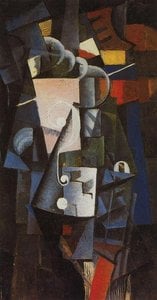
“Vanily Case,” a deceptively simple painting by Kazimir Malevich, offers a profound meditation on form, color, and the very nature of perception. Executed around 1917, this work represents a crucial step in Malevich’s radical journey toward pure abstraction, a movement he would later codify as Suprematism. The image itself – a commonplace scene of cups, spoons, and tables – is rendered with an almost obsessive attention to detail, yet simultaneously stripped down to its most essential elements. The black background acts not merely as a backdrop but as a contained void, intensifying the vibrancy of the red cup and silver spoon, drawing the viewer’s eye into a carefully constructed dialogue between object and space.
‘Vanily Case’ emerged during a period of intense artistic experimentation in Russia, fueled by the influence of European avant-garde movements like Cubism and Futurism. However, Malevich was seeking something beyond mere imitation; he aimed to create a completely new visual language – one that rejected representational illusion entirely. This work anticipates the core tenets of Suprematism, a movement founded by Malevich in 1915, which advocated for art based solely on geometric forms and pure color. The painting’s reductionist approach—focusing on basic shapes and colors—reflects this philosophical shift, moving away from depicting reality to expressing an inner truth.
Malevich’s technique in ‘Vanily Case’ is characterized by meticulous brushwork and a precise rendering of form. The surfaces are built up with thin layers of paint, creating subtle variations in tone and texture that enhance the objects' three-dimensional appearance. The composition itself is deceptively simple, yet carefully balanced. The placement of the cups—one on the left, another towards the top right—creates a dynamic tension within the confined space, guiding the viewer’s eye across the canvas. The use of negative space – the areas around and between the objects – is equally important, contributing to the painting's overall sense of depth and spatial awareness.
Beyond its formal qualities, ‘Vanily Case’ possesses a subtle symbolic resonance. The objects themselves—cups and spoons—represent the everyday rituals of life, yet their isolation within the black void suggests a detachment from worldly concerns. The painting evokes a sense of quiet contemplation and perhaps even melancholy, inviting viewers to reflect on the nature of existence and the search for meaning in a world increasingly dominated by abstraction. This piece is not merely a depiction of objects; it’s an exploration of perception, reality, and the potential of art to transcend the limitations of language and representation.

1878 - 1935 , 우크라이나

Journey through Wassily Kandinsky's 25 most iconic abstract paintings. Explore his revolutionary use of color, form & spiritual expressionism. Find museum-quality Kandinsky reproductions and elevate your home decor with WahooArt.com. Discover all masterpieces on WahooArt.com!
마크 로스코 최고작 25선을 만나보세요. 추상 표현주의 거장의 색채로 표현된 심오한 감정과 예술의 세계를 탐험하고, WahooArt에서 명화 복제본과 특별한 인테리어 아이디어를 찾아보세요. 지금 바로 컬렉션을 확인하세요!

카지미르 말레비치의 최고작 25선을 만나보세요. 추상 미술의 혁신적인 세계, 슈프레마티즘의 정수를 담은 작품들의 이야기와 영감을 WahooArt에서 경험하세요. 고품질 아트 프린트와 인테리어 데코 아이디어를 지금 바로 확인하세요! WahooArt.com

몬드리안, 말레비치 등 거장들의 기하학적 추상 미술 명작 10선을 만나보세요. 각 작품의 예술사적 의미와 색채, 구성을 탐구하고 WahooArt.com에서 고품질 아트 프린트를 소장하세요. 지금 바로 온라인 컬렉션을 확인하세요!

추상표현주의의 심장을 뛰게 한 10대 걸작을 만나보세요. 폴록, 로스코 등 거장의 작품 비하인드 스토리와 예술적 영감을 WahooArt에서! 지금 바로 미술품 컬렉션을 탐험하고, 당신의 공간에 특별한 예술적 감성을 더하세요. WahooArt.com

 실제 크기로 보기
 보내기
보내기 공유하기
공유하기
 상세 보기
상세 보기 가이드 보기

 이미지 다운로드
 유사 작품 더 보기
 X-레이
X-레이 슬라이드 쇼 보기
 통계 정보
통계 정보

 상세 보기
상세 보기









 유리 옵션은 110cm 미만 크기에서만 선택 가능합니다.