
The Geometry of Harmony: Exploring Juan Gris's "Guitar on a Table"
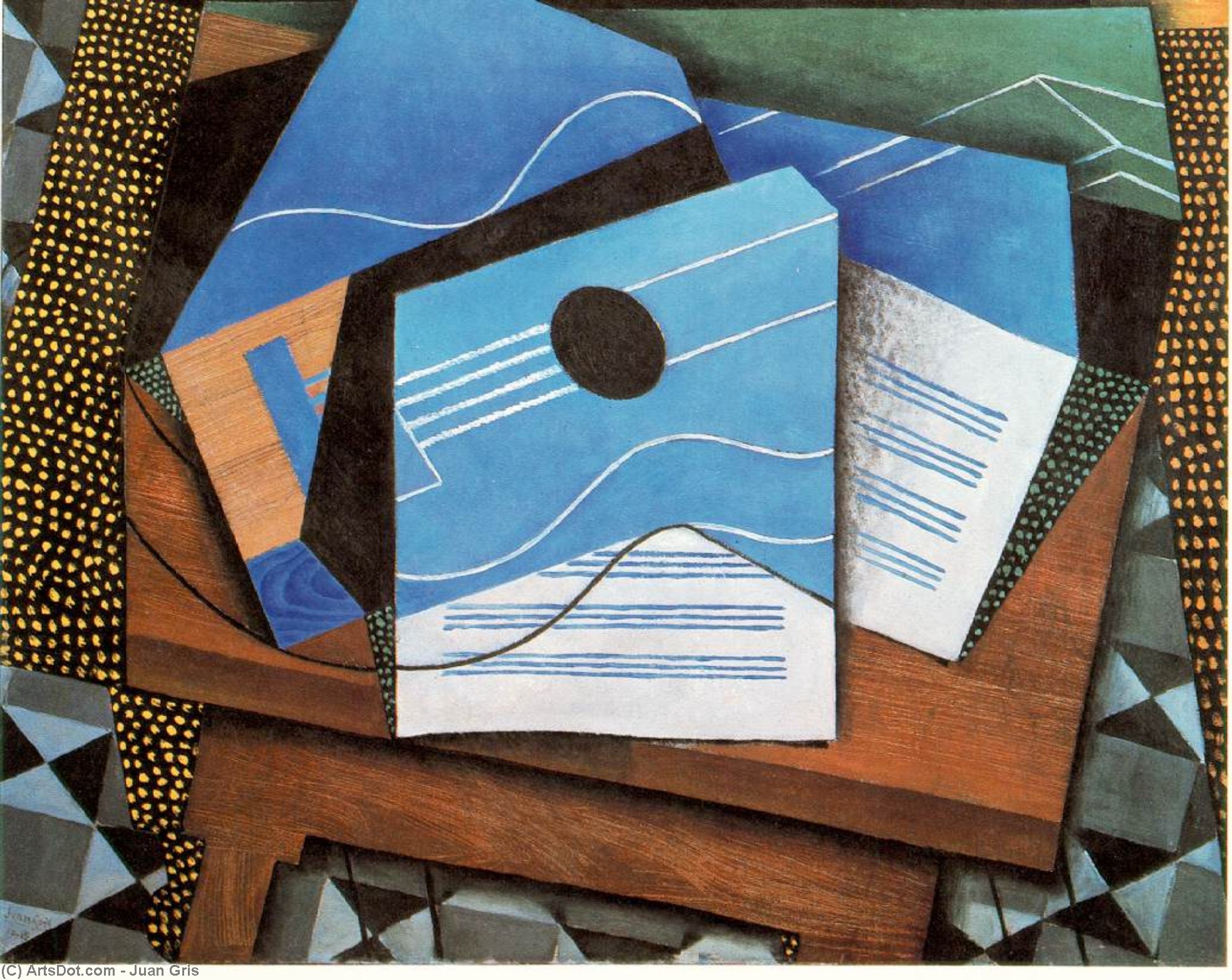
To stand before Juan Gris’s Guitar on a Table is to step directly into the intellectual fervor of the early twentieth century, a moment when art dared to dismantle and reassemble reality. This seminal work from 1915 is not merely a depiction of musical instruments and scattered books; it is a meticulously constructed meditation on form, perspective, and the very nature of representation itself. Gris, ever the analytical mind, approaches his subject matter with the precision of an engineer, yet imbues it with the lyrical grace one expects from a master painter. The composition immediately draws the eye to the central guitar, its curves and planes rendered through the rigorous lens of Synthetic Cubism.
Mastery in Synthetic Cubist Technique
The defining characteristic of this piece is Gris’s masterful handling of overlapping geometric planes. Unlike earlier explorations of fragmentation, Synthetic Cubism, as seen here, builds up reality from recognizable, yet fractured, components. Observe how the guitar itself seems to be composed of interlocking facets—a systematic deconstruction that forces the viewer's eye to trace multiple viewpoints simultaneously. The surrounding books and tabletop elements are treated with equal geometric rigor; they do not simply rest upon a surface but rather emerge from it through calculated overlaps. This technique creates an astonishing illusion of depth while maintaining an undeniable flatness, a hallmark of the movement that challenged centuries of single-point perspective.
Symbolism: Music, Literature, and Intellect
The arrangement of objects—the musical instrument juxtaposed with volumes of literature—suggests a rich dialogue between art forms. The guitar, an object steeped in cultural resonance, becomes the focal point around which intellectual pursuits gather. Gris seems to be suggesting that true creativity is found at the intersection of different disciplines: the passion of music meeting the structure of knowledge contained within books. The subdued earth tones and muted hues employed by Gris lend a sense of quiet contemplation to this gathering of objects, transforming what could be a mere still life into a profound allegory for the cultured mind.
Bringing Cubist Depth Home
For those seeking to integrate such intellectual depth and artistic history into a living space, a reproduction of Guitar on a Table offers an unparalleled opportunity. Its sophisticated balance and harmonious structure allow it to function beautifully in both formal drawing rooms and modern, thoughtfully curated interiors. Owning this piece is not just acquiring art; it is inviting a conversation about perception, structure, and the enduring relationship between beauty and intellect into your home. It remains a vibrant testament to how an artist can find profound harmony even within the most fragmented reality.
질의응답
"Guitar on a table - -"의 주제가 후안 그리스 작가의 평소 작업 세계와 어떤 연관이 있나요?
"Guitar on a table - -"은(는) cubism, still life, guitar, books, geometric, music, art objects을(를) 묘사하고 있는 반면, 후안 그리스의 기존 주제들은 cubist influence on form, exploration of musical motifs, synthetic cubism development phase입니다. 이 두 가지를 비교해 보면 해당 작품이 작가의 통상적인 소재와 어떻게 연관되는지 알 수 있습니다.
증강 현실(AR) 기능을 통해 후안 그리스의 "Guitar on a table - -"를 제 방에 미리 배치해 볼 수 있나요?
호환 가능한 기기에서 증강 현실(AR) 기능을 사용하면, 작품의 AR로 미리보기 페이지를 통해 후안 그리스의 "Guitar on a table - -"을(를) 고객님의 벽에 미리 배치해 볼 수 있습니다.
"Guitar on a table - -"의 Landscape 형식은 어디에 전시하는 것이 가장 좋을까요?
후안 그리스의 "Guitar on a table - -"의 Landscape 형식은 Lounge에 추천합니다. 작품의 형식과 공간의 조화는 복제화 배치에 중요한 가이드가 됩니다.



































