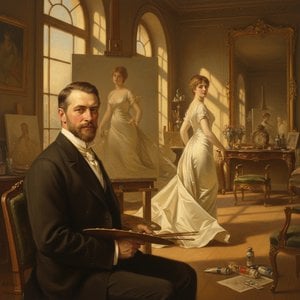
A Portrait of Grace Amidst Elegance: John Singer Sargent’s Mrs. J. William White
The Philadelphia Museum of Art holds within its walls a painting that transcends mere visual representation—it embodies the spirit of an era and captures the profound beauty of human connection: John Singer Sargent’s “Mrs. J. William White,” completed in 1903. More than just a likeness, this portrait is a masterful distillation of Impressionistic principles interwoven with meticulous realism, offering viewers a glimpse into the refined sensibilities of Edwardian society.
The Artist's Vision and Technique
John Singer Sargent (1856-1925) emerged as one of America’s most celebrated expatriate artists during his formative years. Unlike many of his contemporaries who pursued formal academic training, Sargent cultivated his artistic prowess through independent observation and experimentation—a path that ultimately yielded extraordinary results. His technique was characterized by a remarkable ability to capture fleeting moments of light and atmosphere while maintaining an unwavering commitment to anatomical accuracy. Sargent employed loose brushstrokes layered upon one another, creating textured surfaces that shimmered with reflected color – a hallmark of Impressionism championed by artists like Monet and Renoir. Yet, he skillfully blended these expressive strokes with precise rendering of facial features and drapery folds, demonstrating his mastery over both stylistic innovation and technical precision.
Historical Context: The Dawn of the Edwardian Era
“Mrs. J. William White” emerged during a period of significant social transformation in Britain—the Edwardian era (1895-1910). Marked by unprecedented economic prosperity, burgeoning optimism, and a fascination with aristocratic traditions, this epoch witnessed a flourishing of artistic creativity. Sargent’s patrons were predominantly wealthy industrialists and members of the upper echelon, eager to adorn their homes with artworks that reflected their status and refined tastes. The portrait reflects the prevailing aesthetic ideals of the time—a celebration of beauty, composure, and social grace—values deeply ingrained in the Victorian legacy yet infused with a newfound dynamism.
Symbolism Within the Frame
Beyond its technical brilliance, “Mrs. J. William White” is laden with symbolic significance. The woman’s posture exudes confidence and serenity, mirroring the idealized femininity of the Edwardian ideal. Her gaze directs towards the viewer—a deliberate gesture that establishes an intimate connection between subject and observer—underscoring the importance of social interaction within aristocratic circles. Furthermore, the fan held delicately in her hand serves as a visual motif representing both modesty and refinement – traditions upheld by Victorian women. The pearl necklace symbolizes purity and wealth, reinforcing the portrait’s depiction of opulent lifestyle.
Emotional Resonance: Capturing Inner Beauty
Perhaps most powerfully, Sargent succeeds in conveying an emotional resonance that transcends mere surface appearance. The subtle nuances of expression—a hint of melancholy beneath a veneer of composure—reveal glimpses into Mrs. White's inner life. Through masterful manipulation of color and light, Sargent captures the essence of her character—her grace, dignity, and quiet strength—transforming the portrait into an enduring testament to human beauty. It remains a captivating image that continues to inspire admiration for its artistic merit and evokes feelings of nostalgia for a bygone era.
- Artist: John Singer Sargent
- Year Completed: 1903
- Location: Philadelphia Museum of Art