

웹 미리보기 화면을 훨씬 뛰어넘는 인쇄용 파일을 만나보세요. 저희가 판매하는 모든 디지털 이미지는 스톡 데이터베이스 내의 고해상도 마스터 파일(일반적으로 가로 5,000~15,000픽셀)을 기반으로 합니다. 따라서 대형 인쇄나 정밀한 크롭 작업 시에도 세밀한 디테일을 자신 있게 구현할 수 있습니다.
저희 스튜디오를 거치는 모든 파일은 정교한 손길을 거칩니다. 디지털 전문가가 원작과 대조하여 색상을 점검하고 필요 시 보정하며, 전문 리터칭 도구를 사용하여 선명도와 디테일을 높입니다. 이 과정에서 작가의 붓 터치와 화풍을 충실히 유지하는 것을 원칙으로 합니다. 그 결과, 단순한 스캔본에 필터를 입힌 듯한 느낌이 아닌, 마치 실제 회화 작품을 보는 듯한 이미지를 구현해냅니다.
최종 완료 전 확인 단계가 있습니다. 전문가가 검토하실 수 있도록 72시간 이내에 이미지를 이메일로 보내드립니다. 결과물이 만족스럽지 않으신가요? 수정이나 보완을 요청하시거나, 품질이 기대에 미치지 못할 경우 환불을 요청하실 수 있습니다.
출판사, 디자인 스튜디오, 갤러리 및 인쇄소가 신뢰하는 바로 그 품질입니다.
개인 소장 및 전시, 인쇄, 창작 프로젝트를 위한 고해상도 파일을 다운로드하세요. ( 프린트 판매로 전환 수작업 채색 복제본 주문하기)
WahooArt.com를 선택하시면 단순히 이미지를 받는 것을 넘어, 정밀한 보정 과정을 거쳐 완성된 전문적인 디지털 예술 작품을 만나보실 수 있습니다. 모든 주문에는 만족 보장 서비스가 포함되어 있으며, 다음과 같은 사항들이 자동으로 제공됩니다:
주문 후 72시간 이내에 고해상도 디지털 이미지 파일이 이메일로 발송되며, 즉시 사용하실 수 있습니다.
귀하의 작품은 첨단 AI 기술과 정교한 수동 편집 과정을 거쳐 전문적으로 최적화되며, 이를 통해 디테일과 선명도, 색상의 정확도를 극대화합니다.
파일을 실수로 삭제하거나 분실하셨나요? 걱정 마세요. 언제든 무료로 다시 보내드립니다.
관세, 부가세, 배송비 부담 없이 작품을 즉시 소장하세요 - 디지털 다운로드는 언제나 면세 혜택이 적용됩니다.
전문적인 도구와 색상 관리 시스템을 통해 디지털 이미지가 원본의 색상을 최대한 정확하게 구현하도록 보장합니다.
구매하신 디지털 이미지에 만족하지 못하실 경우, 100일 이내에 별도의 조건 없이 수정 또는 100% 환불을 진행해 드립니다.
만족스럽지 않으신가요? 디지털 파일을 받으신 후 100일 이내라면 어떤 이유로든 조건 없이 전액 환불해 드립니다.
이미지 3매 구매 시 10% 할인 - 5매 구매 시 15% 할인 - 10매 이상 구매 시 20% 할인. 크리에이티브 프로젝트, 갤러리, 에이전시에 매우 유용합니다.
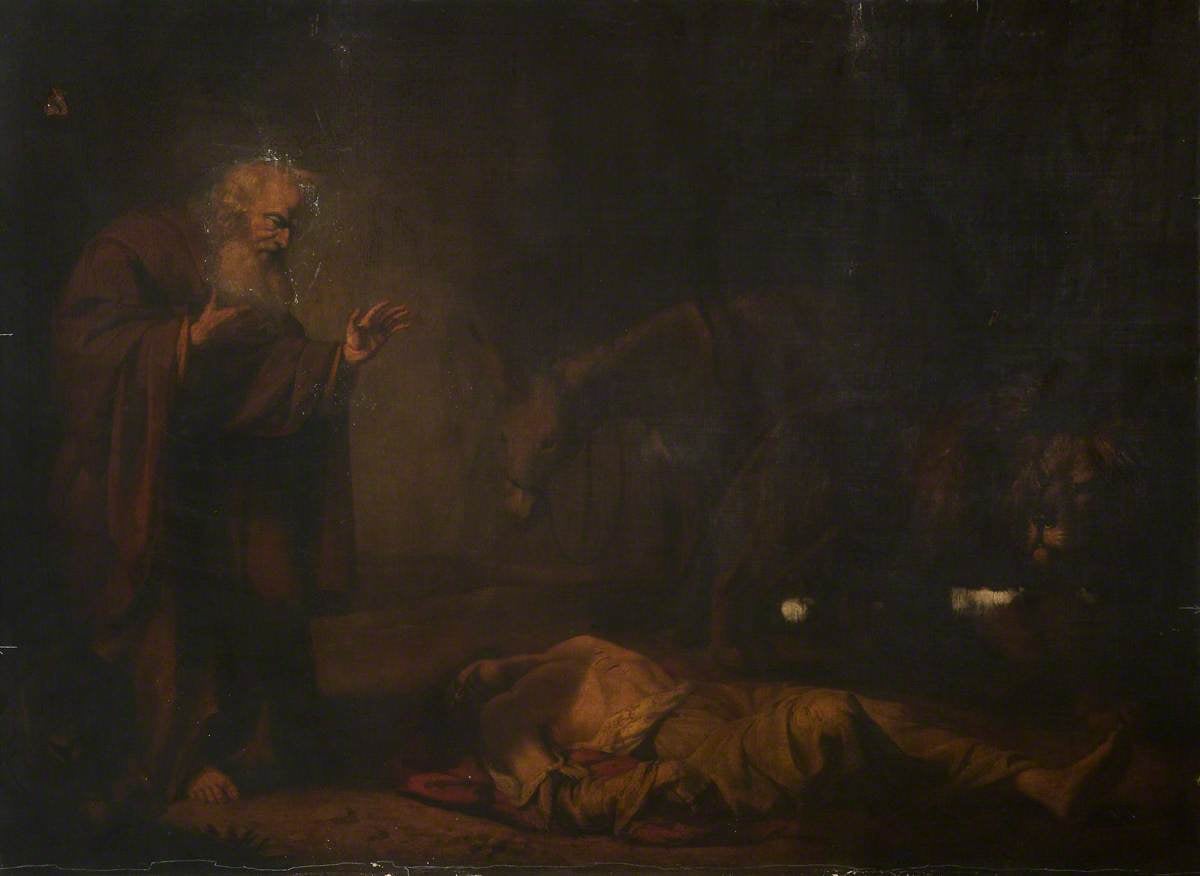
The Disobedient Prophet is an oil on canvas work by John Graham, dating to about 1790. This piece presents a dramatic scene centered on a prophet or messenger of God. The figure is positioned over a person lying on the ground, creating a moment of profound tension. Two horses are also present within the composition, adding to the gravity of the encounter.
Currently, this painting is held at the Royal Scottish Academy of Art - Architecture in Edinburgh, United Kingdom. It remains a significant example of Graham's ability to handle religious subject matter through a lens of intense human emotion. The scale of the work, measuring 243 x 332 cm, allows for a detailed observation of the figures and their interaction.
The arrangement of the figures creates a palpable sense of tension, drawing the eye toward the central interaction. A prophet stands over a person lying on the ground, a positioning that establishes a clear hierarchy within the scene. Two horses are positioned within the frame, adding to the complexity of the spatial arrangement. This careful placement of subjects ensures the viewer feels the weight of the moment being depicted.
Light and shadow are used to define the emotional gravity of the work. A dark background provides a stark contrast, which emphasizes the religious theme and directs attention toward the primary figures. This use of chiaroscuro creates a sense of depth, pulling the viewer into the immediate, dramatic space. The interplay of light helps to isolate the figures from the surrounding darkness, focusing the narrative on the interaction between the messenger and the prone individual.
The work is executed in oil on canvas, a choice that lends a palpable sense of richness to the composition. By utilizing the inherent properties of oil, the artist achieves a depth that allows the light to interact with the surface in a nuanced way. This medium provides the necessary weight to support the dramatic interplay of shadow and illumination seen throughout the scene.
The application of the paint is deliberate and physical. The technique involves layering oil paint in thick strokes, creating a surface that is far from smooth. These textures appear rough and impasto-like, giving the figures and the surrounding environment a tangible, sculptural quality. Such heavy handling of the pigment adds a layer of physicality to the work, emphasizing the tension within the composition through the very substance of the paint itself.
To understand the breadth of this artist's output, one must look toward his other notable compositions. His ability to navigate diverse subject matter is evident when considering works such as An Italian Nobleman. This piece demonstrates a specific command over character and presence that complements the dramatic tension found in his religious narratives. There is a certain poise in his figurative studies that suggests a deep familiarity with the human form and its capacity for expression.
The artist also explored themes of romance and tension through works like The Bandit’s Bride. This piece, alongside John Gibson (1790–1866), highlights a range that extends from historical or character-driven studies to more narrative-focused scenes. Each work reveals a different facet of his technical skill, moving between the quietude of a portrait and the heightened emotion of a dramatic event.
John Graham은(는) Ivan Gratianovitch Dombrowsky, Ivan Gratianovich Dombrowski라는 이름으로도 활동하고 있습니다.
John Graham의 "The Disobedient Prophet"의 저작권 상태는 명확합니다. 이 작품은 저작권 보호 대상입니다 상태이며, Royal Scottish Academy of Art - Architecture에 소장되어 있다는 사실이 해당 상태를 변경하지 않습니다.
Monochrome 색조를 담은 John Graham의 "The Disobedient Prophet"는 Living Room에 배치하시길 추천드립니다. 이 작품의 색감이 이러한 제안의 이유이기도 합니다.

The story of John Graham is one of profound transformation, a narrative that begins far from the bustling studios of New York, amidst the aristocratic elegance and subsequent political turbulence of Kyiv. Born Ivan Gratianovitch Dombrowsky in 1886, his early years were defined by a classical education and a lineage of privilege that seemed destined for a life of law or diplomacy. Yet, the winds of history had other plans. The seismic shifts of the Russian Revolution and the subsequent Bolshevik seizure of power thrust him into a crucible of conflict, leading to his imprisonment as a counterrevolutionary. This period of upheaval served as a spiritual and artistic catalyst; fleeing the chaos of his homeland, he eventually found refuge in the United States in 1920. It was during this migration that he shed his old identity, adopting the name John Graham—a moniker that would come to represent a bridge between the Old World's traditions and the New World's avant-garde energy.
Graham’s arrival in New York City marked the beginning of an extraordinary artistic awakening. Though he did not begin his formal studies in painting until his thirties, his late start was compensated by a voracious intellectual hunger. He immersed himself in the vibrant, gritty reality of the Ashcan School through the mentorship of John F. Sloan, yet his gaze was perpetually fixed on the horizon of modernism. His journey was not merely one of personal discovery but of cultural synthesis, as he navigated the complexities of Cubism, Surrealism, and Abstract Expressionism, weaving these disparate threads into a cohesive visual language that honored classical structure while embracing modern fragmentation.
Beyond his own canvas, Graham functioned as a vital conduit for the burgeoning New York art scene. He was far more than a solitary painter; he was a collector, a writer, and a philosopher of form. His deep engagement with System Theory and dialectics allowed him to view art not just as an aesthetic pursuit, but as a structured argument—a belief encapsulated in his famous assertion that “an abstract painting is an argument drawn to conclusion.” This intellectual rigor made him a central figure in the development of the New York School. As a mentor and advocate, he provided the scaffolding upon which legends like Jackson Pollock and Willem de Kooning could build their revolutionary styles. He possessed the rare ability to champion the radical unknown while maintaining a profound respect for the masters of the past.
His artistic development was characterized by a fascinating tension between the figurative and the abstract. While he was deeply moved by the expressive potential of modern abstraction, his later works returned to a highly sophisticated figurative style. This period saw him drawing inspiration from classical masters to depict subjects such as Russian soldiers with an intensity that felt both ancient and immediate. His brushwork often carried a palpable emotional weight, utilizing vibrant color palettes and a sense of Baroque drama to navigate the tensions of a modern age. Through his work, the heavy shadows of history met the bright, fractured light of the twentieth century.
The historical significance of John Graham lies in his role as a stabilizer and a provocateur within the whirlwind of mid-century modernism. He did not merely witness the birth of Abstract Expressionism; he helped cultivate the environment that made it possible. His legacy is found in several key areas:
Though he passed away in London in 1961, the echoes of Graham's influence remain embedded in the DNA of modern art. He remains a figure of immense mystery and brilliance—a man who survived revolution only to help orchestrate an artistic revolution of his own.

1886 - 1961 , Russia
 미리보기
미리보기
 공유하기
공유하기 공유하기
공유하기
 상세 정보
상세 정보 가이드 보기

 다운로드
다운로드
 유사 작품 더 보기
 X-레이
X-레이 슬라이드 쇼 보기
 질의응답
질의응답
 통계 정보
통계 정보


 더 보기
더 보기


