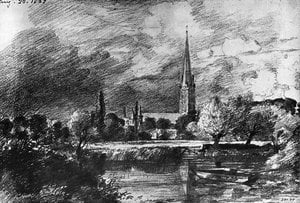
A Symphony of Dusk: Exploring Constable’s ‘Evening Landscape After Rain’
John Constable's “Evening Landscape after Rain,” painted in 1821, transcends mere depiction; it embodies the very spirit of Romantic landscape painting and captures a moment suspended between melancholy beauty and palpable emotion. Born into a family deeply connected to the Suffolk countryside – his father owning both Dedham Vale and mills along the River Stour – Constable’s formative years instilled within him an unparalleled appreciation for the subtleties of natural light and atmosphere, influences that would permeate his artistic vision throughout his career. This wasn't simply about recording what he saw; it was about conveying how he *felt* when confronted with the grandeur and fragility of the English landscape.
- Subject Matter: The painting presents a quintessential rural scene – a vast field bathed in the fading light of twilight, punctuated by scattered trees that stand sentinel against the encroaching darkness. Constable meticulously observed the effects of recent rainfall on the vegetation, capturing the glistening dew clinging to leaves and grasses with remarkable accuracy.
- Style: Constable’s style firmly establishes itself within the Romantic movement, prioritizing emotional expression over strict academic conventions. Unlike his predecessors who sought idealized representations of nature, he aimed for an honest portrayal of its complexities – the interplay of light and shadow, the shifting moods of the sky, and the quiet drama unfolding amidst seemingly tranquil surroundings.
Technique: Atmospheric Impressionism Foretold
Constable’s masterful technique foreshadowed what would later become known as Impressionism. He employed a loose brushstroke style, prioritizing capturing fleeting impressions of light and color rather than striving for photographic realism. Layers of pigment were applied thinly to create an illusion of depth and luminosity, allowing the colors to blend seamlessly into one another—a deliberate departure from the polished surfaces favored by earlier artists. The artist’s careful attention to tonal gradations – particularly the subtle shifts in hue as dusk descends – is evident throughout the composition, creating a palpable sense of atmosphere.
Historical Context: Reflecting Victorian Sensibility
Painted during the Victorian era, “Evening Landscape After Rain” reflects the prevailing mood of Romanticism—a reaction against Enlightenment rationalism and an embrace of imagination and emotion. The painting speaks to anxieties about mortality and beauty’s impermanence, mirroring the broader cultural preoccupation with themes of loss and remembrance prevalent in Victorian literature and art. Furthermore, Constable's work aligns with a burgeoning interest in scientific observation alongside artistic interpretation—a characteristic that distinguishes him from many of his contemporaries.
Symbolism: The Quiet Power of Nature’s Response
Beyond its aesthetic qualities, “Evening Landscape After Rain” carries symbolic weight. The rain-soaked field symbolizes renewal and regeneration after periods of hardship, while the darkened trees represent resilience and steadfastness against adversity. Constable's depiction of the sky—a turbulent expanse of bruised purple and grey—suggests a profound awareness of the forces shaping our world, reminding viewers that even in moments of apparent stillness, nature possesses an inherent dynamism and power.
- Emotional Impact: The painting evokes feelings of serenity mingled with melancholy. It invites contemplation on the passage of time and the beauty found within the natural world—a timeless message resonating powerfully across generations.