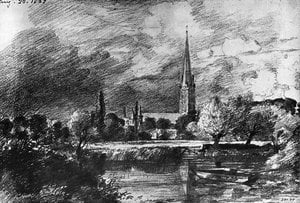
The Serene Landscape of East Bergholt House
John Constable’s “East Bergholt House,” painted in 1809, isn't merely a depiction of a rural scene; it’s a profound meditation on light, space, and the enduring beauty of the Suffolk countryside. Born in the very village he immortalizes, Constable possessed an unparalleled ability to translate the subtle shifts of atmosphere onto canvas – a gift honed by his upbringing amidst the rhythms of agricultural life and the ever-changing hues of Dedham Vale. This particular work captures a moment of quietude, a golden afternoon bathed in the soft light that was characteristic of Constable’s style, and it offers a glimpse into the artist's deeply personal connection to his homeland. The composition is deceptively simple: a modest house nestled on a gentle rise, framed by rolling fields and the distant silhouette of trees. Yet, within this apparent tranquility lies a wealth of observation and artistic skill.
A Painter’s Immersion in Nature
Constable's relationship with his father’s land was pivotal to his artistic development. The corn merchant’s estate – including the mills along the River Stour and the expansive fields surrounding East Bergholt – provided him with an endless source of inspiration, a living classroom where he meticulously studied the interplay of light, shadow, and texture. This intimate familiarity is evident in every brushstroke; the way the grass seems to ripple in the breeze, the precise rendering of the trees’ foliage, and the subtle variations in color that mimic the natural world. Unlike many of his contemporaries who sought grand, dramatic landscapes, Constable focused on capturing the quiet dignity of everyday rural life – a deliberate choice reflecting his own deeply rooted connection to the land. The inclusion of figures scattered throughout the scene adds a layer of human presence without disrupting the overall sense of serenity; they are not imposing subjects but rather integrated elements of the landscape, suggesting a harmonious relationship between people and nature.
Technique and Style: Constable’s Signature Approach
“East Bergholt House” exemplifies Constable's distinctive style – a blend of observation, emotion, and technical mastery. He employed a technique known as “loose brushwork,” characterized by visible strokes that capture the fleeting effects of light and atmosphere. This approach, often criticized during his lifetime, is now recognized as crucial to conveying the immediacy and vibrancy of the scene. Constable’s use of color is particularly noteworthy; he favored muted tones – greens, browns, and golds – creating a sense of depth and realism while simultaneously evoking the warmth and tranquility of the afternoon sun. The painting's perspective subtly draws the viewer into the landscape, inviting them to lose themselves in the details of the fields and trees. The light itself seems to emanate from the canvas, illuminating every element with an almost ethereal glow.
Symbolism and Emotional Resonance
Beyond its purely representational qualities, “East Bergholt House” carries a deeper symbolic weight. The house, situated on a prominent hilltop, represents stability and permanence amidst the ever-changing beauty of nature. It’s a symbol of Constable's own rootedness – his connection to his family, his birthplace, and the land that shaped his artistic vision. The figures in the painting can be interpreted as emblems of rural life, representing the community and the rhythms of agricultural existence. The overall mood is one of peaceful contemplation, inviting the viewer to share in Constable’s appreciation for the simple pleasures of nature and the enduring beauty of the English countryside. It's a scene that speaks to a longing for connection with the natural world – a sentiment that resonated deeply with Romantic artists like Constable and continues to captivate audiences today.
Reproductions and Interior Design
WahooArt offers meticulously crafted, hand-painted reproductions of “East Bergholt House” that faithfully capture the essence of Constable’s original masterpiece. Available in a range of sizes and mediums – from luxurious canvas prints to elegant framed watercolors – these reproductions provide an exceptional opportunity to bring this iconic work into your home or office. Whether you are an art collector, an interior designer seeking to create a serene atmosphere, or simply someone who appreciates the beauty of English landscape painting, a WahooArt reproduction of “East Bergholt House” is sure to be a treasured addition to your collection. Explore our selection today and experience the timeless allure of Constable’s vision.
질의응답
존 컨스터블의 "East Bergholt House"의 저작권 상태는 어떻게 설명되나요?
"East Bergholt House"의 저작권 상태 - 퍼블릭 도메인 - 저작권 보호 기간이 만료되었습니다 - 는 작가의 1837년 사망에 따라 결정됩니다.
"East Bergholt House"을(를) 더 자세히 살펴볼 수 있을까요?
존 컨스터블의 "East Bergholt House"의 X-Ray 뷰는 작품의 X선 분석 페이지에서 확인하실 수 있습니다. 이 페이지에서는 11개의 광학 레이어를 통해 이미지를 인터랙티브하게 살펴볼 수 있습니다.
"East Bergholt House"은(는) 존 컨스터블의 다른 작품들과 어떤 공통점을 지니고 있나요?
"East Bergholt House"은(는) 존 컨스터블의 다른 작품들과 마찬가지로 Romanticism 양식과 더불어 claude lorrain, english landscape, rural life, suffolk setting, constable’s personal connection”, “dedham vale inspiration”, romanticism, emotional depth”라는 작가의 반복되는 주제 의식을 공유합니다.