x


 Oil On CanvasWallArtRomanticism
 1832
1832 25.0 x 28.0 cm
 Nationalgalerie




























작품의 원본 비율을 유지하는 미리 설정된 크기 중에서 선택하세요.

특정 프레임이나 공간에 맞도록 직접 크기를 입력할 수 있습니다. 선택하신 크기가 원본 이미지의 비율과 일치하지 않는 경우, 작품을 자르거나 추가적인 손으로 그린 요소를 사용하여 그림을 확장합니다. 제작 시작 전 승인을 위해 디지털 목업을 보내드립니다.
화면 미리 보기는 실제 자르기 또는 확장을 반영하지 않습니다. 최종 구성은 목업을 통해서만 정확하게 확인하실 수 있습니다.
맞춤 크기 제작도 가능하지만, 원본 비율을 유지하기 위해 사전 정의된 목록에서 크기를 선택하시는 것을 권장합니다.

Cloud Study with Horizon
복제본 크기
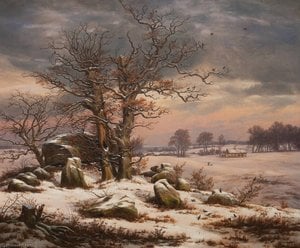
Johan Christian Dahl's "Cloud Study with Horizon," painted in 1832, isn’t merely a depiction of a landscape; it’s a profound meditation on the sublime—a concept central to the Romantic movement and deeply rooted in the Norwegian psyche. This work, rendered in oil on cardboard measuring 25 x 28 cm, transcends simple observation, inviting the viewer into a realm where nature's power and beauty converge with an almost palpable sense of melancholy and awe. Dahl, often hailed as Norway’s “father of landscape painting,” masterfully captures the dramatic interplay of light and shadow across a vast, brooding sky, establishing himself as a pivotal figure in shaping Norwegian artistic identity.
Dahl's artistic journey began humbly, working as a decorative painter in Bergen. However, his exposure to the works of Jens Juel and Christoffer Wilhelm Eckersberg ignited within him a passion for capturing the essence of nature. He sought not just to replicate what he saw, but to convey the *feeling* of being immersed in the Norwegian wilderness—a landscape imbued with both grandeur and vulnerability. This pursuit led him to meticulously study the techniques of Dutch masters like Allaert Everdingen, who had previously documented the stark beauty of the Nordic region, laying a crucial foundation for Dahl’s own style.
The painting's power resides in its masterful manipulation of light and shadow. The dark, almost bruised sky dominates the composition, punctuated by swirling clouds that seem to writhe with an inner energy. These aren’t static formations; they are dynamic entities, constantly shifting and transforming under the unseen influence of the elements. Dahl employs a technique known as *sfumato*, blurring the edges of forms and creating a hazy atmosphere—a characteristic often associated with the Venetian Renaissance masters but brilliantly adapted to evoke the ruggedness and remoteness of the Norwegian mountains. Notice how the light catches on the distant peaks, lending them an ethereal glow while simultaneously deepening the shadows that cling to the valleys below.
The horizon line itself is deliberately ambiguous, receding into a misty distance that suggests both limitlessness and profound mystery. The placement of the trees in the foreground—dark, skeletal forms reaching upwards—further emphasizes this sense of scale and isolation. They are not merely decorative elements; they serve as anchors, grounding the viewer within the scene while simultaneously drawing their gaze towards the infinite expanse above.
“Cloud Study with Horizon” is deeply intertwined with the concept of the “sublime”—a term coined by Edmund Burke to describe an aesthetic experience characterized by awe, terror, and a sense of insignificance in the face of overwhelming natural forces. Dahl’s painting doesn't offer a comforting or idyllic view of nature; instead, it confronts the viewer with its raw power and inherent unpredictability. The dark clouds, the vastness of the landscape, and the subtle hints of danger all contribute to this unsettling yet captivating effect.
The recurring motif of cloud formations in Dahl’s work—as seen also in his “Winter Landscape near Vordingborg”—represents more than just atmospheric conditions. They symbolize mortality, transience, and the cyclical nature of life and death. The shifting clouds mirror the ephemeral quality of human existence against the backdrop of an enduring natural world. This symbolic depth elevates the painting beyond a simple landscape depiction, transforming it into a profound meditation on the human condition.
Dahl’s “Cloud Study with Horizon” stands as a cornerstone of Norwegian Romanticism—a movement that sought to capture the spirit of the nation through its landscapes. His work profoundly influenced subsequent generations of Norwegian artists, establishing a distinct national style characterized by dramatic lighting, evocative color palettes, and an unwavering commitment to portraying the beauty and power of the natural world. The painting’s enduring appeal lies not only in its technical brilliance but also in its ability to evoke a powerful emotional response—a sense of wonder, melancholy, and ultimately, a deep connection to the sublime forces that shape our planet.


1788 - 1857 , 노르웨이

Embark on a visual journey through history's most iconic landscapes. Discover the mastery of Impressionism and the sublime power of nature through our expert guide to classical landscape art, curated for the discerning collector and fine art enthusiast.

Explore the profound emotional depth of Romantic landscape painting. Discover how masters captured the sublime through light, shadow, and untamed nature, and learn to bring this timeless, atmospheric beauty into your collection with museum-quality fine art reproductions.

Explore the profound emotional power of Romantic landscape art. Discover how masters like Friedrich captured the sublime through breathtaking nature, and learn to curate these evocative masterpieces for your luxury interior collection.


최신 미술 뉴스, 특별 혜택 및 인테리어 아이디어를 가장 먼저 만나보세요.
프로젝트에 대해 알려주시면 저희 미술 전문가들이 맞춤형 아트 제안 3가지를 전달해 드립니다.
당신만을 위한 맞춤형 옵션 3가지를 무료로 추천해 드립니다!


 미리보기
미리보기
 프린트 구매
 공유하기
공유하기 공유하기
공유하기
 상세 정보
상세 정보

 다운로드
다운로드
 유사 작품
유사 작품 X-레이
X-레이 슬라이드 쇼
 더 보기
더 보기









 유리 옵션은 110cm 미만 크기에서만 선택 가능합니다.