

빠른 제작과 다양한 마감 옵션을 선택할 수 있는 박물관 수준의 지클레이 및 캔버스 프린트. ( 수작업 채색 복제본 주문하기 디지털 이미지 판매 채널로 전환)
작품의 원본 비율을 그대로 유지하는 프리셋 사이즈 중에서 선택해 보세요.

특정 프레임이나 공간에 맞춰 직접 치수를 입력하실 수 있습니다. 선택하신 사이즈가 원본 이미지의 비율과 일치하지 않을 경우, 작품을 크롭(자르기)하거나 이미지를 대칭 또는 단색 채우기로 확장하여 제작합니다. 제작 시작 전, 최종 확인을 위해 디지털 목업이 전송됩니다.
화면상의 미리보기는 실제 크롭이나 확장 상태를 반영하지 않으므로, 최종 구도는 오직 목업을 통해서만 정확하게 확인하실 수 있습니다.
맞춤 사이즈 제작도 가능하지만, 원본 비율을 유지하기 위해서는 사전 정의된 목록에서 치수를 선택하시는 것을 권장합니다.

Untitled #204
복제본 규격

In the quiet, sweeping expanses of Il Lee’s work, one finds a profound dialogue between the meticulous and the infinite. Born in Seoul in 1952, Lee emerged from a South Korea that was navigating the turbulent waters of postwar reconstruction and rapid modernization. This era, defined by a tension between deep-seated Eastern traditions and an encroaching Western modernity, would become the foundational crucible for his artistic identity. His early life was shaped by a heritage rooted in the mountains of North Korea, a lineage that instilled in him a subtle appreciation for the organic textures of the natural world—a theme that would later manifest in his vast, atmospheric abstractions.
Lee’s formal education provided the technical scaffolding for his eventual rebellion against convention. At Hongik University, he studied within a landscape of Western-oriented painting, earning his B.F.A. in 1976. This period was marked by an engagement with geometric abstraction and oil on canvas, works that were often labor-intensive and structurally rigid. However, it was his move to the United States and his subsequent studies at the Pratt Institute in New York that catalyzed a radical metamorphosis. Immersed in the vibrant, experimental energy of the New York art scene, Lee began to seek a medium that could bridge the gap between the precision of his training and the fluid, meditative qualities of his Korean roots.
The true breakthrough of Il Lee arrived in the early 1980s through an unlikely and humble instrument: the ballpoint pen. While many artists viewed this tool as a mere utilitarian object for sketching, Lee saw it as a vehicle for profound textural exploration. By abandoning the traditional brush in favor of repetitive, rhythmic scribbling motions, he began to build up dense, luminous fields of ink. This technique—a deliberate act of negation against the established hierarchies of fine art media—allowed him to create works that possess an almost geological depth. Through the use of bamboo sticks and other unconventional tools, he layered ink until the paper or canvas seemed to vibrate with a life of its and.
To witness a Lee masterpiece is to experience a sense of arrested motion. The New York Times famously described his ballpoint works as "deceptively casual; sweeping, rhythmical abstractions in blue." Beneath this perceived ease lies an incredible discipline. His process mirrors the meditative practice of Sumukhwa, the traditional Korean monochrome ink wash painting, yet it is translated into a contemporary, global language. The resulting imagery often evokes the grandeur of misty mountain ranges or the shifting currents of water, achieving a sense of timelessness that transcends the specificities of his medium.
As his career progressed, Lee did not remain tethered solely to the ballpoint pen. He expanded his vocabulary to include acrylic and oil on canvas, utilizing these more traditional media to offer a counterpoint to his ink-based explorations. In these later works, he continues to investigate the duality of the positive and the negative, the line and the form, and the tension between what is rendered and what remains unseen. His oeuvre has become a cohesive universe that expands in all directions, much like the very abstractions he creates.
The historical significance of Il Lee lies in his ability to act as a cultural bridge. He has successfully synthesized the minimalist rigor of Western modernism with the spiritual, calligraphic essence of Korean tradition. His achievements have been recognized on the world stage, with major exhibitions spanning from Seoul and Tokyo to Paris, Mexico City, and New Delhi. Through his singular vision, Lee has proven that the most profound artistic truths can be found in the repetitive, humble motion of a pen, turning a simple tool into a gateway to the sublime.

1952 - , South Korea

몬드리안, 말레비치 등 거장들의 기하학적 추상 미술 명작 10선을 만나보세요. 각 작품의 예술사적 의미와 색채, 구성을 탐구하고 WahooArt.com에서 고품질 아트 프린트를 소장하세요. 지금 바로 온라인 컬렉션을 확인하세요!

Journey through Wassily Kandinsky's 25 most iconic abstract paintings. Explore his revolutionary use of color, form & spiritual expressionism. Find museum-quality Kandinsky reproductions and elevate your home decor with WahooArt.com. Discover all masterpieces on WahooArt.com!
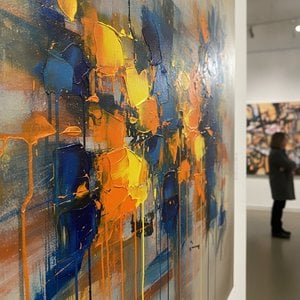
Master the high-impact world of contemporary abstraction. Discover how bold colors, textures, and modern movements like Abstract Expressionism can transform your space with premium, high-energy art curated for the design-conscious professional.

Explore the captivating world of tactile abstraction! Discover impasto techniques, influential artists like Richter & Hoyland, and expert insights for collecting textured art. Elevate your space with museum-quality pieces.

추상표현주의의 심장을 뛰게 한 10대 걸작을 만나보세요. 폴록, 로스코 등 거장의 작품 비하인드 스토리와 예술적 영감을 WahooArt에서! 지금 바로 미술품 컬렉션을 탐험하고, 당신의 공간에 특별한 예술적 감성을 더하세요. WahooArt.com

 실제 크기로 보기
 보내기
보내기 공유하기
공유하기
 상세 보기
상세 보기 가이드 보기

 이미지 다운로드
 유사 작품 더 보기
 X-레이
X-레이 슬라이드 쇼 보기
 통계 정보
통계 정보


 상세 보기
상세 보기






































 유리 옵션은 110cm 미만 크기에서만 선택 가능합니다.


![Abstract Composition [triptych] — Vaclav Vytlacil, Abstract Expressionism](/media/artworks/images-thumb/08/3c/083c0675045645fd42d4e6c6d63f1ced.jpg)

