
빠른 제작과 다양한 마감 옵션을 제공하는 박물관 품질의 지클레이 또는 캔버스 프린트. ( 손으로 그린 그림 구매 디지털 이미지로 전환)





























작품의 원본 비율을 유지하는 미리 설정된 크기 중에서 선택하세요.

특정 프레임이나 공간에 맞춰 직접 치수를 입력하실 수 있습니다. 선택하신 사이즈가 원본 이미지의 비율과 일치하지 않을 경우, 작품을 크롭(자르기)하거나 이미지를 대칭 또는 단색 채우기로 확장하여 제작합니다. 제작 시작 전, 최종 확인을 위해 디지털 목업이 전송됩니다.
화면상의 미리보기는 실제 크롭이나 확장 상태를 반영하지 않으므로, 최종 구도는 오직 목업을 통해서만 정확하게 확인하실 수 있습니다.
맞춤 사이즈 제작도 가능하지만, 원본 비율을 유지하기 위해서는 사전 정의된 목록에서 치수를 선택하시는 것을 권장합니다.

Paul Hamann
복제본 크기
In the quiet, monochromatic realm of Hugo 'Puck' Dachinger’s 1962 drawing, Paul Hamann, we are invited into a private sanctuary of human connection. This piece is far more than a mere sketch; it is a window into a fleeting moment of social repose. The artwork captures three men gathered around a table, their presence defined by the delicate, gestural dance of pencil on paper. There is an undeniable sense of immediacy in the way the lines trace the contours of their figures and the subtle suggestion of formal attire, such as ties, which hints at a structured setting now softened by the casual intimacy of their interaction. The composition, viewed from a slightly elevated perspective, draws the observer into the circle, making us feel less like distant spectators and more like silent participants in this quiet conversation.
The technical mastery of Dachinger lies in his ability to evoke depth and atmosphere through the economy of line. Eschewing heavy shading or complex gradients, the artist utilizes a varying density of thin, sketchy strokes to create a rhythmic visual texture. Where lines cluster, shadows emerge, grounding the figures within the space; where they disperse, light seems to breathe through the paper. This expressionistic approach prioritizes the essence of the scene over photographic realism, capturing the very energy of the gathering. The lack of a vibrant color palette allows the viewer to focus entirely on the interplay of form and the structural elegance of the composition, making it a piece that celebrates the raw, unadorned beauty of graphic observation.
Historically and emotionally, Paul Hamann resonates with a profound sense of shared experience. Created in the post-war era, the work carries an underlying weight of quietude—a reflection of a world finding its footing through simple, human connections. The subject matter, while seemingly mundane, evokes a poignant atmosphere of camaraderie and shared history. For the discerning collector or interior designer, this reproduction offers a sophisticated touch of understated elegance. Its minimalist aesthetic and monochrome palette make it an ideal centerpiece for modern, minimalist, or classic interiors, providing a focal point that invites contemplation without overwhelming the surrounding space. It is a testament to the power of the sketch to capture the soul of a moment, offering a timeless piece of art that speaks of peace, presence, and the enduring strength of companionship.

Born in Moscow in December 1866, Wassily Kandinsky’s life and artistic journey represent a pivotal moment in the history of art – the birth of abstraction. Initially pursuing law and economics, a profound shift occurred when, at the age of thirty, he began to dedicate himself to painting, driven by an intense fascination with color and its evocative power. This nascent passion would ultimately lead him away from traditional representation and towards a radically new visual language.
Kandinsky’s early influences were diverse, encompassing Russian folklore, Byzantine icons, and the works of Vincent van Gogh – particularly his expressive use of color. He studied at the Moscow School of Painting, Sculpture, and Architecture, but found himself increasingly dissatisfied with academic constraints. A pivotal trip to Munich in 1896 marked a turning point, exposing him to Impressionism and Post-Impressionism, further fueling his desire for artistic liberation. It was here that he met Gabriele Münter, who would become not only his lifelong partner but also a crucial collaborator and confidante throughout his career.
The early 1900s witnessed Kandinsky’s rapid experimentation with color theory and form. He meticulously documented his evolving ideas in notebooks filled with sketches, diagrams, and philosophical reflections on the relationship between art and emotion. These writings, particularly “Concerning the Spiritual in Art” (1911), articulate his belief that color and form could directly communicate spiritual truths, bypassing the need for literal depiction. This theoretical framework underpinned his increasingly abstract compositions, moving beyond mere representation to explore pure sensation and inner experience.
Kandinsky’s artistic development was inextricably linked to the “Blue Rider” (Die Brücke) group, a collective of avant-garde artists based in Munich. Founded in 1908, this group sought to challenge established conventions and explore new modes of expression. Kandinsky, along with Mikhail Larionov and Franz Marc, played a central role in shaping the Blue Rider’s aesthetic – characterized by bold colors, simplified forms, and a focus on emotional intensity. The group's name derives from Marc’s painting “The Blue Horse,” reflecting their shared interest in exploring the spiritual dimension of color.
During this period, Kandinsky produced works like "Composition VII" (1913) and "Improvisation 28" (1912), which demonstrate his growing commitment to abstraction. These paintings are not merely devoid of recognizable objects; they are dynamic arrangements of shapes and colors designed to evoke specific emotional responses in the viewer. The use of overlapping planes, rhythmic lines, and vibrant hues creates a sense of movement and energy, reflecting Kandinsky’s belief that art could directly affect the soul.
Following World War I, Kandinsky relocated to Russia, where he played a significant role in establishing the Institute for Art History and later served as director of the Moscow Museum of Fine Arts. He continued to develop his abstract style, exploring new techniques and approaches. During this period, he experimented with geometric abstraction, influenced by Cubism but ultimately forging his own unique path.
In 1922, Kandinsky returned to Germany, joining the Bauhaus school in Weimar, a revolutionary institution dedicated to integrating art, craft, and technology. At the Bauhaus, he taught principles of color theory and design, influencing a new generation of artists. However, the rise of Nazism forced him to flee Germany again, eventually settling in France in 1933. During his time in Paris, he continued to paint, producing works that reflected both his earlier abstract explorations and his growing interest in spirituality.
Wassily Kandinsky’s legacy is immense. He is widely considered one of the founding fathers of abstract art, paving the way for countless artists who followed. His theoretical writings on color and form profoundly influenced the development of modern art movements such as Expressionism, Surrealism, and Abstract Expressionism. His emphasis on the spiritual dimension of art continues to resonate with artists and viewers today.
Kandinsky’s work is exhibited in major museums around the world, including the Guggenheim Museum in New York, the Centre Pompidou in Paris, and the State Russian Museum in St. Petersburg. His paintings are not simply visual objects; they are invitations to a deeper understanding of ourselves and the world around us – a testament to the power of art to transcend the limitations of representation and speak directly to the soul.

1908 - 1995 , Austria
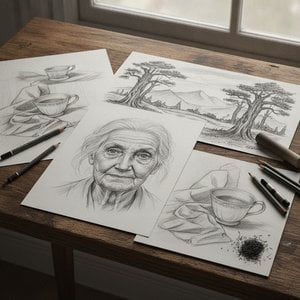
Explore the profound elegance of pencil and charcoal sketching. Discover how masters use line, shadow, and chiaroscuro to capture light and texture, bridging the gap between preparatory studies and timeless fine art masterpieces.

Explore the profound beauty of the sketch. Discover how masters use charcoal and graphite to capture raw emotion, anatomical precision, and fluid movement, bridging the gap between ephemeral marks and eternal oil masterpieces.

Discover the sophisticated mastery of graphite drawing. Explore expert techniques for achieving profound depth, intricate texture, and hyper-realistic detail through the alchemy of carbon, curated for the discerning art enthusiast and professional collector.

Explore the profound artistry of graphite drawing. Discover professional techniques for mastering depth, texture, and detail through a lens of art history, from classical sketches to modern masterpieces. Elevate your understanding of the pencil medium with our expert guide.

Elevate your artistic practice with this expert guide to mastering the line. Discover advanced techniques in graphite, charcoal, and contour drawing designed for art students seeking technical precision and expressive depth in their fine art studies.


 미리보기
미리보기
 공유하기
공유하기 공유하기
공유하기
 상세 정보
상세 정보 Guide
Guide

 다운로드
다운로드
 유사 작품
유사 작품 X-레이
X-레이 슬라이드 쇼
 통계 정보
통계 정보


 더 보기
더 보기









 유리 옵션은 110cm 미만 크기에서만 선택 가능합니다.


