

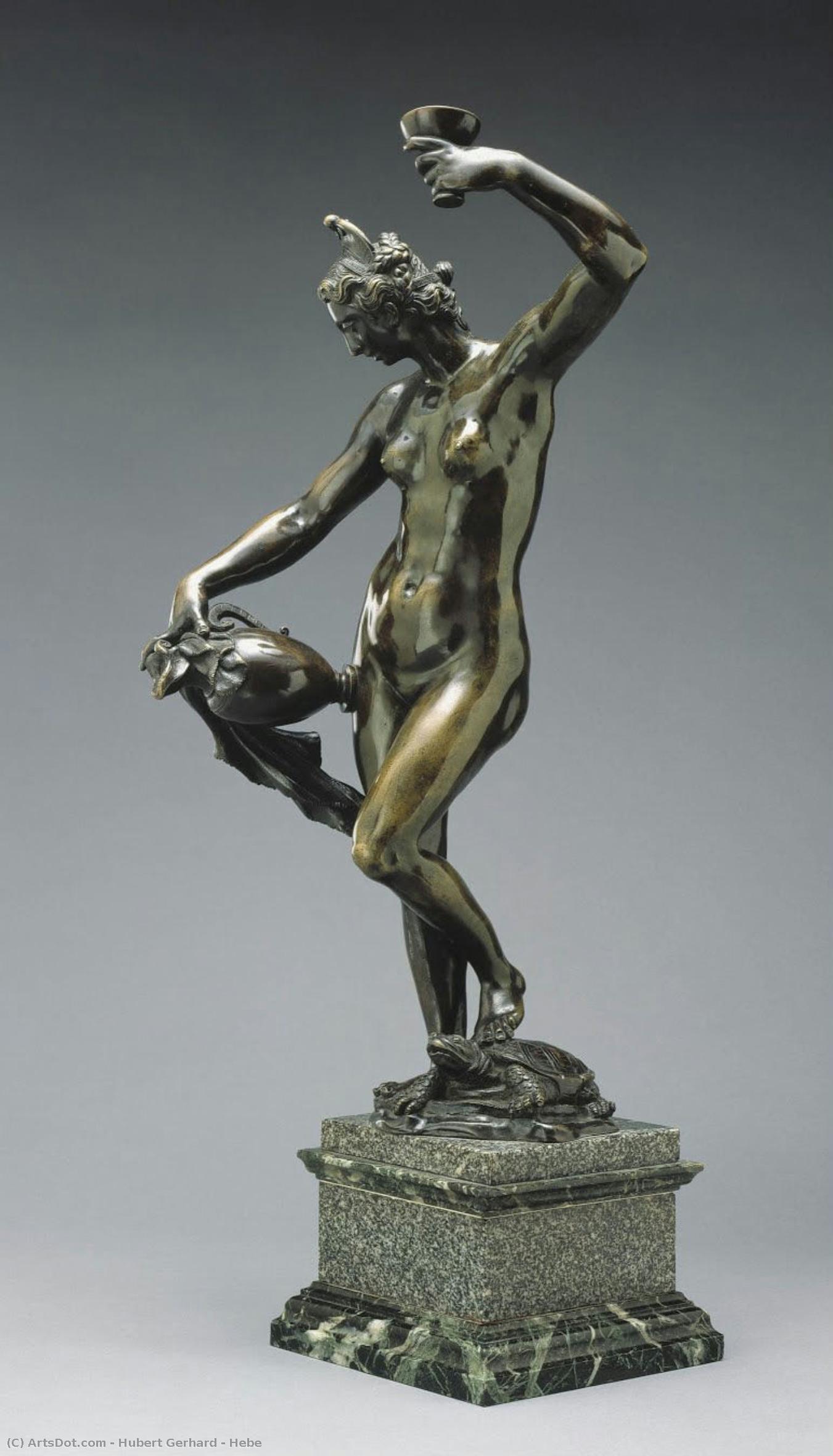
 31.0 x 62.0 cm
 디트로이트 미술관
작품의 원본 비율을 유지하는 미리 설정된 크기 중에서 선택하세요.

특정 프레임이나 공간에 맞춰 직접 치수를 입력하실 수 있습니다. 선택하신 사이즈가 원본 이미지의 비율과 일치하지 않을 경우, 작품을 크롭(자르기)하거나 이미지를 대칭 또는 단색 채우기로 확장하여 제작합니다. 제작 시작 전, 최종 확인을 위해 디지털 목업이 전송됩니다.
화면상의 미리보기는 실제 크롭이나 확장 상태를 반영하지 않으므로, 최종 구도는 오직 목업을 통해서만 정확하게 확인하실 수 있습니다.
맞춤 사이즈 제작도 가능하지만, 원본 비율을 유지하기 위해서는 사전 정의된 목록에서 치수를 선택하시는 것을 권장합니다.

Hebe
복제본 크기

In the swirling currents of the late sixteenth century, a period defined by both profound religious upheaval and a vibrant intellectual rebirth, the sculptor Hubert Gerhard emerged as a master of form and metal. Born around 1545 in Den Bosch, Netherlands, Gerhard’s life was shaped by the turbulent winds of the Reformation, yet his artistic spirit found its true north in the sophisticated workshops of Italy. His journey from the Low Countries to the heart of Europe represents more than just a personal migration; it reflects the broader movement of Northern Mannerism, where the technical precision of the North met the dramatic, elongated elegance of the Italian Renaissance.
The defining chapter of Gerhard’s formative years was undoubtedly his time in Florence. There, he entered the orbit of the legendary Giambologna, a master whose influence acted as the cornerstone of Gerhard's sculptural language. Under this tutelage, Gerhard moved beyond mere anatomical representation to embrace the complexities of Mannerist aesthetics. He learned to manipulate bronze not just as a rigid medium, but as a fluid substance capable of capturing psychological tension, spiraling movement, and the delicate play of light across expressive drapery. This training instilled in him a lifelong devotion to the figura serpentinata—the serpentine pose that breathes life and dynamic energy into static metal.
As Gerhard’s reputation ascended, so too did the scale of his ambitions. His career was marked by a remarkable ability to secure the favor of Europe's most powerful dynasties, moving between the commercial hubs of Augsburg and the ducal courts of Munich. Around 1580, the legendary Fugger banking family in Augsburg provided the essential patronage that allowed Gerhard to realize some of his most enduring civic contributions. His work on the Augustus Fountain stands as a testament to this era of grandeur. In collaboration with architects, he breathed life into the city's landscape through colossal bronze figures representing the mighty rivers: the Rhine, Danube, Lech, and Isar.
These monumental works were far more than mere decorations; they were profound statements of civic identity and humanistic pride. Through these river gods, Gerhard utilized the language of classical mythology to celebrate the natural abundance and political stability of the region. His mastery of bronze casting allowed him to achieve a level of detail that made the heavy metal appear almost weightless, capturing the muscularity of the deities alongside the subtle ripples of water, effectively bridging the gap between the earthly and the divine.
In 1584, Gerhard relocated to Munich, a move that would define his later years and cement his status within the Habsburg sphere of influence. Under the patronage of Wilhelm V, Duke of Bavaria, Gerhard found a fertile environment for exploring mythological and allegorical themes. His work in Munich reached a pinnacle of sophistication, characterized by an intimate command over smaller-scale bronzes that possessed as much emotional gravity as his larger public monuments. Works such as Hebe, Venus and Mars with Cupid, and various allegories of Bavarian strength showcase his ability to weave complex narratives into singular, captivating figures.
The significance of Gerhard’s oeuvre lies in its seamless synthesis of diverse cultural currents. He was an artist who could navigate the transition from the intense, often unsettling energy of Mannerism to the more balanced, majestic requirements of late Renaissance classicism. His legacy is etched into the very fabric of European cities, preserved in the enduring luster of his bronze masterpieces. Even centuries later, the works of Hubert Gerhard continue to command respect, serving as a window into an era where sculpture was used to capture the eternal dance between myth, power, and the human soul.

1545 - 1620 , Netherlands


최신 미술 뉴스, 특별 혜택 및 인테리어 아이디어를 가장 먼저 만나보세요.
프로젝트에 대해 알려주시면 저희 미술 전문가들이 맞춤형 아트 제안 3가지를 전달해 드립니다.
당신만을 위한 맞춤형 옵션 3가지를 무료로 추천해 드립니다!


 Preview
 작품 구매하기
 공유하기
공유하기 공유하기
공유하기
 상세 정보
상세 정보

 다운로드
다운로드
 유사 작품
유사 작품 X-레이
X-레이 슬라이드 쇼
 더 보기
더 보기






































 유리 옵션은 110cm 미만 크기에서만 선택 가능합니다.


