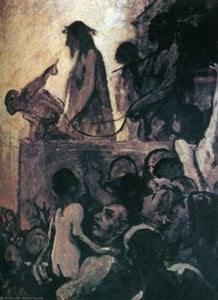
A Tableau of Displacement and Human Resilience
In the somber, monochromatic depths of Honoré Daumier’s “The Emigrants,” we are not merely observers of a sculpture, but witnesses to a profound human tragedy. Created around 1850, this evocative work—rendered in tinted grey plaster—serves as a haunting meditation on the psychological and physical toll of political upheaval. The figures, huddled together in an uncertain outdoor space, embody the very essence of exile. Daumier masterfully captures a spectrum of motion and emotion; some subjects slump under the crushing weight of despair, their bodies surrendered to hopelessness, while others maintain a rigid, upright posture, a silent testament to the dignity one clings to when all else is lost. The composition functions as a dynamic tableau, where the subtle interaction between the figures suggests a shared, collective journey through the shadows of displacement.
The power of this piece lies in its ability to transform a moment of stillness into a narrative of movement and struggle. As one gazes upon the textured folds of their clothing and the weary contours of their limbs, there is an undeniable sense of weight—both literal and metaphorical. For the discerning collector or interior designer, "The Emigrants" offers more than just a visual focal point; it provides a profound emotional anchor. It is a work that invites contemplation, making it an ideal centerpiece for spaces designed for reflection, such as a private study, a sophisticated library, or a gallery-style living area where art is intended to provoke thought and conversation.
The Mastery of Realism and Sculptural Depth
Daumier’s technical execution in "The Emigrants" reveals his deep roots in classical influences, particularly the dramatic chiaroscuro reminiscent of Rubens. However, he eschews the idealized beauty of antiquity in favor of a piercing, unvarnished realism. The use of plaster, tinted with a muted grey, allows for a masterful play of light and shadow that emphasizes the three-dimensional anatomy of each figure. Every crease in the fabric and every slumped shoulder is rendered with meticulous detail, imbuing the sculpture with a palpable sense of life and vulnerability.
This commitment to anatomical accuracy and psychological nuance is what elevates the work from mere caricature to high art. Daumier does not shy away from the "unpolished" truths of the human condition; instead, he uses his sculptural prowess to highlight the textures of suffering and the resilience of the spirit. The monochromatic palette ensures that the viewer is not distracted by color, but is instead drawn into the raw, emotional landscape of the subjects. For those seeking a high-quality reproduction, this piece offers an unparalleled opportunity to bring the gravitas of 19th-century French Realism into a contemporary setting, adding a layer of historical depth and intellectual sophistication to any curated collection.
질의응답
The Emigrants은(는) 오노레 도미에의 예술적 여정 중 어느 시기의 작품인가요?
오노레 도미에의 작품 세계에서 "The Emigrants"은(는) Mature Period 시기의 작품입니다. 이 시기는 작가의 다른 작품들과 비교해 보는 데 유용한 지표가 됩니다.
오노레 도미에의 "The Emigrants"에는 어떤 기법이 사용되었나요?
오노레 도미에의 "The Emigrants"의 재료는 Plaster입니다. 복제화는 이 기법 특유의 질감을 그대로 구현하는 것을 목표로 합니다.
"The Emigrants"은 어떤 종류의 작품인가요?
카탈로그에서 오노레 도미에의 "The Emigrants"은(는) Sculpture로 분류되어 있습니다. 이 카테고리를 통해 유사한 작품들을 찾아보실 수 있습니다.