A Fauvist Symphony: Exploring Matisse’s Revolutionary Still Life (1663)
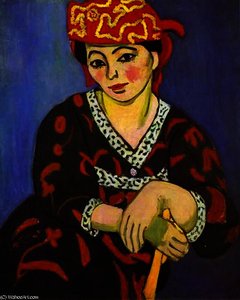
This captivating artwork bursts forth as a prime example of early 20th-century artistic innovation – specifically, the exhilarating style known as Fauvism (“wild beasts” in French). While its precise date remains unknown, stylistic cues firmly place it within Henri Matisse’s period of bold experimentation with color and form. It's not merely a depiction of everyday objects; it is an *experience* of them, electrified by unconventional hues and a dynamic composition.
Subject & Composition: Domesticity Transformed
The painting presents a classic still life – flowers in a vase, fruit, glassware, a book, and a chair – yet Matisse elevates these familiar elements into something extraordinary. A generously sized vase, brimming with intensely red blossoms, immediately commands attention, anchoring the composition. This vibrant focal point is beautifully contrasted against a backdrop of patterned wallpaper adorned with green leaves and delicate pink flowers, creating layers of visual depth. The arrangement isn’t about photographic realism; it's a carefully orchestrated interplay of color and shape designed to evoke feeling. A dark blue vase and a bowl containing an orange introduce further chromatic tension, while the inclusion of a partially open book and yellow chair subtly hint at quiet contemplation within a lived-in space.
Fauvist Technique: Color as Pure Expression
Matisse’s technique is central to the artwork's power. He deliberately abandons traditional modeling and shading, opting instead for flat planes of intense, often arbitrary color. The brushstrokes are loose and visible, contributing to a sense of immediacy and energy. This isn’t about *representing* color accurately; it’s about using color as an expressive force – to evoke emotion and create a purely visual experience. Notice the thick impasto application of paint, which adds texture and physicality to the surface. The deliberate simplification of forms—circles, rectangles, ovals—further emphasizes the decorative quality of the work, moving away from representational accuracy towards abstraction.
Historical Context: Breaking Boundaries in Modern Art
Henri Matisse (1869-1954) was a pivotal figure in the development of modern art. Initially trained in traditional academic painting, he began to question conventional norms in the early 20th century. Alongside artists like André Derain and Maurice de Vlaminck, he spearheaded the Fauvist movement, shocking audiences with their bold use of color and rejection of naturalistic representation. This period marked a significant break from Impressionism and Post-Impressionism, paving the way for further experimentation in abstract art. Matisse challenged viewers to see the world anew – not as it *is*, but as it *feels*.
His influence continues to resonate with artists today.
Symbolism & Emotional Resonance: A Celebration of Simple Joys
While seemingly straightforward, this still life carries subtle symbolic weight. The flowers represent beauty and vitality, while the book suggests intellectual pursuits and inner reflection. The arrangement as a whole evokes a sense of peaceful domesticity – a quiet moment of joy found in simple pleasures. The flattened perspective and lack of deep shadows contribute to an overall feeling of serenity and intimacy. It’s not a dramatic or overtly emotional scene; rather, it's a subtle celebration of life’s everyday beauty.
It is a testament to Matisse’s ability to find profound meaning in the mundane.
For Collectors & Designers: Timeless Appeal
This artwork – or a high-quality reproduction thereof – would be a stunning addition to any collection. Its bold colors and dynamic composition make it a focal point in a modern interior, while its underlying sense of tranquility lends itself well to bedrooms or living spaces. The piece’s enduring appeal lies in Matisse's ability to capture the essence of joy and beauty through pure visual expression – a quality that continues to resonate with audiences today.
- Style: Fauvism, Modern Art
- Key Features: Bold colors, simplified forms, loose brushstrokes, flat planes.
- Ideal For: Modern interiors, collectors seeking iconic works, spaces desiring a touch of vibrancy and serenity.
It is a powerful example of the Fauvist revolution and a lasting tribute to Matisse’s mastery of color and form.



 미리보기
미리보기
 손으로 그린 그림 구매
 공유하기
공유하기 공유하기
공유하기
 상세 정보
상세 정보

 다운로드
다운로드
 유사 작품
유사 작품 X-레이
X-레이 슬라이드 쇼

 더 보기
더 보기






































 유리 옵션은 110cm 미만 크기에서만 선택 가능합니다.