
x


 Ink On PaperExpressionism
 1922Modern
 26.0 x 34.0 cm
 Arnold Schönberg Center
빠른 제작과 다양한 마감 옵션을 제공하는 박물관 품질의 지클레이 또는 캔버스 프린트. ( 손으로 그린 그림 구매 이미지 구매)





























작품의 원본 비율을 유지하는 미리 설정된 크기 중에서 선택하세요.

특정 프레임이나 공간에 맞춰 직접 치수를 입력하실 수 있습니다. 선택하신 사이즈가 원본 이미지의 비율과 일치하지 않을 경우, 작품을 크롭(자르기)하거나 이미지를 대칭 또는 단색 채우기로 확장하여 제작합니다. 제작 시작 전, 최종 확인을 위해 디지털 목업이 전송됩니다.
화면상의 미리보기는 실제 크롭이나 확장 상태를 반영하지 않으므로, 최종 구도는 오직 목업을 통해서만 정확하게 확인하실 수 있습니다.
맞춤 사이즈 제작도 가능하지만, 원본 비율을 유지하기 위해서는 사전 정의된 목록에서 치수를 선택하시는 것을 권장합니다.

Erhebt euch, Freunde, op. 2/4
복제본 크기
In the delicate, aged fibers of the musical score Erhebt euch, Freunde, op. 2/4, one finds more than mere notation; one encounters a profound dialogue between two titans of twentieth-century modernism. Created in the winter of 1922, this piece serves as a poignant intersection where the lyrical text of Klabund meets the burgeoning musical language of Hanns Eisler. The visual presentation of the score—rendered on paper that has mellowed into a warm, nostalgic tan—evokes the atmosphere of a lost era of European intellectualism. As the eye wanders across the dense, vertical arrangement of black ink, it encounters a rhythmic landscape of clefs, rests, and notes that pulse with the quiet intensity of a composer finding his voice amidst the political and social tremors of post-war Germany.
The aesthetic of this work is defined by its structural elegance and the raw, tactile quality of its medium. The composition is dominated by the meticulous geometry of the musical staff, where every horizontal line acts as a stage for the circular dance of notes. There is a striking contrast between the stark, black precision of the engraving and the organic, weathered texture of the parchment. This interplay creates a sense of depth that belies its two-dimensional nature, inviting the viewer to feel the weight of history held within each measure. The lighting, soft and diffused as if captured in a quiet study, highlights the slight wrinkles and imperfections of the aged paper, lending the piece an authentic, archival soul that resonates with those who appreciate the beauty of antiquity.
To understand this work is to understand the tension between tradition and revolution. During this period, the musical world was grappling with the radical shifts introduced by figures like Arnold Schönberg, whom Eisler famously defended as a true master rather than a mere destroyer of convention. The score itself embodies this duality; while it utilizes the established language of musical notation, the very existence of such a piece in 1922 speaks to a period of intense creative reconfiguration. The symbols on the page are not merely instructions for performance but are artifacts of a movement seeking to create a new material for music—one that could achieve the unity of the classics while embracing the complexities of the modern psyche.
For the discerning collector or interior designer, Erhebt euch, Freunde offers a sophisticated focal point that transcends simple decoration. It brings an air of academic prestige and contemplative calm to any space, whether it be a private library, a contemporary studio, or a refined living area. The piece does not demand attention through loud colors or aggressive forms; instead, it commands respect through its subtle complexity and historical gravity. As a high-quality reproduction, it serves as a window into the heart of the twentieth century, offering an emotional connection to the era of profound musical evolution and providing a timeless element of intellectual elegance to any curated environment.


1898 - 1962 , Germany
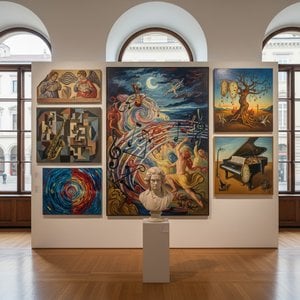
Explore the fascinating history of music's visual representation in art! From ancient symbolism to modern abstraction, discover how artists have captured sound and emotion on canvas. Expert insights & stunning examples.

Explore the captivating world of Mikalojus Konstantinas Čiurlionis, a pioneer of abstract art. Discover his unique blend of music and painting, spiritual themes, and lasting influence on Lithuanian culture. Learn more at WahooArt.
베니스 비엔날레 최고 명작 25선을 만나보세요. 유명 화가들의 숨겨진 이야기와 추상화, 모던 아트 등 예술 작품의 깊이를 탐구합니다. WahooArt에서 고품질 미술 컬렉션을 감상하고 특별한 인테리어를 완성하세요! 지금 바로 온라인으로 둘러보기.


최신 미술 뉴스, 특별 혜택 및 인테리어 아이디어를 가장 먼저 만나보세요.
프로젝트에 대해 알려주시면 저희 미술 전문가들이 맞춤형 아트 제안 3가지를 전달해 드립니다.
당신만을 위한 맞춤형 옵션 3가지를 무료로 추천해 드립니다!


 미리보기
미리보기
 공유하기
공유하기 공유하기
공유하기
 상세 정보
상세 정보

 다운로드
다운로드
 유사 작품
유사 작품 X-레이
X-레이 슬라이드 쇼
 더 보기
더 보기









 유리 옵션은 110cm 미만 크기에서만 선택 가능합니다.


