
빠른 제작과 다양한 마감 옵션을 제공하는 박물관 품질의 지클레이 또는 캔버스 프린트. ( 손으로 그린 그림 구매 디지털 이미지로 전환)





























작품의 원본 비율을 유지하는 미리 설정된 크기 중에서 선택하세요.

특정 프레임이나 공간에 맞춰 직접 치수를 입력하실 수 있습니다. 선택하신 사이즈가 원본 이미지의 비율과 일치하지 않을 경우, 작품을 크롭(자르기)하거나 이미지를 대칭 또는 단색 채우기로 확장하여 제작합니다. 제작 시작 전, 최종 확인을 위해 디지털 목업이 전송됩니다.
화면상의 미리보기는 실제 크롭이나 확장 상태를 반영하지 않으므로, 최종 구도는 오직 목업을 통해서만 정확하게 확인하실 수 있습니다.
맞춤 사이즈 제작도 가능하지만, 원본 비율을 유지하기 위해서는 사전 정의된 목록에서 치수를 선택하시는 것을 권장합니다.

꽃 정물
복제본 크기
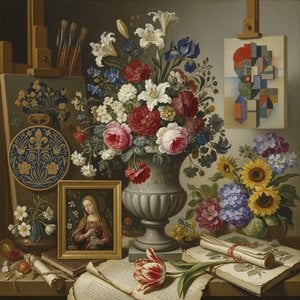
Gustave Courbet's Flower Still-Life, painted in 1863 and now residing within the hallowed halls of The Hermitage Museum in St. Petersburg, isn’t merely a depiction of flowers; it's a carefully constructed statement about art itself, a defiant rejection of Romantic idealism, and a profound exploration of everyday beauty. Courbet, a pivotal figure in the Realist movement, deliberately chose this humble subject – a vase brimming with roses, daisies, and orchids – to challenge the prevailing artistic norms of his time. He sought to capture the world as he *saw* it, unvarnished by sentimentality or idealized forms, a radical proposition that would reverberate throughout the art world for decades to come.
The painting’s genesis lies in Courbet's own studio in Ornans, France. He meticulously observed and rendered the arrangement of flowers, paying close attention to their textures, colors, and the way light played upon them. This dedication to accuracy is evident in every detail – from the delicate veins of the rose petals to the subtle shadows cast by the leaves. It’s a testament to Courbet's belief that true art should be rooted in direct observation and honest representation, rather than imaginative invention.
Measuring 65 x 54 cm, Flower Still-Life is a masterclass in compositional balance and the manipulation of light. The central vase, overflowing with an assortment of blooms – vibrant reds, cheerful yellows, and delicate purples – immediately draws the viewer’s eye. Courbet skillfully employs chiaroscuro, a technique borrowed from Renaissance masters like Caravaggio, to create dramatic contrasts between light and shadow. This isn't simply about creating visual interest; it’s about imbuing the flowers with volume and presence, making them appear almost tangible. The arrangement is further enhanced by the surrounding foliage, which adds depth and complexity to the scene, while the strategically placed smaller vases and bowl contribute to a sense of spatial layering.
The use of color is equally deliberate. Courbet avoids overly bright or artificial hues, opting instead for muted tones that evoke the natural beauty of the flowers themselves. The subtle gradations of color create a harmonious effect, while the careful placement of each bloom contributes to the overall sense of balance and order.
Courbet’s work stands as a crucial link between Romanticism and Impressionism. While he rejected the idealized forms and emotional intensity of Romantic art, he also moved away from the rigid academic conventions that dominated the 19th century. His focus on everyday subjects – flowers, still lifes, landscapes – paved the way for later artists who sought to capture the fleeting moments of modern life. Notably, Courbet’s emphasis on direct observation and his willingness to depict ordinary people resonated with Paul Cézanne, another influential artist of the period, whose work explored the underlying structure of objects and the use of planes of color—a lineage that ultimately led to Cubism.
Furthermore, the proto-Cubist experimentation occurring around 1906-1910, with artists like Braque and Picasso, can be seen as a direct consequence of Courbet’s pioneering approach. The fragmentation of forms and reduction of color in these early Cubist works mirrored Courbet's own desire to break free from traditional artistic conventions and represent the world in a more immediate and truthful way.
Gustave Courbet’s Flower Still-Life remains a powerful testament to his commitment to Realism and his enduring influence on the art world. It’s more than just a pretty picture; it's a profound meditation on beauty, observation, and the role of the artist in society. For those seeking to delve deeper into Courbet’s work or explore the broader context of 19th-century art movements, we encourage you to visit /art/list/?Filter=8Y3593-Gustave-Courbet-Flower-Still-Life and /art/list/?Filter=A@D3BNJ5-El-Museo-Far-de-Khabarovsk-Rusia. Further exploration can be found on Wikipedia: https://en.wikipedia.org/wiki/Paul_C%C3%A9zanne and https://en.wikipedia.org/wiki/Proto-Cubism.


1819 - 1877 , 프랑스
Explore the rich history of flower symbolism in Western painting! Discover how artists from the Renaissance to Modernism used blossoms to convey meaning, emotion & beauty. Learn about iconic artworks and movements.

현실을 충실히 담아낸 리얼리즘 명작 10선! 쿠르베, 밀레 등 거장의 작품으로 미술사의 흐름을 만나보세요. 와후아트에서 고품질 예술 작품과 인테리어 영감을 얻고, 당신의 공간에 예술적 감성을 더하세요. 지금 바로 와후아트에서 모든 명작을 발견해보세요!

Explore 10 defining masterpieces of Romantic Realism! Discover Courbet, Millet & Daumier's powerful paintings—capturing emotion and social realities. Find museum-quality reproductions for your home at WahooArt.com.

Explore 10 iconic realism artworks by Courbet, Millet & more! Discover the stories behind these masterpieces of 19th-century painting. Find museum-quality art reproductions and elevate your home decor with WahooArt.com.

Explore the revolutionary art of Gustave Courbet, pioneer of Realism. Discover his iconic paintings, social commentary, and lasting impact on 19th-century French art history. Expert analysis & insights.


 미리보기
미리보기
 공유하기
공유하기 공유하기
공유하기
 상세 정보
상세 정보 Guide
Guide

 다운로드
다운로드
 유사 작품
유사 작품 X-레이
X-레이 슬라이드 쇼
 통계 정보
통계 정보


 더 보기
더 보기









 유리 옵션은 110cm 미만 크기에서만 선택 가능합니다.


