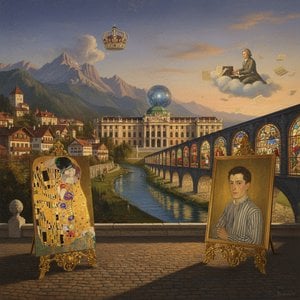
A Vision in Gold Leaf – Decoding Klimt's Masterpiece
Gustav Klimt’s *Untitled (3791)* stands as a cornerstone of Viennese Symbolism and Art Nouveau, embodying the movement’s fascination with opulent ornamentation and psychological depth. Painted between 1907 and 1908 during Klimt’s “Golden Phase,” this artwork transcends mere visual representation; it's an invitation into a realm where tactile richness intertwines with profound emotional resonance. The painting depicts a woman seated in repose, enveloped by swirling patterns of gold leaf – a technique pioneered by Klimt himself – that dominate the canvas and create an atmosphere of ethereal beauty. This deliberate use of gold isn’t simply decorative; it symbolizes fertility, divinity, and spiritual transformation—themes central to Symbolist thought and reflecting Klimt's exploration of feminine sexuality within a framework of mythological allusion.
Technique & Materiality: The Alchemy of Gold
Klimt’s mastery lay not only in his compositional vision but also in his unparalleled command of artistic technique. He employed a cloisonné enamel method, painstakingly layering thin sheets of gold leaf onto a substrate of canvas primed with gesso. This process demanded immense patience and precision, resulting in surfaces that shimmer with an otherworldly luminescence. The intricate geometric patterns surrounding the woman are juxtaposed against organic forms—the scarf draped around her head—creating a dynamic tension that underscores Klimt’s stylistic ambition. Furthermore, the artist meticulously blended oil paints with resin to achieve remarkable textural depth and luminosity, ensuring that every brushstroke contributes to the overall visual experience.
Historical Context: Vienna Secession & Artistic Rebellion
*Untitled (3791)* emerged from the crucible of the Vienna Secession, a group of artists who vehemently rejected the conservative artistic conventions of their time. Founded in 1897 by Klimt, Emil Schiele, Josef Maria Olbrich and Viktor Münzberger, the Secession challenged academic dogma and championed individualism—values deeply rooted in Symbolist aesthetics. The Secession’s manifesto declared “We demand freedom for art!” rejecting the patronage system and advocating for artistic autonomy. Klimt's work directly confronted societal anxieties surrounding sexuality and gender roles, reflecting the broader intellectual currents of the era – Nietzschean philosophy and Freud’s psychoanalytic theories—which questioned traditional moral frameworks.
Symbolism & Mythological Allusion: The Woman as Divine Feminine
The woman at the center of *Untitled (3791)* is presented with a deliberate ambiguity that invites contemplation. Her gaze directs outwards, suggesting introspection and awareness, while her posture exudes serenity and grace. Surrounding her are stylized floral motifs—likely inspired by Japanese prints—which symbolize rebirth and renewal. The scarf enveloping her head represents protection and femininity, echoing imagery found in ancient mythology where goddesses were often adorned with scarves or shawls. Klimt’s masterful use of symbolism elevates the painting beyond a mere depiction of beauty; it speaks to universal themes of spirituality, desire, and transformation—concepts that resonate powerfully across cultures and epochs.
Emotional Impact: Capturing Inner Radiance
Ultimately, *Untitled (3791)* succeeds in conveying an extraordinary emotional depth. The pervasive gold leaf imbues the scene with a sense of grandeur and mystery, transporting viewers into a realm of dreamlike contemplation. Klimt’s ability to capture inner radiance—the subtle nuances of emotion conveyed through gesture and expression—is remarkable. It's a portrait not just of a woman but of an idealized feminine spirit—a testament to Klimt’s enduring legacy as one of the most influential artists of his generation. The painting continues to captivate audiences today, reminding us that art possesses the power to illuminate the human condition and inspire profound reflection.
질의응답
클림트의 "untitled (3791)"은 어떤 소재와 분위기를 담고 있나요?
클림트의 "untitled (3791)"은(는) Romantic한 분위기 속에서 symbolism, female figure, ornamentation, gold leaf, vienna art, allegory, decorative arts을(를) 묘사합니다. 작품의 주제와 분위기가 어우러져 하나의 완성된 세계를 보여줍니다.
클림트의 "untitled (3791)"의 색채 구성은 어떻게 묘사되어 있나요?
클림트의 "untitled (3791)"의 색채 구성은 Earthy로 요약할 수 있습니다. 이는 작품에 사용된 색상들을 간결하게 표현한 것입니다.
클림트의 "untitled (3791)"은(는) Vienna Secession를 작가의 모국과 어떻게 연결하고 있나요?
"untitled (3791)"은 오스트리아 출신의 클림트가 Vienna Secession 운동의 흐름 속에서 제작한 작품입니다. 작가의 출신 배경은 이 작품을 오스트리아 예술가들이 선보인 Vienna Secession 양식과 연결해 줍니다.