

 OilWallArtRealism
 188319th Century
 17.0 x 22.0 cm
 Nordnorsk Kunstmuseum
작가가 직접 캔버스에 손으로 그린 유화 작품으로, 원하는 크기와 액자로 맞춤 제작해 드립니다. ( 프린트 판매로 전환 디지털 이미지 판매 채널로 전환)





























작품의 원본 비율을 그대로 유지하는 프리셋 사이즈 중에서 선택해 보세요.

특정 프레임이나 공간에 맞춰 원하는 크기를 직접 입력하실 수 있습니다. 선택하신 크기가 원본 이미지의 비율과 일치하지 않을 경우, 작품을 자르거나 추가적인 수작업 요소를 더해 그림을 확장하여 제작합니다. 제작 시작 전, 최종 확인을 위해 디지털 목업을 보내드립니다.
화면상의 미리 보기는 실제 크롭(자르기)이나 확장된 상태를 완벽히 반영하지 않을 수 있습니다. 최종 구도는 오직 목업을 통해서만 정확하게 확인하실 수 있습니다.
맞춤 크기 제작도 가능하지만, 원본의 비율을 그대로 유지하기 위해서는 미리 정의된 목록에서 크기를 선택하시는 것을 권장합니다.

House and Barge
복제본 규격
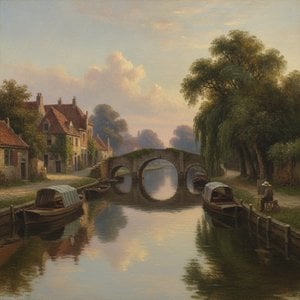
In the quietude of House and Barge, we are invited into a moment of profound stillness, where the rhythmic pulse of nature meets the humble structures of human existence. This exquisite painting by the Norwegian master Gunnar Berg captures a scene that feels both intimate and timeless. A small wooden house, crowned with a rustic thatched roof, sits nestled against the water's edge, surrounded by the lush, verdant embrace of trees. The composition is anchored by the presence of a barge moored at a modest dock, its heavy form resting peacefully upon the surface. As the eye wanders through the frame, two boats drift within the scene—one centrally placed to draw our focus, and another tucked toward the periphery—suggesting a life lived in constant, gentle dialogue with the tides. The inclusion of a solitary figure on the left adds a layer of human narrative, a quiet observer or perhaps a worker tending to the vessel, grounding the landscape in the reality of daily maritime life.
The technique employed here speaks to Berg’s rigorous training in the Düsseldorf school, where he refined his ability to manipulate light and texture to evoke atmosphere. Through delicate brushwork, the artist renders the organic textures of the thatch and the weathered wood of the house with remarkable sensitivity. There is a palpable sense of moisture in the air, a characteristic of Berg’s ability to capture the specific, heavy atmosphere of Northern Europe. The interplay of light across the water and the soft shadows cast by the surrounding foliage create a depth that pulls the viewer into this tranquil, rural setting. For the collector or interior designer, this piece offers more than just a visual subject; it provides a window into a world of pastoral peace, where every stroke contributes to a sense of enduring calm.
To understand the soul of House and Barge, one must look toward the life of its creator. Painted around 1883, during a pivotal period of Berg's education in Germany, the work reflects a sophisticated blend of his Norwegian roots and the academic precision he acquired abroad. While Berg is most famously celebrated for his evocative depictions of the rugged, dramatic landscapes of the Lofoten Islands, this particular piece showcases a more contemplative, perhaps even nostalgic, side of his artistry. It captures a moment of transition—a period when the artist was absorbing the broader European landscape traditions while carrying the spirit of his home in Svolvær within him.
The painting serves as a beautiful testament to the late 19th-century fascination with the romanticized rural life, far removed from the encroaching industrialization of the era. There is a profound emotional impact found in its simplicity; it evokes a sense of nostalgia for a slower, more deliberate way of living. For those seeking to adorn a space with art that inspires reflection and tranquility, this reproduction offers an unparalleled opportunity. It brings into a modern interior the quiet dignity of the past, making it an ideal centerpiece for rooms designed for relaxation, study, or sophisticated contemplation.

In the annals of Norwegian art history, few names evoke the raw, salt-sprayed atmosphere of the Arctic Circle as poignantly as Gunnar Berg. Born on May 21, 1863, on the rugged island of Svinøya in Svolvær, Berg was a child of the Lofoten archipelago. His very existence was intertwined with the rhythmic ebb and flow of the Norwegian Sea and the towering granite peaks that define his native landscape. As the eldest of twelve children born to a prosperous merchant and landowner, Lars Thodal Walnum Berg, and Lovise Johnsen, his early life was steeped in the maritime traditions and mercantile stability of the North. Yet, beneath this structured upbringing lay a burgeoning sensitivity to the dramatic natural world surrounding him—a sensitivity that would eventually lead him away from the counting house and toward the easel.
Berg’s artistic journey was one of disciplined refinement and profound observation. His formal education began at the Trondheim Cathedral School, but his true calling took shape through private instruction under the artist H.J. and later through rigorous academic training in the prestigious Düsseldorf School of Painting. Between 1883 and 1885, Berg immersed himself in the German art scene, studying alongside masters such as Wilhelm Leibl and Anton Faigl. This period was transformative; it provided him with a sophisticated technical vocabulary, particularly in the realms of realism and tonal painting. From these mentors, he learned to use subtle gradations of color and masterful brushwork not merely to replicate reality, but to imbue it with psychological depth and atmospheric weight. He returned to Norway not just as a painter of scenes, but as a chronicler of moods.
The true heart of Berg’s oeuvre lies in his unwavering devotion to the Lofoten Islands. While many of his contemporaries sought to romanticize the North through idealized, sweeping vistas, Berg pursued a more profound truth. He focused his gaze on the everyday realities of the local fishing communities—the grit, the labor, and the quiet resilience required to survive in such an unforant environment. His paintings often feature the iconic elements of the region: the sturdy wooden boats, the weathered docks, and the small, thatched-roof dwellings that cling to the shoreline.
In works such as House and Barge, one can witness his ability to capture a moment of profound stillness. Through delicate brushwork, he renders the organic textures of thatch and wood with such sensitivity that the viewer can almost feel the dampness in the air. Conversely, his more dramatic compositions reflect the tempestuous nature of the North Atlantic. He possessed a rare talent for manipulating light—capturing the ethereal glow of a summer twilight or the heavy, oppressive shadows of an approaching winter storm. This mastery of impasto and tonal variation allowed him to document both the grandeur of the mountains and the humble dignity of the fishermen, creating a visual narrative that is as much about human endurance as it is about landscape.
Though his life was tragically short—ending in Berlin in 1893 at the age of only thirty—Gunnar Berg left behind an indelible mark on Norwegian art. His ability to bridge the gap between the academic precision of the Düsseldorf School and the raw, emotive spirit of Norwegian naturalism helped define a unique national aesthetic. He did not merely paint landscapes; he captured the very soul of a way of life that was being shaped by the relentless forces of nature.
Today, Berg is remembered as a singular figure whose work transcends mere representation. His paintings serve as vital historical documents of a vanishing era of maritime life, preserved through his evocative use of light and texture. The legacy of Gunnar Berg continues to resonate with collectors and art historians alike, offering a window into a world where the boundary between man and the elements is beautifully, and sometimes hauntingly, blurred.

1863 - 1893

Embark on a visual journey through the world's most serene landscapes. Discover curated masterpieces of tranquil beauty, from alpine peaks to monastic stillness, and learn how to bring timeless peace into your home with expert art curation.
Embark on a visual journey through the tranquil beauty of canal scenes in fine art. Discover how master painters capture light, reflection, and serenity through impressionistic landscapes and timeless maritime masterpieces.

Embark on a visual journey through the serene mastery of lake scene landscapes. Explore the profound beauty of Impressionist, Romantic, and Luminist oil paintings, curated for the sophisticated collector seeking timeless tranquility and artistic excellence.

Embark on a visual journey through Claude Monet's most iconic water lily masterpieces. Discover the profound beauty of Impressionism, explore the evolution of Giverny's light, and learn how to bring these serene, museum-quality landscapes into your private collection.

 실제 크기로 보기
 보내기
보내기 공유하기
공유하기
 상세 보기
상세 보기 가이드 보기

 이미지 다운로드
 유사 작품 더 보기
 X-레이
X-레이 슬라이드 쇼 보기
 통계 정보
통계 정보 상세 보기
상세 보기









 유리 옵션은 110cm 미만 크기에서만 선택 가능합니다.


