
x


작품의 원본 비율을 유지하는 미리 설정된 크기 중에서 선택하세요.

특정 프레임이나 공간에 맞도록 직접 크기를 입력할 수 있습니다. 선택하신 크기가 원본 이미지의 비율과 일치하지 않는 경우, 작품을 자르거나 추가적인 손으로 그린 요소를 사용하여 그림을 확장합니다. 제작 시작 전 승인을 위해 디지털 목업을 보내드립니다.
화면 미리 보기는 실제 자르기 또는 확장을 반영하지 않습니다. 최종 구성은 목업을 통해서만 정확하게 확인하실 수 있습니다.
맞춤 크기 제작도 가능하지만, 원본 비율을 유지하기 위해 사전 정의된 목록에서 크기를 선택하시는 것을 권장합니다.

Archangel
복제본 크기

In the vibrant, intellectual atmosphere of fourteenth-century Padua, a transformative artistic voice emerged that would forever alter the trajectory of Venetian painting. Guariento di Arpo (c. 1310–1370) stands as a monumental figure of the Trecento, acting as the essential bridge between the grounded, volumetric realism of Florence and the ethereal, ornamental splendor of the Venetian Gothic tradition. Born into a city flourishing with humanist ideals and Byzantine echoes, Guariento did not merely inherit a style; he synthesized two worlds. His career was defined by an extraordinary ability to marry the structural innovations of the early Renaissance with the decorative grace that would become the hallmark of the Veneto region.
The foundations of Guariento’s genius were laid in the workshops of his contemporaries, where the shadows of masters like Giotto di Bondone and Giovanni Pisano loomed large. From Giotto, Guariento absorbed the revolutionary language of spatial perspective and weight, learning how to imbue figures with a sense of physical presence and psychological depth. Yet, he did not become a mere imitator of the Florentine school. Instead, he infused this new naturalism with a uniquely Venetian sensibility—a penchant for linear elegance and a luminous, almost spiritual abstraction derived from Byzantine influences. This delicate balance allowed his work to possess both a tangible human emotion and a transcendent, heavenly beauty.
Guariento’s most profound contributions to the history of art are etched into the very walls of Padua. His magnum opus remains the breathtaking cycle of frescoes within the choir of the Church of San Bernardino. Commissioned in 1338, these monumental depictions of the life of St. Augustine serve as a masterclass in narrative storytelling. Through these works, one can witness his mastery of volumetric modeling, where figures seem to occupy real space, yet they are draped in a stylistic grace that prevents them from feeling heavy or earthbound. Though much of this cycle was tragically scarred by the bombardments of 1944, the surviving fragments continue to whisper of a lost era of Paduan splendor.
Beyond the expansive reach of his frescoes, Guariento’s skill as a panel painter brought intimacy to the altarpieces of the era. His ability to command precious materials like gold leaf and tempera is evident in several surviving masterpieces held in the world's most prestigious collections:
As his reputation ascended, so too did his influence beyond the borders of Padua. In 1365, the prestige of the Venetian Republic itself beckoned him to the Palazzo Ducale. Tasked with painting a representation of the Coronation of the Virgin, Guariento left an indelible mark on the heart of Venice. In a remarkable twist of art history, his work was only rediscovered in the modern era, hidden beneath the layers of Tintoretto’s later masterpiece, Paradise, during conservation efforts in 1903. This discovery underscored the profound depth of his contribution to the Venetian aesthetic.
Ultimately, the significance of Guariento di Arpo lies in his role as a stylistic pioneer. He was the artist who successfully navigated the transition from the rigid, symbolic forms of the Middle Ages to the more human-centric, three-dimensional reality of the early Renaissance. By weaving together the structural logic of Florence and the decorative lyricism of the Veneto, he provided the blueprint for generations of Venetian painters to follow, ensuring that his name would remain forever entwined with the golden age of Italian art.

1310 - 1370
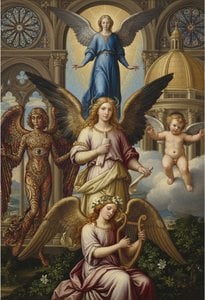
Explore the profound beauty of angelic figures in art history. From Renaissance masterpieces to celestial symbolism, our expert guide offers a sophisticated journey through the divine imagery of the Old Masters for discerning collectors and art enthusiasts.

Embark on a visual journey through Early Medieval art. Explore the profound beauty of illuminated manuscripts, sacred symbols, and golden light through an expert historical lens, celebrating the enduring legacy of medieval craftsmanship and divine artistry.

Embark on a scholarly journey through the sacred beauty of High Medieval art. Discover the profound symbolism, luminous iconography, and spiritual depth of Gothic masterpieces in this expert guide for classical art enthusiasts.


최신 미술 뉴스, 특별 혜택 및 인테리어 아이디어를 가장 먼저 만나보세요.
프로젝트에 대해 알려주시면 저희 미술 전문가들이 맞춤형 아트 제안 3가지를 전달해 드립니다.
당신만을 위한 맞춤형 옵션 3가지를 무료로 추천해 드립니다!


 미리보기
미리보기
 프린트 구매
 공유하기
공유하기 공유하기
공유하기
 상세 정보
상세 정보

 다운로드
다운로드
 유사 작품
유사 작품 X-레이
X-레이 슬라이드 쇼
 더 보기
더 보기






































 유리 옵션은 110cm 미만 크기에서만 선택 가능합니다.


