

 Acrylic On CanvasWallArt
 1754
1754 155.0 x 150.0 cm
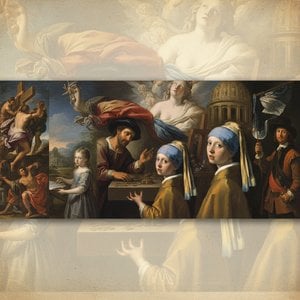
 산 마르코
산 마르코작가가 직접 캔버스에 손으로 그린 유화 작품으로, 원하는 크기와 액자로 맞춤 제작해 드립니다. ( 프린트 판매로 전환 디지털 이미지 판매 채널로 전환)





























작품의 원본 비율을 그대로 유지하는 프리셋 사이즈 중에서 선택해 보세요.

특정 프레임이나 공간에 맞춰 원하는 크기를 직접 입력하실 수 있습니다. 선택하신 크기가 원본 이미지의 비율과 일치하지 않을 경우, 작품을 자르거나 추가적인 수작업 요소를 더해 그림을 확장하여 제작합니다. 제작 시작 전, 최종 확인을 위해 디지털 목업을 보내드립니다.
화면상의 미리 보기는 실제 크롭(자르기)이나 확장된 상태를 완벽히 반영하지 않을 수 있습니다. 최종 구도는 오직 목업을 통해서만 정확하게 확인하실 수 있습니다.
맞춤 크기 제작도 가능하지만, 원본의 비율을 그대로 유지하기 위해서는 미리 정의된 목록에서 크기를 선택하시는 것을 권장합니다.

Charity
복제본 규격
In the luminous, water-bound world of eighteenth-century Venice, few artists captured the profound tension between the earthly and the divine as masterfully as Giuseppe Angeli. Born in 1712, Angeli emerged during a period when the late Baroque style was reaching its most sophisticated and emotive peak. His life’s work serves as a vibrant window into the cultural soul of Venice, bridging the gap between intimate genre scenes of everyday Venetian life and the monumental, sweeping narratives of religious devotion. To study Angeli is to witness the evolution of a painter who could command both the quiet subtlety of a domestic moment and the thunderous grandeur of a celestial vision.
The foundation of Angeli’s brilliance was laid under the watchful eye of Giambattista Piazzetta, one of the most formidable figures in Venetian painting. From his mentor, Angeli inherited a profound understanding of chiaroscroll—the dramatic interplay of light and shadow—and a technique that prioritized emotional resonance over mere decorative flourish. This rigorous training allowed him to navigate the complex guild systems of the era with professional ease. By 1741, his ascent was formalized through his enrollment in the Venetian Academy of Fine Arts, an institution that would later become the stage for his greatest professional triumphs.
Angeli was not merely a practitioner of art but a guardian of its future. His relationship with the Venetian Academy of Fine Arts transitioned from student to leader, a journey marked by deep intellectual commitment. In 1756, he began sharing his mastery through teaching, and by 1772, he had ascended to the prestigious position of President of the Academy. This role placed him at the heart of Venice's artistic evolution, where he shaped the pedagogical standards for a new generation of painters, ensuring that the traditions of the Baroque would endure even as the winds of Neoclassicism began to stir.
His influence extended far beyond the classroom, manifesting in grand architectural interventions that transformed sacred and secular spaces alike. His reputation was cemented by several monumental achievements:
What truly distinguishes Angeli is his remarkable ability to pivot between scales and subjects without losing his stylistic signature. While his religious works, such as St Roch in Glory and Elijah Taken Up in a Chariot of Fire, utilize dramatic movement and biblical grandeur to evoke awe, his smaller-scale works offer a more intimate look at the human condition. In pieces like Lesson in Astronomy, one can sense the intellectual elegance of the era, where the pursuit of scientific knowledge was treated with the same reverence as spiritual enlightenment.
His oeuvre remains a testament to the enduring power of the Venetian school. Whether through the tender personifications found in works like Charity or the sweeping theatricality of his frescoes, Angeli’s art continues to resonate. He remains a pivotal figure whose work captures the twilight of the Baroque era—a period defined by its ability to find the extraordinary within the ordinary and the divine within the human experience.

1712 - 1798 , Italy

바로크 예술의 풍요로운 세계를 탐험하고, 현대 인테리어에 감동을 불어넣는 방법을 WahooArt에서 만나보세요. 카라바조, 렘브란트 등 거장들의 작품과 키아로스쿠로 기법 활용 노하우를 공개합니다.

틴토레토의 드라마틱한 빛과 색채가 살아 숨쉬는 걸작 25선을 만나보세요. 베네치아 회화 거장의 명작 속 역사, 기법, 그리고 영감을 느껴보세요. WahooArt에서 고품질 유화와 아트 프린트를 감상하고 특별한 인테리어를 완성하세요. 지금 바로 컬렉션을 탐험하세요!

Explore the dramatic world of Baroque art! Discover iconic artists like Caravaggio & Rubens, defining techniques, and its lasting impact on art history. Expert insights for collectors & enthusiasts at WahooArt.
화려함과 극적인 표현이 압권! 바로크 미술을 대표하는 10대 걸작의 숨겨진 이야기를 만나보세요. 베르니니, 루벤스 등 거장의 작품부터 바로크 색감, 예술적 기법까지 – WahooArt.com에서 명품 복제 & 인테리어 영감을 얻으세요! 지금 바로 컬렉션을 탐험해보세요.

Explore the dramatic world of Baroque art! Discover iconic masters like Caravaggio & Rembrandt, their techniques, and the movement's lasting impact. Expert insights for collectors & enthusiasts at WahooArt.

 실제 크기로 보기
 보내기
보내기 공유하기
공유하기
 상세 보기
상세 보기 가이드 보기

 이미지 다운로드
 유사 작품 더 보기
 X-레이
X-레이 슬라이드 쇼 보기
 통계 정보
통계 정보 상세 보기
상세 보기









 유리 옵션은 110cm 미만 크기에서만 선택 가능합니다.


