


 Oil On CanvasWallArtPointillist Modernism
 1882Early Medieval
 32.0 x 40.0 cm
 Musee d'Art Moderne de Troyes
빠른 제작과 다양한 마감 옵션을 제공하는 박물관 품질의 지클레이 또는 캔버스 프린트. ( 손으로 그린 그림 구매 이미지 구매)





























작품의 원본 비율을 유지하는 미리 설정된 크기 중에서 선택하세요.

특정 프레임이나 공간에 맞춰 직접 치수를 입력하실 수 있습니다. 선택하신 사이즈가 원본 이미지의 비율과 일치하지 않을 경우, 작품을 크롭(자르기)하거나 이미지를 대칭 또는 단색 채우기로 확장하여 제작합니다. 제작 시작 전, 최종 확인을 위해 디지털 목업이 전송됩니다.
화면상의 미리보기는 실제 크롭이나 확장 상태를 반영하지 않으므로, 최종 구도는 오직 목업을 통해서만 정확하게 확인하실 수 있습니다.
맞춤 사이즈 제작도 가능하지만, 원본 비율을 유지하기 위해서는 사전 정의된 목록에서 치수를 선택하시는 것을 권장합니다.

Suburb
복제본 크기
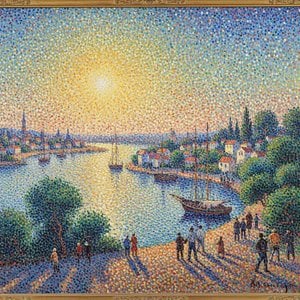
Georges Pierre Seurat's "Suburb," painted in 1882, isn’t merely a depiction of a provincial village; it’s a meticulously constructed meditation on light, color, and the burgeoning industrial landscape of late 19th-century France. This small canvas, measuring just 32 x 40 cm, offers an intimate window into a world undergoing rapid transformation – a world where rural traditions were increasingly intertwined with the rise of factories and urban centers. Seurat, a true pioneer of luminous precision, sought to capture not simply what he *saw*, but how the eye *perceived* that sight, a principle at the heart of his revolutionary technique: Pointillism.
The scene unfolds with remarkable clarity despite its fragmented composition. A prominent factory dominates the background, a stark reminder of industrial progress, yet it’s treated with a delicate, almost hesitant brushstroke – or rather, a deliberate application of tiny dots of color. This is key to understanding Seurat's approach. He wasn’t interested in blending colors directly on the canvas; instead, he built up layers of individual hues, allowing the viewer’s eye to optically mix them and create the illusion of depth, texture, and vibrant light. The village itself is rendered with a similar precision, each building subtly defined by variations in tone and color, creating an almost photographic quality.
Seurat’s obsession with scientific observation profoundly shaped his artistic practice. He meticulously studied the work of Eugène Delacroix, particularly his use of complementary colors to intensify hues and create a sense of luminosity. However, unlike Delacroix’s expressive brushstrokes, Seurat sought to strip painting down to its most fundamental elements: color and light. He believed that by isolating these components and applying them in a systematic manner, he could achieve an unprecedented level of realism – not through imitation, but through the accurate representation of optical phenomena.
The technique itself is deceptively complex. Each individual dot, no larger than a pinhead, was carefully chosen for its hue and placement. Seurat employed a rigorous system, often using a grid to ensure consistent color distribution. This painstaking process demanded immense patience and control, reflecting his intellectual rigor and dedication to achieving optical accuracy. The effect is mesmerizing; the painting seems to shimmer and vibrate with an internal light, as if capturing the very essence of sunlight filtering through the atmosphere.
Beyond its technical brilliance, “Suburb” carries subtle symbolic weight. The presence of the factory, while representing industrial progress, is not presented as overtly celebratory. Instead, it’s depicted with a certain detachment, almost as if observing from a distance. The two horses, one on the left and another closer to the center, could be interpreted as symbols of rural life – perhaps hinting at the inevitable displacement caused by industrialization. The figures scattered throughout the village represent the human element, engaged in everyday activities, suggesting a quiet resilience amidst change.
Furthermore, the composition itself—the careful arrangement of dots and colors—mirrors Seurat’s own methodical approach to life. He was a man driven by logic and reason, seeking order within chaos. “Suburb” can be seen as an embodiment of this philosophy – a carefully constructed tableau that reflects both the beauty and the anxieties of a world in transition. It's a poignant reminder of a fleeting moment captured with extraordinary precision and imbued with a quiet, contemplative power.
WahooArt offers meticulously crafted hand-painted reproductions of Georges Seurat’s “Suburb,” allowing you to bring this iconic work into your home or office. Our skilled artists replicate Seurat's Pointillist technique with the utmost care, ensuring that every dot is faithfully reproduced, capturing the painting’s luminous quality and intricate detail. Whether you are an art enthusiast, a collector, or simply seeking a unique piece of décor, our reproductions provide an authentic and beautiful representation of this remarkable masterpiece. Explore our selection today and experience the enduring allure of Georges Seurat's "Suburb."


1859 - 1891 , 프랑스

Explore the vibrant evolution of Post-Impressionism. From Seurat's revolutionary Pointillism to the emotional depth of masters, discover how this movement redefined modern art history through color, structure, and unparalleled creative expression.

Explore the scientific brilliance of Seurat and Signac. Discover how Pointillism revolutionized color through optical mixing and light, offering a profound look into the Neo-Impressionist movement for true art connoisseurs and collectors.
Discover the mesmerizing world of Pointillism. Explore the revolutionary techniques of Georges Seurat, the science of optical color mixing, and the enduring legacy of Neo-Impressionism in this expert guide for classical art enthusiasts.

Master the nuances of Impressionism vs. Post-Impressionism with our expert guide. Explore the revolutionary shift from Monet’s fleeting light to Van Gogh’s emotional depth. Discover how these iconic movements continue to inspire fine art collectors and modern interiors today.
Embark on a sophisticated journey into the luminous world of Neo-Impressionism. Uncover the scientific brilliance of Pointillism, from Georges Seurat’s revolutionary color theory to the mesmerizing magic of the dot. An expert exploration for true art history enthusiasts.


 미리보기
미리보기
 공유하기
공유하기 공유하기
공유하기
 상세 정보
상세 정보

 다운로드
다운로드
 유사 작품
유사 작품 X-레이
X-레이 슬라이드 쇼
 더 보기
더 보기









 유리 옵션은 110cm 미만 크기에서만 선택 가능합니다.


