

 1880
1880 28.0 x 21.0 cm
빠른 제작과 다양한 마감 옵션을 선택할 수 있는 박물관 수준의 지클레이 및 캔버스 프린트. ( 수작업 채색 복제본 주문하기 디지털 이미지 판매 채널로 전환)
작품의 원본 비율을 그대로 유지하는 프리셋 사이즈 중에서 선택해 보세요.

액자나 벽면 크기에 맞춰 필요한 가로와 세로 길이를 입력해 주세요. 프린트는 원본 이미지보다 크게 제작할 수 없으며 오직 자르는 것만 가능하므로, 비율이 다른 사이즈를 선택할 경우 이미지의 일부가 잘려 나갈 수 있습니다. 인쇄 작업에 들어가기 전, 최종 확인을 위해 디지털 목업을 보내드립니다. 이 페이지에 표시된 이미지는 실제 잘리는 영역을 나타내지 않으며, 오직 목업을 통해서만 정확한 확인이 가능합니다.
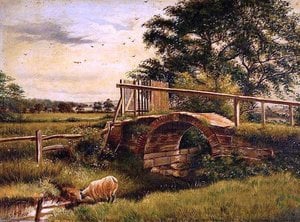
Landscape, Suffolk View
복제본 규격

The work of Frederick Davy, a largely unsung figure of 19th-century American art, offers a poignant glimpse into the rural heartland of the United States – specifically, the rolling hills and quiet landscapes of Suffolk, Maryland, and later, Tennessee. Born in 1832, Davy’s artistic journey unfolded against a backdrop of rapid change and westward expansion, shaping his distinctive style: a serene blend of realism and impressionistic sensitivity that captures the essence of the American countryside with remarkable tranquility. His paintings aren't grand narratives or dramatic scenes; instead, they are intimate portraits of everyday life – farmers tending their fields, families gathered around hearths, and the subtle beauty of nature’s rhythms.
Davy’s early life was deeply rooted in the traditions of East Anglia. Raised in Southwold, Suffolk, he benefited from a familial connection to art through his father, Henry Davy, an artist himself who later became a respected art teacher. This lineage instilled in him not just technical skill but also a profound appreciation for observation and representation. His formal training at the Ipswich School of Science & Art further honed his abilities, culminating in qualifications as an Art Master and Advanced Painting instructor. However, unlike many artists of his era focused on grand historical or mythological subjects, Davy chose to depict the familiar – the landscapes and people he encountered in his immediate surroundings. This deliberate focus speaks volumes about his artistic philosophy: that beauty and significance could be found not in the extraordinary, but in the ordinary moments of life.
Davy’s artistic development can be traced through a series of exhibitions, primarily within Suffolk and Ipswich. His early works, such as “St Stephens Church” and "Portrait of a Lady," showcased a nascent talent for capturing light and atmosphere. A shift towards landscapes is evident in pieces like ‘View of Holy Wells’ and 'Laying the Foundation Stone of the New Corn Exchange, Ipswich,' revealing an increasing interest in depicting the natural world. His later work, including paintings from his time in Wrexham, demonstrates a refined technique and a growing mastery of color and composition. Notably, his painting "Man in a Lane Approaching a House" exemplifies his signature style – a quiet, contemplative scene imbued with a sense of timelessness.
While Davy’s work doesn't immediately align with the grand scale or dramatic narratives of the Hudson River School, it shares a common thread: a deep engagement with American landscapes. Artists like Thomas Cole and Frederic Church sought to capture the spirit of the nation through depictions of its wilderness, and Davy, though working in a more restrained manner, similarly aimed to convey a sense of connection between humanity and nature. However, unlike the Hudson River School’s often idealized vision, Davy's paintings possess a subtle melancholy—a recognition of the passage of time and the fragility of rural life.
Furthermore, Davy’s artistic sensibilities were undoubtedly influenced by the broader currents of 19th-century art. The rise of Impressionism, with its emphasis on capturing fleeting moments of light and color, can be detected in his use of loose brushstrokes and atmospheric effects. The influence of Japanese prints—particularly their focus on composition and tonal values—is also apparent in some of his landscapes. It’s important to note that Davy was not simply imitating these movements; he synthesized them into a uniquely personal style, rooted in his own experiences and observations.
Frederick Davy's life was inextricably linked to the world of art education. Following his training at Ipswich School of Science & Art, he pursued a career as an art teacher, holding positions at various institutions including the Ipswich School of Art, South Kensington School of Art, and Chesterfield School of Art. This commitment to teaching not only provided him with financial stability but also allowed him to share his passion for art with generations of students. His dedication extended beyond the classroom; he actively participated in local artistic circles and contributed to the development of the arts community in Suffolk and Tennessee.
Despite his professional achievements, Davy’s life was marked by personal challenges. He remained unmarried throughout his life, a fact that has often been noted in biographical accounts. His untimely death in 1890 at the age of 57—a “found dead in bed” incident—underscores the fragility of life and the abruptness with which artistic careers could be cut short. His legacy, however, endures through his paintings, which offer a valuable window into the visual culture of 19th-century America.
Davy’s oeuvre is characterized by a remarkable consistency in subject matter and style. He primarily focused on landscapes—rolling hills, fields, farms, and rural villages—often depicting them with a quiet dignity and understated beauty. His paintings are notable for their meticulous attention to detail, particularly in the rendering of light and shadow. He employed a muted color palette, favoring earthy tones and subtle gradations of hue.
Davy’s paintings are not flamboyant or overtly dramatic; rather, they possess a subtle power—a capacity to evoke a sense of peace, nostalgia, and connection to the land. His work stands as a testament to the enduring appeal of simple, honest depictions of everyday life.
Frederick Davy’s contribution to American art is often overlooked, yet his paintings offer a valuable perspective on the visual culture of the 19th century. He represents a significant voice within the broader landscape tradition, one that prioritized observation, restraint, and a deep appreciation for the beauty of the rural world. While he may not be as widely recognized as some of his contemporaries, Davy’s work continues to resonate with viewers today—a quiet reminder of the enduring power of art to capture the essence of place and time.
1833 - 1890

 실제 크기로 보기
 보내기
보내기 공유하기
공유하기
 상세 보기
상세 보기 가이드 보기

 이미지 다운로드
 유사 작품 더 보기
 X-레이
X-레이 슬라이드 쇼 보기
 통계 정보
통계 정보 상세 보기
상세 보기






































 유리 옵션은 110cm 미만 크기에서만 선택 가능합니다.


