작품 상세 설명
A Bold Embrace of Modernity: Exploring Fernand Léger’s “Untitled (9262)”
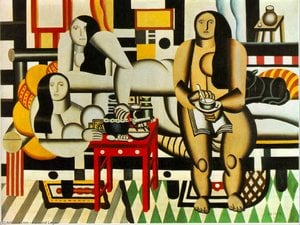
Fernand Léger's "Untitled (9262)" isn’t merely a painting; it’s a declaration. Created sometime between 1930 and 1935, this vibrant canvas embodies the spirit of Cubism and its successor, Tubism—a movement that fundamentally challenged artistic conventions and sought to represent reality not as perceived by the eye but as experienced by the mind. Léger, born Joseph Fernand Henri Léger in Argentan, Normandy, possessed a formative connection to the physicality of rural life, which paradoxically fueled his fascination with the burgeoning industrial landscape of Paris. This duality informs every brushstroke of “Untitled (9262),” resulting in an artwork that simultaneously celebrates organic forms and geometric abstraction.
The Tubist Vision: Simplifying Complexity
Léger’s distinctive approach—Tubism—stemmed directly from Cubism's groundbreaking exploration of multiple perspectives. However, unlike Picasso and Braque who fragmented objects into interlocking planes, Léger deliberately flattened them further, reducing forms to their essential geometric components. This simplification wasn’t an abandonment of observation; rather, it was a conscious effort to distill the essence of visual experience. The painting depicts six birds soaring against a backdrop dominated by bold reds, whites, and blues—a palette chosen not for decorative effect but for its ability to convey movement and energy. Each bird is rendered in simplified shapes, emphasizing their contours and conveying a sense of dynamism that transcends mere representation.
Color as Emotional Resonance
The chromatic choices within “Untitled (9262)” are particularly noteworthy. Léger’s use of red—particularly the prominent scarlet on the left side—isn't arbitrary. Red symbolizes passion, vitality, and even danger – emotions he wished to evoke in the viewer. Complementing this fiery hue is a crisp white stripe at the upper right corner, representing purity and clarity, juxtaposed against the pervasive blue expanse that suggests depth and tranquility. These colors aren’t blended seamlessly; instead, they are applied in distinct blocks, reinforcing the painting's geometric structure and contributing to its overall impact.
Symbolism Beyond Form
Beyond its formal qualities, “Untitled (9262)” carries subtle symbolic weight. The birds themselves represent freedom, aspiration, and perhaps even a yearning for transcendence—themes prevalent in Léger’s broader artistic philosophy. Their positioning within the composition suggests an upward trajectory, mirroring the artist's own ambition to push boundaries and redefine artistic expression. Furthermore, the two diminutive figures flanking the birds could be interpreted as representing humanity’s relationship with nature and technology – elements inextricably intertwined in Léger’s vision of the future.
A Legacy of Innovation
Fernand Léger’s “Untitled (9262)” stands as a testament to his unwavering commitment to innovation and his profound understanding of the transformative power of art. It exemplifies Tubism's ability to capture not just what is seen but how it feels—a feat achieved through masterful simplification, bold color palettes, and carefully considered symbolism. Reproductions of this captivating artwork offer an opportunity to experience firsthand the brilliance of Léger’s artistic legacy and to incorporate a piece of modernist history into any interior design scheme.



 미리보기
미리보기
 손으로 그린 그림 구매
 공유하기
공유하기 공유하기
공유하기
 상세 정보
상세 정보

 다운로드
다운로드
 유사 작품
유사 작품 X-레이
X-레이 슬라이드 쇼
 더 보기
더 보기






































 유리 옵션은 110cm 미만 크기에서만 선택 가능합니다.