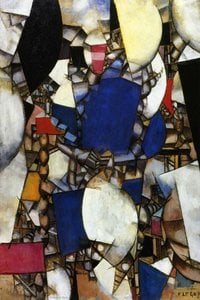
Fernand Léger’s “Untitled (3146)” – A Fragmented Vision of Modernity
Fernand Léger's "Untitled (3146)," a monochrome study rendered in charcoal and graphite, isn’t merely a depiction of figures; it’s a distilled essence of the early 20th century—a visual embodiment of the anxieties and exhilarations of a rapidly changing world. Born in 1881 amidst the rural landscapes of Normandy, Léger's artistic journey took him from the physicality of agricultural labor to the vibrant, often chaotic, heart of Parisian avant-garde circles. This particular work, created around 1920, encapsulates his pivotal role as a bridge between Impressionism and the burgeoning Cubist movement, offering a glimpse into his unique “Tubism” – an approach that sought to integrate the dynamism of machinery and industrial forms into a recognizable visual language.
The scene unfolds within what appears to be an interior space, perhaps a bustling café or a lively lounge. Figures are fragmented and reassembled, their forms reduced to geometric shapes—cylinders, cones, and rectangles—that interlock and overlap in a deliberately unsettling manner. There’s no attempt at realistic representation; instead, Léger employs a flattened perspective, abandoning traditional spatial relationships in favor of a multi-dimensional space where objects exist simultaneously on multiple planes. This deliberate distortion isn't arbitrary; it reflects the artist’s fascination with the mechanics of modern life—the repetitive rhythms of factories, the streamlined forms of automobiles, and the increasingly impersonal nature of urban existence.
The Language of Tubism: Form and Rhythm
Léger’s “Tubism,” a term coined by critics, is immediately apparent in this work. The dominant motif is the cylindrical form – a recurring element throughout his oeuvre—representing not just physical objects but also the underlying structure of industrial production. These cylinders aren't smooth or polished; they are rough-hewn, suggesting their origins in raw materials and the processes of manufacture. The angular lines that define these forms create a powerful sense of rhythm and movement, as if the composition itself is vibrating with energy. The monochrome palette—a carefully orchestrated range of grays—further emphasizes this rhythmic quality, eliminating distractions and allowing the viewer to focus on the interplay of shapes and their spatial relationships.
Notice how Léger utilizes subtle tonal variations within the grayscale to suggest depth and volume. Darker areas delineate shadows and create a sense of solidity, while lighter patches highlight forms and draw attention to key elements. This masterful manipulation of tone adds a surprising amount of texture to what appears at first glance to be a purely abstract composition. The visible marks of charcoal or graphite—the slight roughness of the surface—remind us that this is not a machine-generated image but the product of human hand and eye.
Symbolism and Emotional Resonance
While seemingly detached, “Untitled (3146)” carries a potent symbolic weight. The fragmented figures evoke a sense of alienation and displacement – reflecting the anxieties of a society grappling with rapid industrialization and urbanization. The lack of clear narrative or identifiable characters contributes to this feeling of ambiguity, inviting viewers to project their own interpretations onto the scene. Léger’s work isn't about telling a story; it’s about capturing a mood—a sense of dynamism, uncertainty, and perhaps even a touch of melancholy.
The influence of World War I is undeniably present. Léger’s experiences on the front lines, witnessing the destructive power of machinery and the dehumanizing effects of war, profoundly shaped his artistic vision. The simplified forms and mechanical rhythms in this work can be seen as a response to the trauma of conflict—a desire to find beauty and order amidst chaos.
A Legacy of Modernity
Fernand Léger’s “Untitled (3146)” stands as a crucial document in the history of modern art. It exemplifies his innovative approach to Cubism, blending abstraction with recognizable forms and capturing the spirit of the machine age. His work foreshadowed developments in Pop Art decades later, demonstrating a remarkable prescience in anticipating the shift towards incorporating everyday objects and mass culture into artistic expression. Reproductions of this captivating piece offer a unique opportunity to experience the power and beauty of Léger’s vision—a fragmented yet profoundly resonant portrait of modernity.
질의응답
"untitled (3146)" 작품은 명암 대비가 강한 편인가요?
페르난 레제의 "untitled (3146)"의 대비 수준은 Statement입니다.
페르난 레제의 "untitled (3146)"의 엑스레이(X-ray) 이미지를 볼 수 있을까요?
페르난 레제의 "untitled (3146)"의 X-Ray 뷰는 작품의 X선 분석 페이지에서 확인하실 수 있습니다. 이 페이지에서는 11개의 광학 레이어를 통해 이미지를 인터랙티브하게 살펴볼 수 있습니다.
"untitled (3146)"에서 매체와 움직임은 어떻게 결합되어 있나요?
"untitled (3146)"에서 Acrylic On Canvas 기법은 Cubist Analytical 사조와 만납니다.