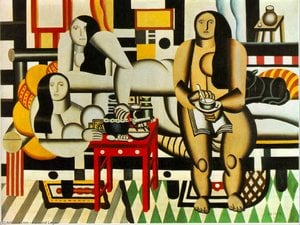
Trouville: A Snapshot of Modern Impressionism
Fernand Léger’s “Trouville” (1949) isn't merely a depiction of a seaside town; it’s a distillation of the spirit of the burgeoning modernist movement, capturing a moment frozen in time with remarkable precision and emotional resonance. Executed in monochrome – a deliberate choice reflecting Léger’s fascination with geometric abstraction – this drawing transcends simple representation to convey a palpable sense of dynamism and urban energy. Léger's signature style, Tubism, prioritizes simplified forms and rhythmic lines, mirroring the influence of Cubism on his artistic vision. The scene unfolds against a backdrop of weathered buildings bathed in muted blues and yellows, colors that subtly evoke the Mediterranean light characteristic of Trouville’s coastal landscape.
- Style: Tubism – Léger's innovative approach to Cubism championed geometric abstraction while retaining recognizable elements of the subject matter.
- Medium: Charcoal on paper – The artist favored charcoal for its ability to achieve tonal variations and convey texture, lending an immediacy to the composition.
- Composition: Léger skillfully employs overlapping planes and intersecting lines to create a sense of depth and movement, mirroring the rhythm of industrial life.
The inclusion of a clock – positioned prominently on the right side – serves as more than just a decorative element; it underscores the passage of time and subtly emphasizes the artwork’s connection to the broader context of the early 20th century. Léger's preoccupation with machinery and industrial forms reflects the anxieties and aspirations of his era, mirroring the transformative impact of technological advancements on society. This piece embodies Léger’s belief that art could communicate complex ideas about the human condition through simplified visual language.
- Symbolism: The clock symbolizes time and progress – themes central to Léger's exploration of modernity and its relationship to humanity.
- Historical Context: Created during World War II, “Trouville” reflects Léger’s desire to express optimism and resilience amidst the devastation of conflict.
“Trouville” resonates with viewers today not only for its stylistic brilliance but also for its ability to evoke a feeling of quiet contemplation within a bustling urban environment. It's a testament to Léger’s enduring legacy as one of the most influential artists of his generation, securing his place in art history as a pioneer of geometric abstraction and a champion of the modernist aesthetic. The drawing invites us to consider how art can capture not just what we see but also what we *feel*, presenting Trouville as an emblem of both beauty and intellectual engagement.
질의응답
페르난 레제의 "Trouville"의 어떤 프린트 사이즈가 추천된 공간에 잘 어울릴까요?
Living Room 공간에는 페르난 레제의 "Trouville" 작품을 Large 크기로 인쇄하시는 것을 추천합니다.
"Trouville"의 작가는 누구인가요?
"Trouville"의 작가는 페르난 레제입니다.
페르난 레제은(는) 몇 세에 "Trouville"을(를) 제작했을까요?
페르난 레제은(는) 1911년에 "Trouville"을(를) 제작했을 당시 30세였습니다. 이 나이는 작가의 출생 연도인 1881을(를) 기준으로 계산되었습니다.
페르난 레제의 "Trouville"의 제작 연도는 언제인가요?
페르난 레제의 "Trouville"은(는) 1911년에 제작되었습니다.
페르난 레제의 "Trouville"의 특징적인 기법과 화풍은 무엇인가요?
"Trouville"에서 Acrylic On Canvas 기법은 Cubism 사조와 만납니다.
페르난 레제의 "Trouville"의 색감은 채도가 높은 편인가요, 아니면 차분한 편인가요?
페르난 레제의 "Trouville"의 색상은 Subtle Color 정도의 채도를 띱니다. 채도는 색상이 얼마나 선명하거나 차분한지를 나타냅니다.
페르난 레제의 "Trouville"의 휘도는 어느 정도인가요?
페르난 레제의 "Trouville"의 기록된 휘도는 Soft Shadow입니다.