The Parade: A Symphony of Geometric Form and Industrial Spirit
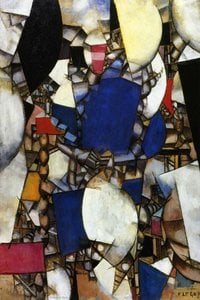
Fernand Léger’s “The Parade,” executed in lithograph, transcends mere depiction; it embodies the very essence of Cubism's revolutionary embrace of modern life. Created during the formative years of the 20th century, this artwork isn’t simply a visual record but rather an assertion of artistic innovation—a bold declaration that abstraction could illuminate the complexities of the burgeoning machine age without sacrificing palpable emotion. Léger’s singular vision distinguishes him from many contemporaries who retreated into purely conceptual realms; instead, he sought to synthesize observation and imagination, resulting in a masterpiece that simultaneously captures the dynamism of urban existence and adheres to the disciplined logic of geometric abstraction.
Composition and Visual Elements: Capturing Movement Within Stillness
The artwork’s central focus is a sprawling tableau populated by figures—approximately thirteen individuals—engaged in various activities. Léger skillfully employs a dynamic compositional arrangement, prioritizing movement and interaction over static representation. The figures aren't rendered as realistic portraits but rather fragmented forms—geometric shapes—that overlap and intersect to convey the energy of a bustling procession. Notably, a prominent clock dominates the left side of the image, symbolizing time’s relentless march forward, while a chair sits centrally, representing domesticity amidst the industrial landscape. Scattered bottles contribute to the visual texture and subtly hint at themes of consumption and societal rituals. Léger's meticulous attention to detail—evident in the textured surface achieved through lithographic printing—amplifies the artwork’s impact, inviting viewers to contemplate both form and content.
Cubist Style: Simplifying Reality Through Geometric Reduction
Léger’s stylistic approach firmly establishes “The Parade” within the canon of Cubism, pioneered by Picasso and Braque. Unlike traditional painting techniques that strive for illusionistic depth and perspective, Cubism dismantles these conventions, presenting subjects from multiple viewpoints simultaneously. Léger achieves this feat through reductive geometric forms—cubes, cylinders, and cones—which are strategically employed to depict objects and figures in a fragmented manner. This technique isn’t merely stylistic; it reflects the artist's conviction that abstraction could convey greater truth than representational art by stripping away superfluous details and focusing on fundamental shapes. The bold lines and simplified forms characteristic of Cubism powerfully communicate Léger’s fascination with industrial architecture and machinery, mirroring the pervasive influence of technology on daily life during his time.
Historical Context: Embracing Futurism's Vision of Progress
Fernand Léger’s artistic trajectory was inextricably linked to the burgeoning intellectual currents of the early 20th century, particularly Futurism—a movement that championed speed, dynamism, and technological advancement. Influenced by thinkers like Luigi Russolo and Filippo Tommaso Marinetti, Léger embraced Futurist ideals, rejecting academic conventions in favor of a visual language that mirrored the rapid transformations reshaping European society. “The Parade” serves as an emblem of this era’s optimism—a celebration of progress and innovation—while simultaneously questioning traditional notions of beauty and representation. The artwork's aesthetic aligns seamlessly with the broader artistic landscape of its time, demonstrating Léger’s commitment to pushing boundaries and redefining artistic expression.
Symbolism and Emotional Resonance: Beyond Mere Form
Despite its geometric austerity, “The Parade” possesses a profound emotional resonance. Léger skillfully utilizes color—primarily reds and yellows—to imbue the artwork with vibrancy and energy, conveying a sense of excitement and anticipation. The repetition of geometric shapes reinforces the theme of unity and rhythm, mirroring the rhythmic movement of the parade itself. More subtly, the inclusion of objects like bottles speaks to broader societal concerns about consumption and ritualistic behavior. Ultimately, Léger invites viewers to contemplate not only what is seen but also how it feels—a testament to his ability to transform abstract form into emotionally evocative imagery.
질의응답
제 방에 "The Parade"을(를) 어떤 사이즈로 프린트하는 것이 좋을까요?
페르난 레제의 "The Parade"에 추천하는 조합: Living Room 공간에 어울리는 Large 사이즈 프린트입니다.
페르난 레제의 "The Parade"의 대비는 어느 정도로 강한가요?
"The Parade"의 명암 대비는 Statement로 기록되었습니다. 대비는 밝은 부분과 어두운 부분의 차이가 얼마나 강한지를 나타냅니다.
페르난 레제의 "The Parade"은(는) 어떤 느낌을 전달하나요?
페르난 레제의 "The Parade"에 담긴 분위기는 Industrial이며, 정서적 어조는 Energetic입니다.
"The Parade" 프린트의 권장 용도는 무엇인가요?
페르난 레제의 "The Parade"의 복제본은 Accent에 활용하시기에 좋습니다. 이는 작품의 주제와 분위기, 그리고 색감을 고려한 제안입니다.
페르난 레제의 "The Parade"의 수작업 복제화를 어디에서 구매할 수 있나요?
페르난 레제의 "The Parade"의 수작업 복제화는 본 웹사이트의 리넨 캔버스 위에 손으로 직접 그린 유화 복제화에서 만나보실 수 있으며, 현재 페이지를 통해 주문 가능합니다.
페르난 레제의 "The Parade"의 구성을 주도하는 색상은 무엇인가요?
페르난 레제의 "The Parade"의 주요 색상은 White (#f1f0e3)입니다.
"The Parade" 작품을 파인 아트 프린트로 구매할 수 있나요?
페르난 레제의 "The Parade"의 프린트를 소장하시려면, 현재 페이지에서 간편하게 주문하실 수 있습니다: 코튼 캔버스 또는 아카이브용 캔버스지에 인쇄된 파인 아트 프린트.
"The Parade"과(와) 유사한 작품이 더 있을까요?
페르난 레제의 "The Parade"의 유사한 작품 페이지에서 관련 작품들을 만나보세요.