원하는 크기와 액자로 주문 제작되는, 작가들이 직접 캔버스에 손으로 그린 유화 작품입니다. ( 프린트 판매로 전환 디지털 이미지로 전환)





























작품의 원본 비율을 유지하는 미리 설정된 크기 중에서 선택하세요.

특정 프레임이나 공간에 맞도록 직접 크기를 입력할 수 있습니다. 선택하신 크기가 원본 이미지의 비율과 일치하지 않는 경우, 작품을 자르거나 추가적인 손으로 그린 요소를 사용하여 그림을 확장합니다. 제작 시작 전 승인을 위해 디지털 목업을 보내드립니다.
화면 미리 보기는 실제 자르기 또는 확장을 반영하지 않습니다. 최종 구성은 목업을 통해서만 정확하게 확인하실 수 있습니다.
맞춤 크기 제작도 가능하지만, 원본 비율을 유지하기 위해 사전 정의된 목록에서 크기를 선택하시는 것을 권장합니다.

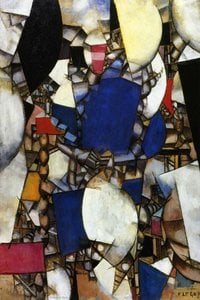
The men in the city
복제본 크기
Fernand Léger's "The Men in the City," painted around 1916, is more than just a depiction of two figures; it’s a vibrant declaration of modernity itself. Emerging from the fertile artistic landscape of early 20th-century Paris, Léger was a key figure in bridging the gap between representational art and the burgeoning abstract movements. This work exemplifies his unique approach – a bold synthesis of Cubist fragmentation with an undeniable fascination for industrial forms and the dynamism of urban life. The painting immediately draws the eye to its geometric composition: the figures are rendered as blocky, almost machine-like shapes, their bodies simplified into angular planes that echo the structures surrounding them. This deliberate distortion wasn’t a rejection of realism but rather a new way of perceiving and representing the world – one shaped by the rise of industry and the increasingly dominant role of technology.
Léger's artistic journey began with a profound connection to his rural upbringing near Argentan, Normandy. This early exposure to the physicality of agricultural labor – the rhythms of the land, the textures of wood and stone – profoundly influenced his later work. He initially studied architecture, a discipline that instilled in him an appreciation for structure and form. However, it was his encounter with Post-Impressionist painters like Cézanne and Gauguin, coupled with the revolutionary ideas circulating within the Cubist movement, that truly ignited his artistic vision. Cubism, championed by Picasso and Braque, offered a radical new way of seeing – breaking down objects into their constituent parts and reassembling them in abstract compositions. Léger adopted this technique but infused it with his own distinctive vocabulary, prioritizing the visual impact of geometric shapes over strict representational accuracy.
Beyond its formal qualities, “The Men in the City” is rich in symbolic meaning. The two figures, rendered as almost identical blocks, could be interpreted as representing humanity itself – reduced to essential forms within the overwhelming context of the modern city. The umbrella held by one man becomes a poignant detail, suggesting protection and perhaps a yearning for refuge amidst the chaos of urban life. The inclusion of the bird adds an unexpected layer of symbolism; often associated with freedom and spirituality, it subtly contrasts with the rigid geometry of the scene, hinting at a desire for transcendence within a mechanized world. The overall atmosphere is one of quiet observation, inviting the viewer to contemplate their own place in this rapidly changing landscape.
Léger’s technique involved applying paint in thick, layered strokes, creating a tactile surface that emphasizes the three-dimensional quality of his forms. His color palette is deliberately restrained – primarily consisting of earthy tones like ochre, brown, and gray, punctuated by occasional bursts of vibrant blue and red. These bold colors aren't used for decorative effect but rather to accentuate the geometric shapes and create visual impact. The artist’s meticulous attention to detail—the precise rendering of each plane and angle—demonstrates a remarkable command of his medium and a deep understanding of the principles of Cubist composition. The result is a powerfully expressive work that captures both the beauty and the alienation of modern urban life.

1881 - 1955 , 프랑스

Explore the vibrant world of Fernand Léger. Discover how his 'Tubism' and Machine Age aesthetics redefined modern art, offering profound inspiration for discerning collectors seeking geometric beauty and industrial dynamism.

Discover the excellence of WahooArt.com premium poster prints. Designed for elite collectors, our museum-quality Giclée reproductions offer unmatched durability and archival precision to elevate your luxury interiors with high-impact, sophisticated art decor.

Explore the profound evolution of Cubist still life, from Cézanne's structural foundations to the fragmented brilliance of Braque and Léger. Discover how geometric abstraction redefined reality through a sophisticated lens of form, color, and modern artistic mastery.

Elevate your design projects with WahooArt's premium canvas prints and hand-painted reproductions. From Giclée excellence to bespoke oil commissions, we provide professional decorators with museum-quality, affordable art solutions delivered worldwide with a 100% satisfaction guarantee.


 미리보기
미리보기
 공유하기
공유하기 공유하기
공유하기
 상세 정보
상세 정보 가이드 보기

 다운로드
다운로드
 유사 작품
유사 작품 X-레이
X-레이 슬라이드 쇼
 통계 정보
통계 정보

 더 보기
더 보기









 유리 옵션은 110cm 미만 크기에서만 선택 가능합니다.