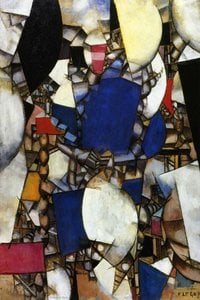
A Mechanical Vision: Deconstructing Reality in Fernand Léger’s *Composition 2***
This striking black and white composition by Fernand Léger is a powerful example of his distinctive artistic language – a bridge between the analytical fracturing of Cubism and the dynamic energy of Constructivism. Created at an unknown date, but demonstrably reflective of his mature style developed in the 1910s and beyond, *Composition 2* presents not a scene from reality, but rather a deconstruction *of* reality itself, reassembled into a compelling visual statement about modernity and the machine age.
Style & Influences: From Cubism to ‘Tubism’
Léger initially engaged with Impressionism before rapidly evolving towards a unique brand of Cubism. However, unlike Picasso or Braque's more muted palettes and focus on still life, Léger embraced bold forms and increasingly, the aesthetics of industry. Critics dubbed his style “Tubism” – a fitting descriptor for the emphasis on cylindrical, machine-like components that characterize much of his work.
Composition 2 exemplifies this perfectly; fragmented geometric shapes—rectangles, circles, ovals, and curved lines—interlock and overlap, creating a sense of dynamic tension. The flattened perspective further emphasizes the two-dimensionality of the canvas while simultaneously suggesting depth through strategic shading and overlapping planes.
Technique & Materiality
The artwork’s graphic quality suggests execution in ink or charcoal on paper. Léger masterfully utilizes line weight and tonal variation to imply texture and volume, creating a sense of solidity within the abstract forms. The bold, angular lines define each component with precision, contributing to the overall impression of mechanical construction. While lacking detailed rendering, the technique is remarkably effective in conveying a feeling of robust materiality.
Subject Matter & Symbolism
The subject matter remains deliberately ambiguous. It’s not a depiction *of* something specific, but rather an evocation *of* something – perhaps a complex machine, an industrial apparatus, or even the fragmented experience of modern life. This ambiguity is key to Léger's artistic intent. He wasn’t interested in replicating reality; he sought to capture its underlying structures and rhythms. The composition can be interpreted as a celebration of technology and industry, but also as a commentary on their potential to fragment and alienate.
The machine becomes a metaphor for the modern condition.
Historical Context & Léger’s Vision
Fernand Léger (1881-1955) was a pivotal figure in 20th-century art, deeply influenced by the rapid industrialization and technological advancements of his time. He witnessed firsthand the rise of mass production and the increasing mechanization of society. His work reflects this fascination, transforming mechanical forms into powerful aesthetic elements. Léger’s engagement with Cubism and subsequent development of “Tubism” positioned him at the forefront of modern art movements, influencing generations of artists to come – even foreshadowing aspects of Pop Art decades later.
Emotional Impact & Interior Design
*Composition 2* evokes a sense of controlled energy and intellectual rigor. The dynamic arrangement of shapes creates visual movement, while the monochromatic palette lends a sophisticated and timeless quality. This artwork would be a striking addition to any modern or contemporary interior, particularly spaces that value bold design and abstract expression. Its graphic nature makes it versatile – equally at home in a minimalist loft or a more eclectic setting.
It’s a piece that invites contemplation and sparks conversation.
질의응답
"Composition2"은 전체적으로 밝은 편인가요, 아니면 어두운 편인가요?
페르난 레제의 "Composition2"의 측정된 수치는 다음과 같습니다: 밝기 brilliant, 휘도 Bright Balance.
페르난 레제의 "Composition2"은(는) 퍼블릭 도메인인가요?
페르난 레제의 "Composition2"의 저작권 정보: 해당 작품은 퍼블릭 도메인 - 저작권 보호 기간이 만료되었습니다 상태입니다. 이는 이미지 복제 가능 여부를 결정하는 기준이 됩니다.
"Composition2"은 미술사적으로 어떤 위치를 차지하고 있습니까?
페르난 레제의 "Composition2"의 미술사적 분류는 Modern 시대의 Cubism입니다.