A Pioneer of Geometric Abstraction: Exploring Fernand Léger’s “Composition”
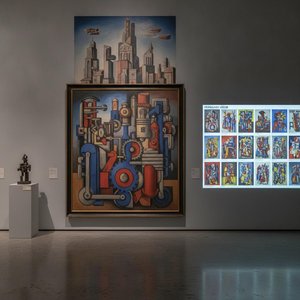
Fernand Léger's "Composition," painted in 1919, represents a crucial juncture in the trajectory of modern art—a bold assertion that abstraction could simultaneously honor and interpret the burgeoning influence of industrialization. More than just a visually striking image, it embodies Léger’s profound engagement with the transformative forces reshaping European society at the dawn of the twentieth century. The painting immediately captivates with its harmonious blend of geometric forms: circles dominate the canvas, interspersed with squares that create a dynamic interplay of shapes and textures. These aren't merely decorative elements; they are deliberate choices reflecting Léger’s fascination with machine construction and his desire to distill visual experience into fundamental building blocks.
- Subject Matter: The artwork presents a carefully arranged tableau featuring commonplace objects – a clock, a cup, and a bowl – positioned against a backdrop of abstract geometric shapes. This juxtaposition is key to Léger’s artistic strategy.
- Style & Technique: Léger's style aligns squarely with the burgeoning movement of Geometric Abstraction, spearheaded by artists like Piet Mondrian and Kazimir Malevich. He employed a technique characterized by bold color palettes—primarily reds, yellows, and blues—applied in flat planes of pigment to achieve maximum visual impact. The surface is treated with a matte finish, emphasizing texture and solidity despite the absence of representational detail.
Historical Context: Embracing the Machine Age
“Composition” emerged during a period marked by unprecedented technological advancements – the rapid expansion of factories, railways, and automobiles – fundamentally altering daily life and reshaping perceptions of space and time. Léger wasn’t simply reacting to these changes; he actively sought to translate their essence into artistic expression. The machine age symbolized efficiency, precision, and a rejection of organic forms in favor of geometric structures. Léger believed that art should mirror the rhythms and patterns of industrial society, capturing its energy and dynamism without resorting to illusionistic representation. This conviction stemmed from his own experiences working as a sculptor on railway carriages, where he witnessed firsthand the transformative power of mechanized production.
Symbolism Beyond Form: Exploring Underlying Ideas
While seemingly devoid of narrative content, “Composition” is laden with symbolic significance. The repetition of geometric shapes—circles and squares—represents stability and order amidst the chaos of industrial progress. Léger deliberately avoided depicting recognizable subjects to focus on conveying a deeper emotional response – a feeling of optimism and dynamism rooted in the belief that humanity could harness technology for constructive purposes. The inclusion of everyday objects serves as a reminder that even the most mundane aspects of life can be imbued with artistic meaning, prompting viewers to contemplate the relationship between art and reality.
Emotional Impact & Artistic Legacy
Ultimately, “Composition” transcends its formal elements to evoke a sense of purposeful energy and quiet contemplation. Léger’s masterful manipulation of color and form communicates not just visual beauty but also an underlying conviction in the transformative potential of modern civilization. It stands as a testament to his pioneering role in establishing Geometric Abstraction as a dominant aesthetic force, influencing generations of artists who followed him. Reproductions of this artwork offer collectors and interior designers alike a chance to experience the enduring power of Léger’s vision—a celebration of form and function united in pursuit of an aesthetically compelling representation of the world around us.
질의응답
"Composition"의 작가는 누구인가요?
"Composition"의 작가는 페르난 레제입니다.
페르난 레제의 "Composition"의 슬라이드쇼를 볼 수 있는 곳이 있나요?
페르난 레제의 "Composition"은(는) 작품의 슬라이드쇼 페이지에서 슬라이드쇼로 감상하실 수 있습니다.
"Composition"의 뒤에 숨겨진 예술가와 화풍은 무엇인가요?
"Composition"은(는) Geometric Abstraction 양식으로 페르난 레제가 제작하였습니다. 작가와 미술 사조는 해당 작품의 전통을 나타냅니다.
"Composition"이(가) 페르난 레제의 가장 인기 있는 작품 중 하나인가요?
페르난 레제의 "Composition"의 인기도는 Recognized 수준입니다. 이 분류는 해당 작품이 얼마나 널리 알려져 있는지를 반영합니다.
페르난 레제은(는) 몇 세에 "Composition"을(를) 제작했을까요?
페르난 레제은(는) 38세에 "Composition"을(를) 제작했습니다. 작가는 1881년에 태어났으며, 이 작품의 제작 연도는 1919년입니다.
Composition의 제작 연도인 1919년은 페르난 레제의 예술적 경력 중 어느 시기에 해당하나요?
1919년에 제작된 "Composition"은(는) 페르난 레제의 Machine Aesthetic에 해당합니다.
페르난 레제의 "Composition"의 제작 연도는 언제인가요?
페르난 레제의 "Composition"은(는) 1919년에 제작되었습니다.