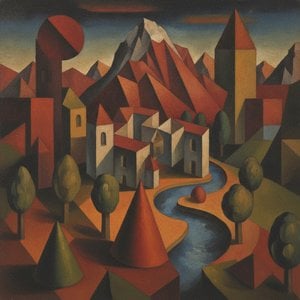
A Snapshot of Modern Life: Léger’s ‘Breakfast’
Fernand Léger's “The Breakfast,” painted in 1921, isn’t merely a depiction of a simple meal; it’s a bold declaration of Cubist principles and an ambitious attempt to translate the burgeoning dynamism of industrial society onto canvas. Created during a period marked by rapid technological advancement – the rise of automobiles, factories, and urban sprawl – Léger sought to capture this transformative era not through idealized landscapes or portraits, but through fractured geometric forms that mirrored the fragmented experience of modern existence. The painting’s stark black and white palette amplifies its impact, stripping away superfluous detail to focus on essential shapes and textures.
Cubist Innovation: Deconstructing Reality
Léger's stylistic approach firmly establishes him within the influential Cubist movement spearheaded by Pablo Picasso and Georges Braque. Unlike Impressionists who prioritized capturing fleeting moments of light and color, Cubists rejected illusionistic representation altogether. Instead, they dissected objects into multiple perspectives simultaneously, presenting them as interlocking planes that challenge conventional notions of space and form. In “The Breakfast,” this is evident in the elongated head of the figure—a deliberate distortion designed to convey movement and instability—and the fragmented arrangement of the table’s elements. These geometric shapes aren't simply decorative; they embody the underlying structure of reality itself, as perceived through the lens of industrial progress.
Technique and Texture: Pointillism Revisited
While primarily categorized as Cubist, Léger subtly incorporates techniques reminiscent of Neo-Impressionism—specifically Pointillism—to achieve a remarkable textural effect. Rather than blending pigments to create smooth gradations, Léger meticulously applied tiny dots of color – predominantly white and ochre – onto the canvas. This method maximizes luminosity and creates an illusion of shimmering surface texture that mimics the light reflecting off metal surfaces prevalent in the period. The artist’s painstaking attention to detail underscores his commitment to conveying both visual accuracy and emotional resonance.
Symbolism Beyond Representation
Beyond its formal innovations, “The Breakfast” carries symbolic weight. The table itself represents stability amidst chaos—a grounding element against which the fragmented figure asserts its presence. The bottle symbolizes nourishment and vitality, mirroring Léger’s fascination with the human body as a machine capable of adapting to new environments. Furthermore, the vase adds an element of organic beauty – a counterpoint to the dominant geometric forms – suggesting that even in the industrialized world, there remains space for contemplation and appreciation of nature.
Emotional Resonance: Capturing the Spirit of an Age
Ultimately, Léger’s “Breakfast” succeeds in conveying the emotional core of its time—a sense of optimism tempered by apprehension about the future. The painting isn't sentimental; it doesn’t strive to evoke nostalgia for a bygone era. Instead, it confronts viewers with a deliberately unsettling image that compels them to consider how humanity navigates change and embraces new possibilities. It remains a powerful testament to Léger’s artistic vision and his enduring legacy as one of the pioneers of modern art.
질의응답
1921년에 "Breakfast"을(를) 제작할 당시 페르난 레제의 나이는 몇 세였나요?
1921년에 "Breakfast"이(가) 제작되었을 당시, 1881년에 태어난 페르난 레제의 나이는 40세였습니다.
"Breakfast"의 작가는 누구인가요?
"Breakfast"의 작가는 페르난 레제입니다.
페르난 레제의 "Breakfast"에 대한 가이드가 있나요?
페르난 레제의 "Breakfast"에 대한 가이드 페이지를 이용하실 수 있습니다. 이 페이지는 학생들과 수업용으로 제작된, 인쇄 가능한 작품 정보 시트를 제공합니다.
페르난 레제의 "Breakfast"은(는) 몇 년도에 제작되었나요?
페르난 레제의 "Breakfast"은(는) 1921년에 제작되었습니다.
페르난 레제의 "Breakfast"과(와) 유사한 작품을 어떻게 찾을 수 있나요?
페르난 레제의 "Breakfast"과(와) 유사한 작품들은 해당 작품의 유사한 작품 페이지에서 확인하실 수 있습니다.
페르난 레제의 "Breakfast"은(는) 얼마나 잘 알려져 있나요?
페르난 레제의 "Breakfast"의 기록된 인기도는 Recognized입니다.
페르난 레제의 "Breakfast"의 수작업 복제화를 어디에서 구매할 수 있나요?
페르난 레제의 "Breakfast"의 수작업 복제화는 본 웹사이트의 리넨 캔버스 위에 손으로 직접 그린 유화 복제화에서 만나보실 수 있으며, 현재 페이지를 통해 주문 가능합니다.