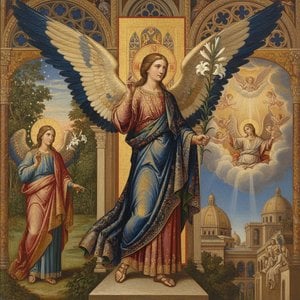
A Vision of Faith: Exploring El Greco’s “The Annunciation”
Doménikos Theotokópoulos, universally known as El Greco (1541 – 1614), stands apart from his contemporaries as a painter whose artistic vision transcended conventional boundaries. Born in Crete—then under Venetian rule—his journey through Venice and Rome ultimately solidified his legacy as one of the most influential figures in European art history. More than just an artist; El Greco was a conduit for spiritual contemplation, fusing Byzantine traditions with Renaissance innovation into a style that continues to captivate audiences today.
“The Annunciation,” completed around 1576, exemplifies this singular approach. Now housed in the Museo Thyssen-Bornemisza in Madrid, this oil painting on canvas is considered one of El Greco’s earliest works and represents a pivotal moment in Christian iconography. It depicts the biblical narrative of Gabriel informing Mary about her divine conception—a scene laden with symbolism that speaks to themes of humility, grace, and divine intervention.
Compositional Harmony: Byzantine Influence Meets Renaissance Precision
The painting’s arrangement is meticulously crafted, reflecting El Greco's masterful blending of artistic styles. At its core lies Mary, seated on a bench—a deliberate choice that harkens back to Byzantine depictions of the Virgin Mother—her hands clasped in prayerful contemplation. Above her floats Gabriel, rendered with elongated proportions characteristic of El Greco’s distinctive technique, conveying an aura of solemnity and divine authority.
Surrounding Mary are figures representing onlookers—a testament to the communal experience of faith—and a book symbolizes knowledge and divine revelation. The artist skillfully utilizes light and color—primarily vibrant reds and blues—to heighten emotional impact, creating a dramatic tableau that draws viewers into the heart of the sacred narrative.
El Greco’s Unique Style: A Pioneer of Expressionism
What distinguishes El Greco's work is his unparalleled ability to imbue visual representations with profound emotion. His elongated figures—a hallmark of his style—are not merely anatomically accurate; they embody spiritual yearning and convey a sense of transcendence. This stylistic choice anticipates the expressive tendencies of later movements like Expressionism, demonstrating El Greco’s enduring influence on artistic innovation.
The Museo Thyssen-Bornemisza provides an invaluable opportunity to experience this masterpiece firsthand. For those seeking a high-quality reproduction, WahooArt.com offers a meticulously crafted version that captures the essence of El Greco's vision—a testament to his enduring power as an artist and a symbol of spiritual contemplation.
Alongside “The Annunciation,” explore other iconic works by El Greco: “The Burial of Count Orgaz,” “View of Toledo,” and “Apostolado.” These paintings reside in museums across Europe, including the Museo del Prado and El Greco Museum in Toledo—each offering a window into the artist’s extraordinary artistic legacy.
질의응답
엘 그레코의 "The Annunciation"은 어떤 소재와 분위기를 담고 있나요?
"The Annunciation"은(는) religion, annunciation, virgin mary, angel, biblical scene, renaissance art, el greco style, spanish painting을(를) 담아내며, Dramatic한 분위기를 자아냅니다.
"The Annunciation"은 전체적으로 밝은 편인가요, 아니면 어두운 편인가요?
"The Annunciation"의 전체적인 밝기는 shadow이며, 휘도는 Soft Shadow입니다.
엘 그레코의 "The Annunciation"의 기법은 무엇인가요?
엘 그레코의 "The Annunciation"의 재료는 Acrylic On Canvas입니다. 복제화는 이 기법 특유의 질감을 그대로 구현하는 것을 목표로 합니다.