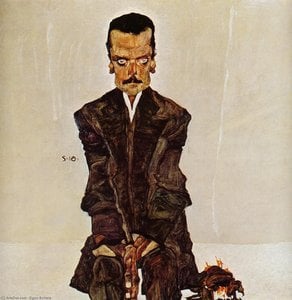
Winter Trees by Egon Schiele
Egon Schiele’s “Winter Trees,” created in 1912, stands as a hauntingly beautiful emblem of Expressionism—a movement that sought to convey raw emotion and psychological intensity rather than merely depicting the external world. Measuring 80 x 80 cm, this oil on canvas piece transcends its dimensions to become an immersive experience for the viewer, inviting contemplation on themes of isolation, mortality, and the sublime power of nature.
The Artistic Vision: Beyond Representation
Schiele wasn’t interested in capturing a picturesque winter scene; he aimed to distill the very essence of the season—its desolate grandeur—into a visual language that spoke directly to the human soul. Unlike Impressionists who prioritized fleeting light effects, Schiele confronted the viewer with stark reality, presenting three bare trees against a muted backdrop. This deliberate simplification underscores Schiele’s conviction that art should grapple with profound emotional truths rather than offering superficial beauty. The artist's intention was to evoke a visceral response—a feeling of chill and vulnerability—transforming the landscape into a mirror reflecting inner turmoil.
Stylistic Influences: Echoes of Schoenberg and Berg
Schiele’s distinctive style flourished within the crucible of the Second Viennese School, where he collaborated closely with composers Arnold Schoenberg and Alban Berg. These figures championed atonality and dissonance—musical techniques that mirrored Schiele's artistic preoccupation with unsettling harmonies and fractured perspectives. Just as Schoenberg pushed musical boundaries, Schiele challenged conventional notions of pictorial representation, prioritizing expressive gesture and textural richness over meticulous detail. His technique is characterized by bold brushstrokes and a deliberate disregard for traditional perspective, creating an atmosphere of palpable tension.
Historical Context: The Dawn of Modern Art
“Winter Trees” emerged during a period of seismic upheaval in European culture—the early 20th century witnessed the rise of avant-garde movements that rejected academic conventions and embraced experimentation. Schiele’s work reflects this era's fascination with exploring inner psychological states through art, mirroring the broader cultural shift toward confronting uncomfortable truths about human existence. The painting embodies the Expressionist impulse to capture subjective experience—to convey not what one sees but how one feels—a cornerstone of artistic innovation during that transformative time.
Symbolism and Emotional Impact: A Landscape of Loss
The muted palette—dominated by earthy tones accented with subtle blues and reds—serves as more than mere aesthetic choice; it symbolizes the dormancy of winter, mirroring Schiele’s preoccupation with themes of decay and regeneration. The anthropomorphic rendering of the trees—their branches reaching upwards like supplicating limbs—suggests a yearning for connection amidst solitude and reinforces the painting's overarching mood of melancholy. “Winter Trees” remains a powerful testament to Schiele’s ability to transform a simple landscape into a deeply symbolic meditation on human vulnerability and the inevitability of mortality, continuing to resonate with audiences today.
- Artist: Egon Schiele
- Year: 1912
- Medium: Oil on Canvas
- Dimensions: 80 x 80 cm
질의응답
에곤 실레의 "Winter Trees"은 어떤 사조와 시대에 속하나요?
에곤 실레의 "Winter Trees"에서는 Expressionism 사조와 근대 미술 시대가 만납니다.
"Winter Trees"이(가) 제작되었을 당시 에곤 실레의 나이는 어떻게 되었나요?
1912년에 "Winter Trees"이(가) 제작되었을 당시, 1890년에 태어난 에곤 실레의 나이는 22세였습니다.
학생들을 위한 에곤 실레의 "Winter Trees" 관련 팩트시트가 있나요?
"Winter Trees"에 대한 안내는 작품의 가이드 페이지에서 확인하실 수 있습니다. 이 페이지는 작품의 캡션, 크레딧, 그리고 상세 정보 표(작가, 제작 연도, 재료, 원본 크기, 소장처)를 포함하여 출력 가능한 형태의 팩트시트로 제공됩니다.
"Winter Trees"이(가) 에곤 실레의 가장 인기 있는 작품 중 하나인가요?
에곤 실레의 "Winter Trees"의 인기도는 Recognized 수준입니다. 이 분류는 해당 작품이 얼마나 널리 알려져 있는지를 반영합니다.
에곤 실레의 "Winter Trees"은(는) 몇 년도에 제작되었나요?
"Winter Trees"은(는) 1912년에 제작되었습니다. 이 시기는 에곤 실레의 예술적 경력과 당시의 시대상을 잘 보여줍니다.
에곤 실레의 "Winter Trees"은 어느 시대의 작품인가요?
에곤 실레의 "Winter Trees"의 역사적 시기는 Modern입니다. 이러한 분류는 미술사적 맥락에서 해당 작품의 위치를 정의합니다.
"Winter Trees"은(는) 어느 작가의 작품인가요?
"Winter Trees"의 작가는 에곤 실레입니다.