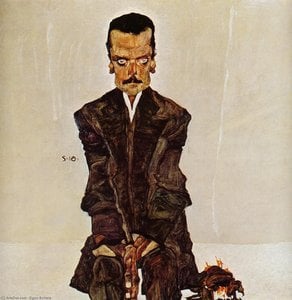
A Portrait of Inner Turmoil: Exploring Egon Schiele’s Untitled Watercolor
This captivating watercolor by
Egon Schiele offers a poignant glimpse into the artist's signature exploration of the human psyche. While simply titled “untitled (7158),” this work is far from anonymous; it’s a powerful statement rendered with characteristic intensity and emotional rawness. The painting depicts a female figure, not as an idealized beauty, but as a vessel for profound psychological expression.
Style & Technique: Expressionism Defined
Schiele was a leading figure in early 20th-century Expressionism, and this piece exemplifies the movement’s core tenets. Notice the deliberate distortion of proportions – the elongated form, the angularity of the limbs – these aren't errors but intentional choices to convey an inner state rather than objective reality. The technique is masterful; Schiele employs layered watercolor washes, building up color and texture with loose brushstrokes. This creates a dynamic surface where hues blend and bleed, mirroring the fluidity and complexity of human emotion. The flattened perspective further intensifies this effect, drawing the viewer directly into the figure’s space.
Subject & Composition: A Study in Asymmetry
The composition is deliberately asymmetrical, immediately creating a sense of unease and dynamism. Your eye is drawn to the figure's face and upper body, where Schiele focuses his expressive line work. The subject matter – a woman’s portrait – transcends mere representation. It isn’t about *who* she is, but *how* she feels. The drapery, rendered with textured brushwork, adds another layer of visual interest and contributes to the overall sense of movement.
Historical Context: Vienna's Artistic Ferment
Born in 1890, Schiele lived a tragically short life, dying during the Spanish Flu pandemic of 1918. His artistic development unfolded within the vibrant, yet often conservative, cultural landscape of Vienna. He was influenced by Gustav Klimt – initially working in his studio – but quickly forged his own path, pushing boundaries and challenging societal norms with his frank depictions of sexuality and psychological vulnerability. Schiele’s work emerged during a period of significant social and political upheaval, reflecting the anxieties and uncertainties of the era. Artists like Heinrich Böhler and Broncia Koller-Pinell were also part of this artistic milieu, exploring similar themes of human emotion and expression.
Symbolism & Emotional Impact: Unease and Vulnerability
The vibrant, sometimes clashing colors contribute to a sense of psychological tension. The exaggerated features – the intense gaze, the contorted pose – suggest inner turmoil and vulnerability. Schiele doesn’t shy away from portraying difficult emotions; instead, he embraces them, using his art as a vehicle for self-exploration and emotional honesty. This painting isn't simply *about* sadness or anxiety; it *evokes* those feelings in the viewer.
Collecting & Display: Bringing Schiele’s Vision Home
A reproduction of this work would be a striking addition to any collection, particularly for those drawn to Expressionism and psychologically charged art. Its muted yet impactful color palette lends itself well to various interior styles – from modern minimalist spaces to more eclectic, bohemian settings. Consider pairing it with works by Klimt or other Austrian Expressionists to create a cohesive and thought-provoking display. Museums like the Leopold Museum in Vienna and the Egon Schiele Art Centrum in Český Krumlov offer further insight into the artist’s life and work, providing inspiration for appreciating this powerful piece.
질의응답
에곤 실레의 "untitled (7158)"은 밝은 분위기의 작품인가요, 아니면 어두운 분위기의 작품인가요?
"untitled (7158)"의 전체적인 밝기는 brilliant이며, 휘도는 Luminous입니다.
"untitled (7158)"은(는) Expressionism 사조를 대표하는 유명한 작품인가요?
Expressionism 사조 내에서, "untitled (7158)"은(는) Iconic 정도의 인지도를 보유하고 있습니다.
에곤 실레의 "untitled (7158)"의 색조는 어떻게 묘사되어 있나요?
에곤 실레의 "untitled (7158)"의 색채 구성은 Neutrals로 설명됩니다. 이는 작품에 사용된 색상들을 간결하게 묘사한 것입니다.